Security
Memory your agents can write. Records you can trust.
Most security stops at who can sign in. Busabase also covers what your agents write: what they can reach, what they changed, and how you get it back.
Agent memory is usually a black box
You can't see what it kept
Memory layers store what the agent decided to remember, shaped for the agent to recall — rarely for a person to read through and check.
“Don't touch this” is only a request
A rule in a prompt asks the agent to behave. It does not stop a write the agent decides to make anyway.
Logs arrive after the fact
An activity log tells you who changed something once it has already changed. It never asks whether the change should happen.
Memory helps an agent recall. A record lets a person check it — and cite it.
What can it reach?
An agent only gets the access you hand it
People and agent keys share the same four levels, and an agent never ends up with more than you meant to give it.
Four levels
Read, Can propose changes, Can write, and Manage — the same levels for teammates and for agent keys.
Capped twice
An agent is limited by the level of its key and by the access of the person who issued it, whichever is lower.
Restrict a folder, table or doc
Limit it to named people. Put a space in Restricted mode and anything not explicitly shared stays hidden.
Shared links stay read-only
An embedded app link shows what it was built to show. It never carries the sharer's admin rights.
- Roles and permissions come with Busabase Cloud and Premium self-hosted. The free open-source edition is for one person on one machine.
What did it change?
Agents can do the work. You decide what becomes trusted.
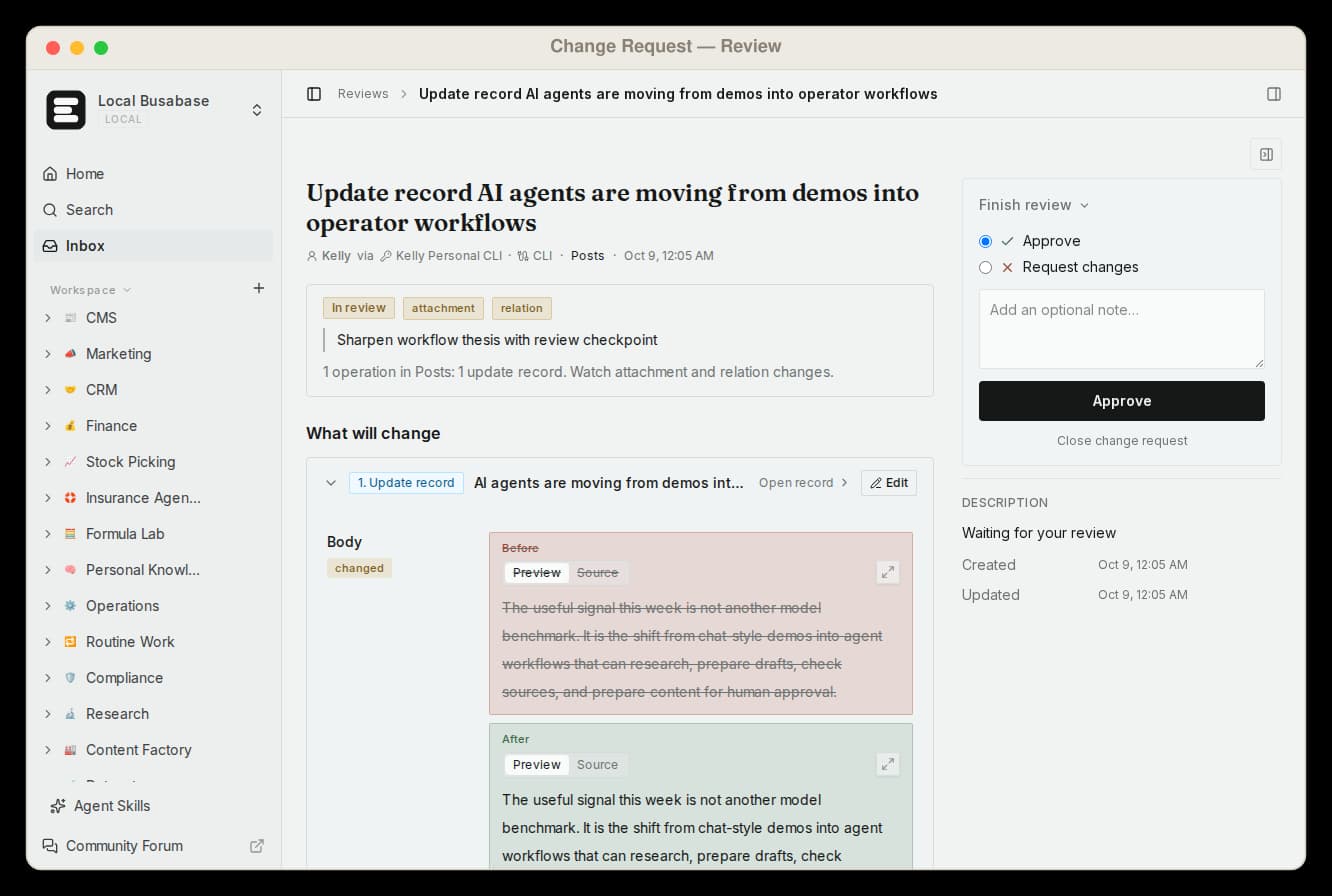
A write from an agent can arrive as a change request — a proposal you read before it becomes a record.
See the change before it applies
Each change request shows every field as before and after. Approve it, ask for changes, or close it.
You choose who needs review
Give an agent a key that can propose changes, and its writes wait in your inbox. Give it a key that can write, and changes apply straight away — still recorded as a merged change.
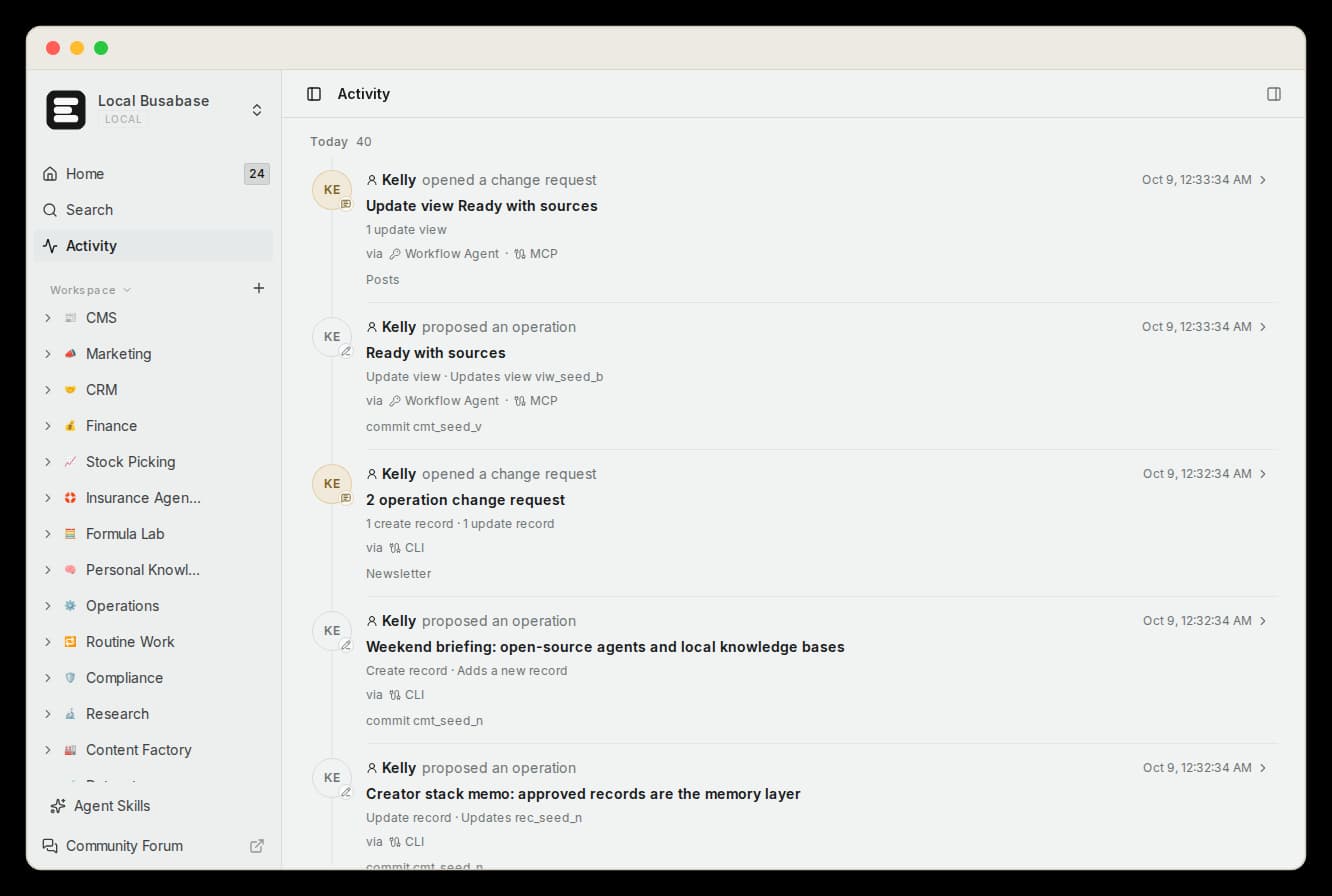
Every change says where it came from
Which agent wrote it (Claude Code, Codex and others), through which channel (CLI, MCP or API), and who approved it.
Got it wrong?
Mistakes stay small and visible
Review stops a bad write before it lands. History and restore cover the rest.
Rejecting changes nothing
Close a change request and the data it targeted stays exactly as it was.
History on records and docs
See how a record or doc reached its current state, and who changed it at each step.
Restore what was removed
Deleted or archived records, fields and views can be brought back.
Código abierto · Local primero
Tus datos, donde tú decidas
Busabase es de código abierto (MIT). El mismo motor funciona en tu portátil, en tu propio servidor o en Busabase Cloud.
En tu equipo
Busabase Desktop
Los datos se quedan en una carpeta de tu ordenador. Sin seguimiento de uso, y sigue funcionando sin conexión.
En tu propio servidor
Docker · autoalojado
Despliégalo dentro de la red de tu empresa. Tus datos no tienen por qué salir de ella.
En Busabase Cloud
Cloud
Para equipos que quieren colaborar desde ya, sin instalar nada.
How this compares
What you can do about agent writes, out of the box.
Writes from any agent, including outside agents over API or MCP, can wait for your review with a field-by-field diff
- Busabase
- Yes
- Agent memory tools
- Some
- Notion / Airtable with AI
- Partly
- Backend platforms
- Build it yourself
Choose per key which agents need review and which write directly
- Busabase
- Yes
- Agent memory tools
- Some
- Notion / Airtable with AI
- Partly
- Backend platforms
- Build it yourself
Each change records the agent, the channel and who approved it
- Busabase
- Yes
- Agent memory tools
- Partly
- Notion / Airtable with AI
- Partly
- Backend platforms
- Partly
Open source, runs on your own machine or servers
- Busabase
- Yes
- Agent memory tools
- Some
- Notion / Airtable with AI
- No
- Backend platforms
- Some
When something else fits better
- You need your app's backend — sign-in, realtime, file storage for your own users. A backend platform does that, and Busabase can sit beside it.
- You only need an agent to remember one user's preferences between chats. A memory layer is lighter.
- Your team writes docs by hand and agents only help now and then. Notion or Airtable may be all you need — Notion's own agents can already ask before they edit.
What we don't do yet
Security reviews go faster when the gaps are written down.
Field-level permissions
Access is set per space, folder, table and doc today. Hiding single fields from some people is in development.
Guest access
Letting someone outside the team see a single item without becoming a member is in development.
Compliance certifications
Busabase does not hold SOC 2 or ISO 27001 certification yet.
On your own server, host access is the boundary
Anyone who can open a shell on the host is past every control described here. Treat access to the host as the real trust boundary.
Questions security reviewers ask
Can an agent delete my data?
Only if its key allows it. With a key that can only propose changes, a delete becomes a change request that waits for you. Deleted or archived records, fields and views can also be restored.
Do I have to approve every change?
No. Review applies where you ask for it: to agents whose key can only propose changes, and to writes that ask to wait. A key that can write applies changes straight away, and they are still recorded.
Is Busabase agent memory?
It is where your agents keep what they learn and produce — as records, docs, files and skills that people can read, check and reuse. Memory tools help an agent recall; Busabase keeps the facts you can cite.
Can I use Busabase as my agents' knowledge base and database?
Yes. Agents read and write records, docs, files and skills there over the CLI, MCP or API, and people work in the same data. Access is capped per key, writes can wait for your review, and every change records which agent made it.
Where is my data stored?
Busabase Desktop and the open-source server keep data on your own machine. You can self-host with Docker inside your own network, or use Busabase Cloud.
Can I see which agent changed a record?
Yes. Each change records whose key was used, the agent and channel it came through, and who approved it.
Let your agents work on real data
Start in Cloud, or run Busabase on your own machine. Either way, you decide what becomes a record.