Google’s AI threat report: control what agents can read and change
Set access, review writes, trace changes.
Google’s AI threat report: control what agents can read and change
An agent that organizes customer information, updates project status, or remembers team policies needs access to real business data. As those connections grow, a practical question follows: if the agent makes a mistake, its credentials are stolen, or its runtime is altered, how much can it read—and how much can it change immediately?
Google Threat Intelligence Group’s November 16, 2026 AI threat report makes that question more urgent. Attackers are connecting work that once required repeated human intervention into automated execution pipelines. The time available to notice, assess, and respond shrinks.
For teams already using agents, three controls deserve attention: data access, the conditions under which writes take effect, and the ability to trace and recover changes. Together, they shape how far an error or credential misuse can spread through business records.
What Google observed
GTIG reports that threat actors are using multi-agent frameworks to automate discrete stages of live intrusions. These systems can adjust subsequent actions using execution feedback. Google also emphasizes that the underlying weaknesses remain familiar, including compromised credentials and unpatched systems; automation changes the speed and scale of exploiting them.
One framework, exploit_agent, compares code before and after patch announcements, analyzes potential vulnerabilities, drafts exploits, and executes them automatically. The n-day vulnerabilities involved are already disclosed flaws. A fix or its details may be public while organizations remain exposed because they have not updated. This finding does not establish that AI can compromise any system.
Two other observations matter to ordinary agent deployments. Attackers are stealing model credentials and cloud resources for their own use or resale. In separate intrusions, attackers modified coding-assistant configuration so that normal startup could trigger malicious behavior.
A request coming from a familiar agent, or carrying a valid credential, is therefore insufficient grounds for broad data access and unrestricted business-data writes.
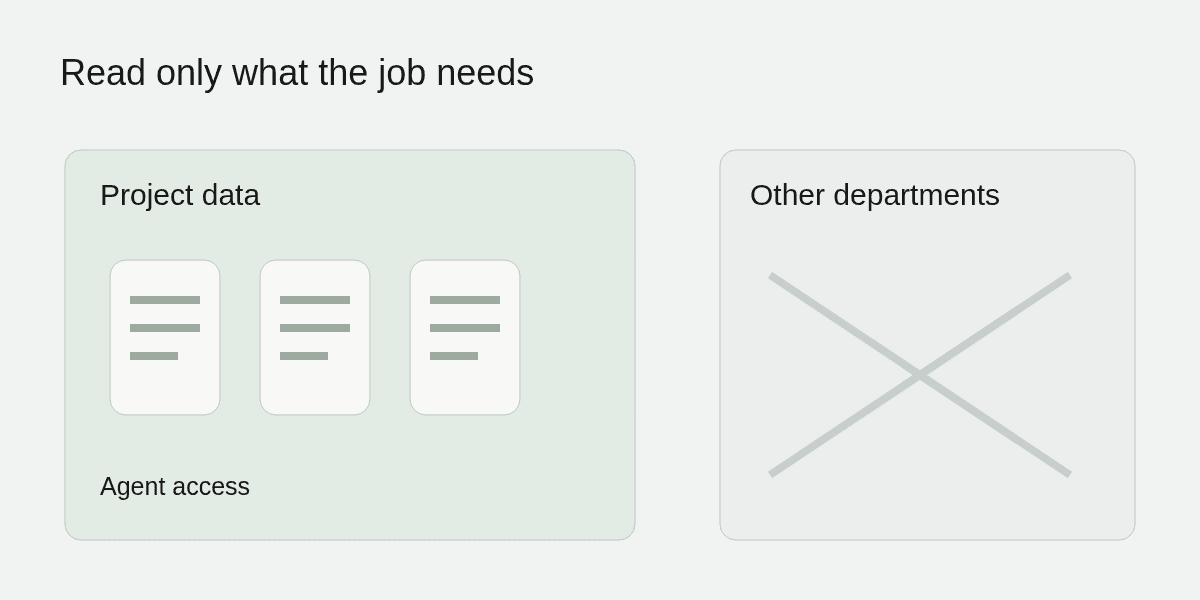
Decide the reading boundary when you connect an agent
Teams often get an agent working first and address permissions later. For convenience, they give it access to everything the connecting account can see.
For customer information, internal policies, and commercial documents, that expands the consequences of a mistake. An agent organizing one project usually has no reason to read every department’s files. Write review cannot solve excessive reading: rejecting a proposed update cannot undo information already retrieved and sent to an external model.
Start with the resources required for the job. Identify the folder, table, or document the agent needs, and decide separately whether it must modify it. Access needed to summarize research and authority needed to maintain official customer records deserve different decisions.
Busabase’s security controls provide four levels: Read, Can propose changes, Can write, and Manage. An agent key is capped by both its own level and the access of its issuer, whichever is lower. Access can be restricted at the space, folder, table, and document level. Roles and permissions are available in Cloud and Premium self-hosted; the free open-source edition is intended for one person on one machine.
Put the boundary in the system. A prompt saying “do not touch other information” expresses an instruction; it cannot replace access control.
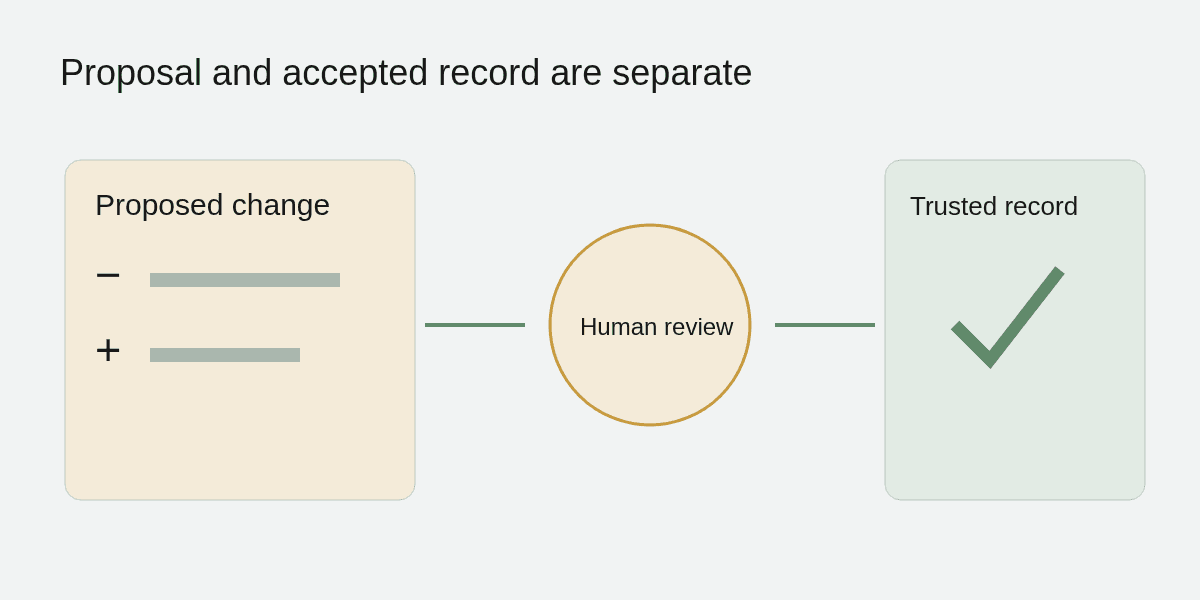
Proposing a change and applying it are different powers
Read access determines exposure. Write access determines whether an agent’s output can change business facts.
An agent extracting information from email or a web page may identify the wrong person, rely on an outdated policy, or mistake malicious source text for an instruction. If it updates shared records directly, people and later agents may treat that output as confirmed. An error in persistent memory can become input for the next task.
High-impact changes need a clear point at which they become authoritative. An agent can research and draft an update while the proposed modification remains separate from the accepted record. Reviewers should see before-and-after values and check whether the evidence supports the change, particularly for deletions, identity relationships, policies, and important status updates.
In Busabase, a key that can only propose changes leaves writes waiting for review. A ChangeRequest presents field-level differences; closing it leaves the targeted data unchanged. A key with write access applies changes immediately and still records them as merged changes. Whether a write waits depends on the actual permissions and the write’s review requirements.
Allocate review according to impact. Use proposal permissions for official information that requires judgment. Consider direct writes only where scope is clear, results are readily checked, and risk is acceptable. If the queue becomes unmanageable, redesign task boundaries and permissions so reviewers receive changes they can meaningfully assess.
History makes the affected scope inspectable
Review and history have separate jobs. Review decides whether a change should happen; history explains changes that already happened.
When investigating a suspicious record, a team needs to know which agent submitted it, through which channel, what changed, who approved it, and whether later work consumed it. The current value alone cannot explain whether it reflects human judgment, agent inference, or an earlier mistake.
Busabase records the agent, channel, and approval provenance of changes. Records and documents retain history, and deleted or archived records, fields, and views can be restored. These controls support investigation and recovery. Restoring a record does not automatically recall an email, reverse an external action, or recover disclosed information.
An incident still requires attention to affected credentials and connections, examination of related changes and downstream use, and a decision about what to restore. Change history supplies evidence for that work; it does not perform the entire response.
Self-hosting leaves the host boundary with your team
Keeping data on your own server can satisfy deployment and data-location requirements. It also leaves responsibility for hosts, networks, secrets, and updates with your team. The patch window described in Google’s report applies to self-hosted systems too.
Busabase explicitly states that someone with shell access to the host is past its application-level controls. Self-hosting therefore requires protected host access, timely updates, careful credential handling, and maintained backups. Application review governs accepted writes; infrastructure protection secures the environment running the application.
Busabase currently controls access at the space, folder, table, and document level. Field-level permissions are still in development. If an agent should read only part of a dataset, organize it around supported resource boundaries rather than assuming a hidden interface field provides isolation. Busabase does not currently hold SOC 2 or ISO 27001 certification; assess procurement requirements directly.
Start with one existing agent
Choose an agent already handling real business information and inspect its actual connections:
-
Where can it read? Compare necessary resources with everything its credentials can reach, and remove excess access.
-
Which changes apply immediately? Check whether high-impact changes to official information wait for review. A prompt agreement is insufficient.
-
Who can assess its proposals? Make sure differences, sources, and reasoning are understandable, with an owner for exceptions.
-
What can you trace afterward? Verify change provenance and history, and plan data recovery separately from downstream remediation.
Google’s report documents attackers removing human pauses from execution chains. Teams deploying agents need data boundaries enforced along the real access and write paths.
Use Busabase Security to check the current permission, review, and recovery model. Then inspect one live connection: give the agent enough authority to do its work while preserving the team’s judgment over what becomes a trusted record.