AGENT DELIVERY
An agent saying done is not a handoff
A reliable handoff names the requested outcome, shows the real artifact, carries evidence, records the human decision, and leaves accepted state where the next person or agent can use it.
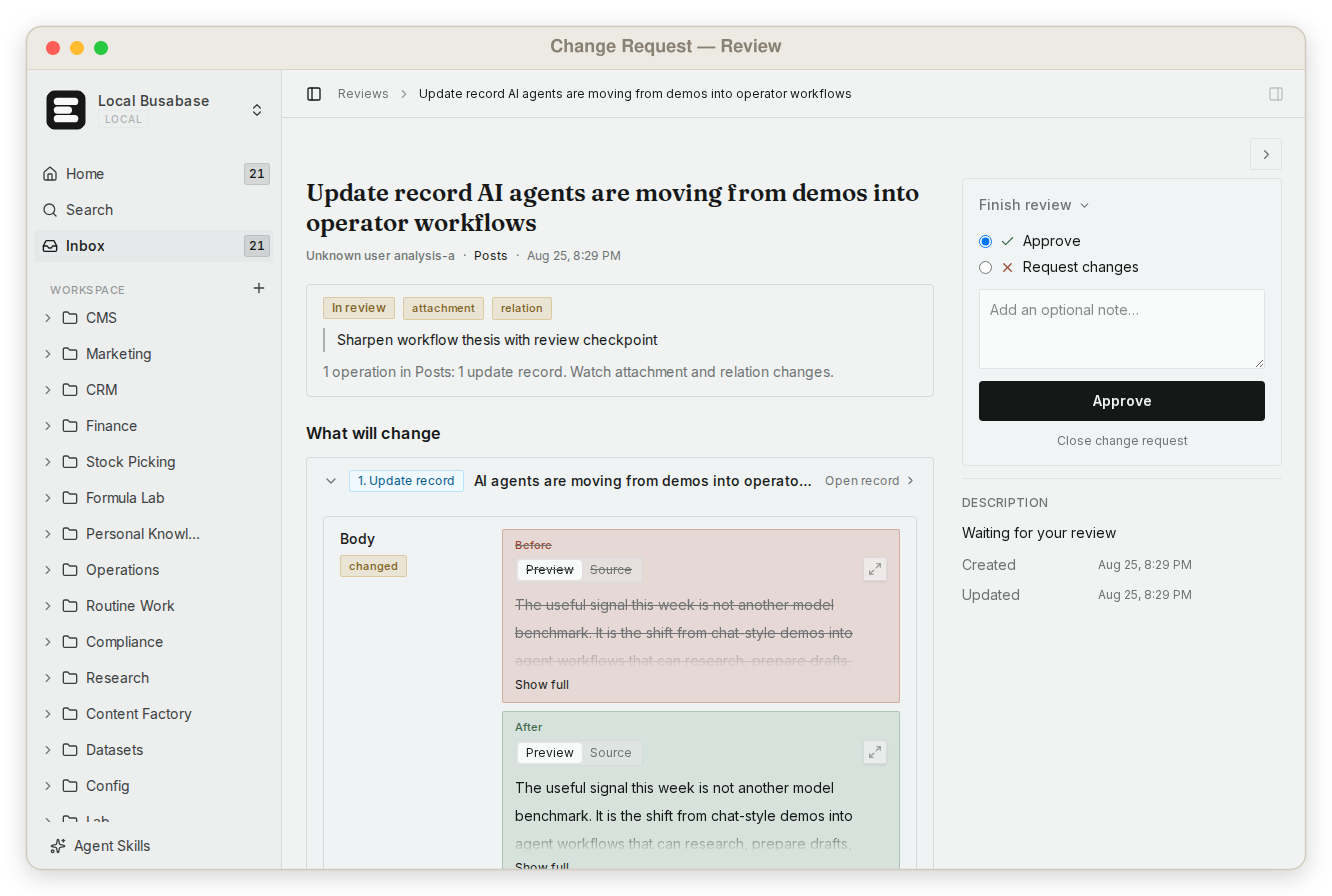
The workflow problem
Chat summaries hide scope drift, missing evidence, and the difference between proposed work and accepted truth.
A Change Request connects intent, artifact, diff, source, reviewer, and accepted version.
Structure
Model the work before scaling it
Typed fields and relations keep agent output consistent across channels and clients.
Review
Inspect the real deliverable
Rendered content, files, and field diffs make judgment faster than raw payloads.
Authority
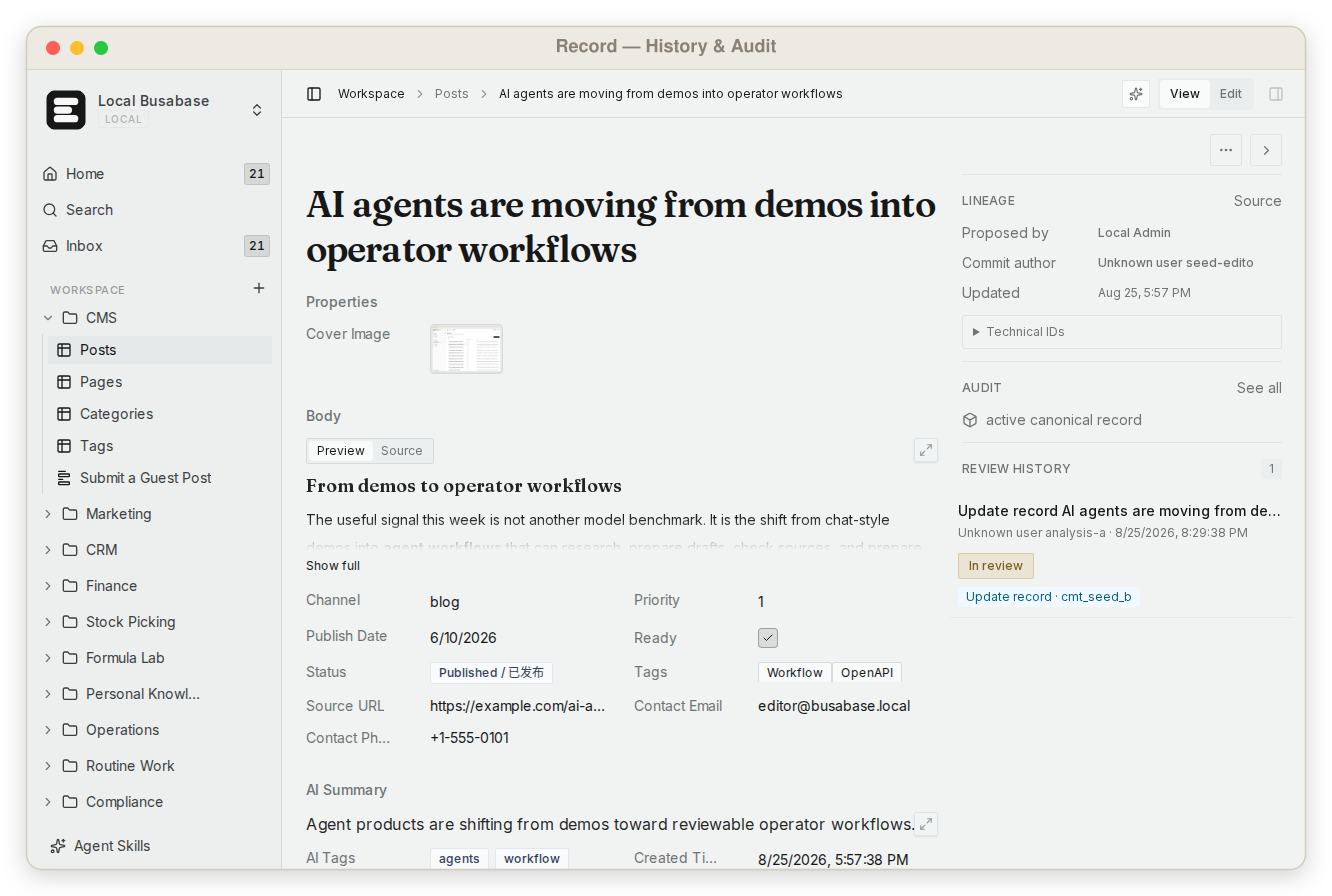
Separate proposals from truth
Only accepted work becomes canonical data exposed to downstream systems.
Reuse
Keep methods beside the work
Skills, Docs, evidence, and AirApps remain available after the first successful run.
Operating flow
Request to accepted handoff
A durable workflow makes each transition visible and gives the next participant a clear starting state.
Name the expected result, owner, fields, evidence, and acceptance rule.
Agents prepare structured records, files, and purpose-built views.
The responsible person reviews the actual result and requests changes where needed.
The approved version becomes canonical with provenance and history attached.
People, agents, APIs, and apps continue from the accepted state.
Delivery contract
A Change Request connects intent, artifact, diff, source, reviewer, and accepted version.
A durable state transition, not a message
| Deliverable | Owner | Operational value |
|---|---|---|
| Scope and acceptance criteria | Workflow owner | A shared definition of done |
| Structured proposal and evidence | Agent and producer | An inspectable result |
| Review decision | Accountable workflow owner | A clear authority boundary |
| Canonical record and operating view | Client or internal team | A durable state transition, not a message |
Visible result
A durable state transition, not a message
The accepted artifact stays connected to its evidence, history, and downstream use instead of becoming another detached export.
Use Busabase when
The result must become reusable work
- Agent output must become structured, reviewable work
- Several people or systems depend on the accepted version
- The owner needs a clear diff, evidence, and history
- The workflow should remain usable after one Agent session
Choose another layer when
Keep the surrounding stack honest
- Use a publishing platform when the job is direct channel distribution
- Use a transactional database for synchronous product writes
- Use a model runtime for inference hosting and scheduling
- Do not add approval where nobody will make a meaningful decision
Frequently asked questions
Does Busabase create the content or client solution itself?
No. Your agents and team do the work. Busabase structures the deliverables, review, accepted state, reusable methods, and operating views.
Can approved results feed another system?
Yes. Downstream tools can read canonical records through the API while unapproved proposals remain separate.
Does every draft need review?
No. Apply review where a result becomes public, contractual, financial, customer-facing, or reusable as a business fact.
What remains after the project or campaign?
The accepted records, evidence, Docs, files, Skills, history, and AirApps remain in the workspace for continued operation.
Agent Delivery
A durable state transition, not a message
A reliable handoff names the requested outcome, shows the real artifact, carries evidence, records the human decision, and leaves accepted state where the next person or agent can use it.