The last mile of sovereign AI: you self-hosted the model, now where does the agent’s work live?
Self-hosting an open-weights LLM is only step one. Real sovereign AI means keeping your agents stateless while owning the database, skills, air-gapped runtime, and human review gate on your own metal.

Most conversations about sovereign AI begin and end with the model. Teams buy or rent GPUs, pull an open-weights model like DeepSeek, Qwen, or Llama into a private VPC, and declare their AI stack sovereign.
Six months later, they hit a wall. The model runs inside the firewall, but the work does not.
Employees still paste sensitive customer context into personal chat threads. Every agent session starts from zero. Operating procedures live trapped inside one developer's prompt files or a cloud SaaS workspace. And when someone proposes letting an autonomous agent write directly to a production database, security shuts the project down—because nobody can prove what the agent will overwrite or who approved the change.
This is the last-mile problem of sovereign AI. MIT's NANDA initiative found that roughly 95% of enterprise generative AI pilots fail to deliver measurable business returns, pointing not to weak models, but to a learning and context gap: generic tools do not retain or govern how an organization actually works.
Owning the model weights gives you inference sovereignty. Turning AI into a durable, compliant capability requires workspace sovereignty: owning the structured data, the reusable skills, the runtime boundary, and the human approval gate where agent work becomes truth.
Why model-only sovereignty stalls in production
A language model is stateless by design. It takes tokens in, emits tokens out, and forgets. Everything that makes an AI agent useful over time—customer records, project history, standard operating procedures, and review state—lives outside the model weights.
When organizations invest in private inference without a sovereign workspace for their agents, four failure modes appear almost immediately:
| Layer | What model-only sovereignty does | How it fails in real operations |
|---|---|---|
| Inference | Runs an open-weights LLM in a private VPC or on-premises server | Solves compute privacy, but leaves agents with no shared state across sessions |
| Context & records | Keeps documents and tables in public SaaS tools or scattered chat logs | Either business context leaks outside the boundary, or agent output dies in individual chat windows |
| Skills & workflows | Hardcodes prompts into a specific vendor's copilot or one engineer's repo | Locks the team into one agent harness; switching models means rebuilding every workflow |
| Database writes | Gives an agent a service account with direct INSERT / UPDATE access | Agents write hallucinations at machine speed with no field-level diff, human review, or provenance |
If your model sits in your own data center, but your team's operating knowledge is locked inside a vendor's cloud memory—or your agents cannot safely update a record without risking silent corruption—you do not have sovereign AI. You have a private chatbot.
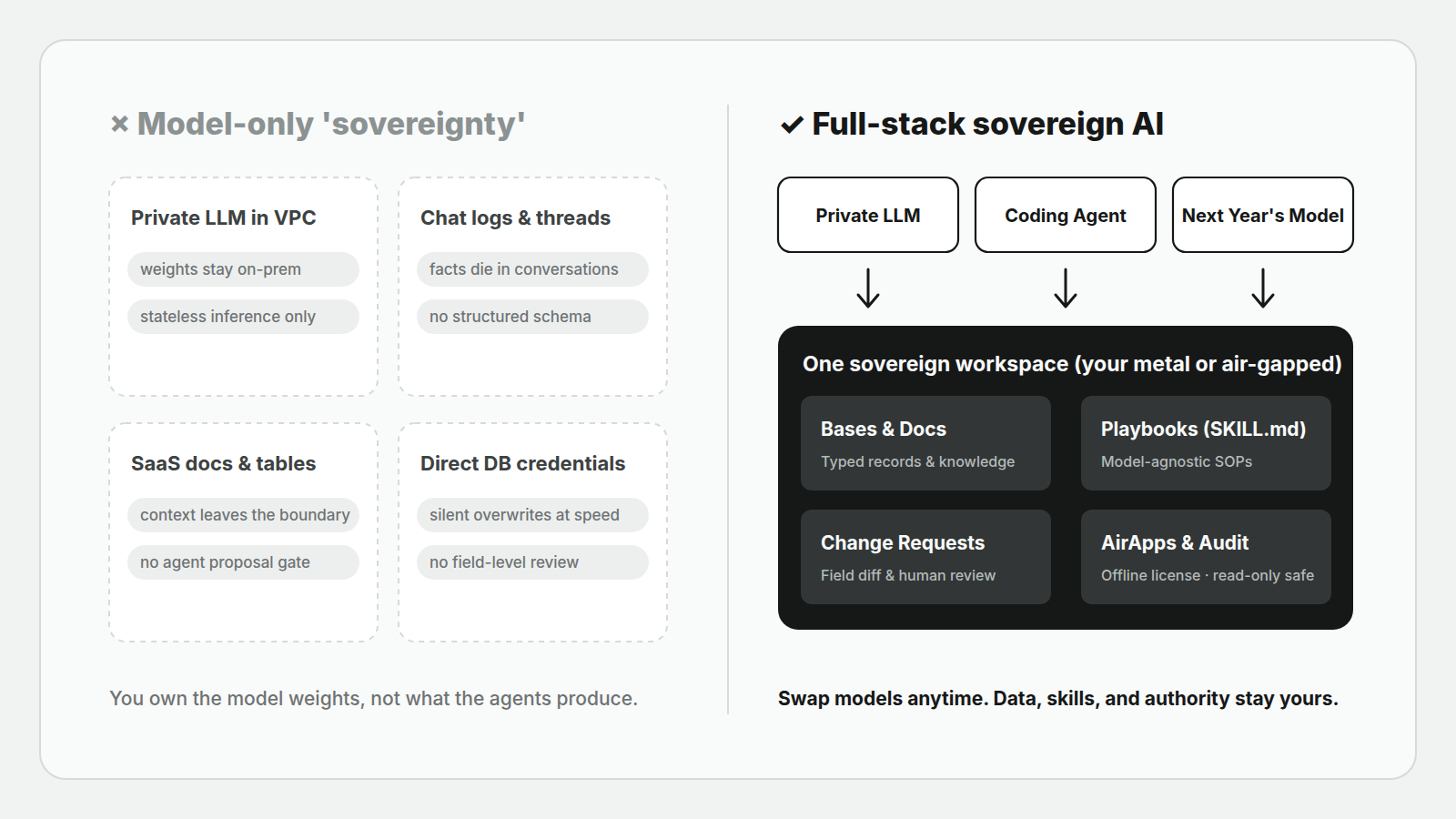
To close the last mile, sovereignty has to extend to the layer where agents and people actually meet.
Pillar 1: Model independence—keep agents stateless, keep skills in the workspace
True sovereignty means freedom from lock-in. In 2026, model rankings shift every few months, and different tasks call for different harnesses: an internal open-weights model for regulated data, Claude Code or Codex for software delivery, Cursor or OpenCode in the IDE, or a custom DeepSeek harness on an internal server.
If each agent stores its own memory and its own instructions, switching models destroys your institutional memory. We wrote about the organizational cost of this in How to make AI work for teams: agents should be stateless, and the memory should belong to the team.
In Busabase, that principle is architectural:
- Typed Bases and Docs hold the structured facts and long-form knowledge every agent reads before acting.
- Playbooks (
SKILL.mdand custom prompts) live as first-class nodes inside the workspace. When any connected agent starts a task, its first step is to query the workspace's Playbooks catalog for the standard operating procedure. - AirApps run directly on top of workspace data, giving humans a clean operational interface—a CRM, a review desk, an incident tracker—without building a separate frontend from scratch.
- Open protocols (MCP, OpenAPI, CLI, Agent Skill) mean no built-in model requirement. Whether your agent speaks MCP or calls REST endpoints over
/api/v1, the workspace contract never changes.
When you upgrade from one local model to the next, or let engineers switch coding agents, nothing in your business logic is rewritten. The new agent reads the same SKILL.md, queries the same Bases, and picks up where the previous agent stopped.
Pillar 2: Physical and operational sovereignty—from laptop to air-gapped metal
Data sovereignty is only as real as your deployment boundary. A workspace that requires a permanent connection to a vendor's control plane cannot serve an air-gapped lab, a regulated financial floor, or a developer working offline.
Busabase is built on a single open-core engine (busabase-core) that runs across every sovereignty tier without changing how your agents or applications talk to it:
| Sovereignty tier | How it runs | Who it serves | Operational footprint |
|---|---|---|---|
| Local & Personal | npx busabase server or Busabase Desktop (embedded PGlite + local disk) | Individual builders, local agents, offline work | Zero config, MIT open source, data never leaves your computer |
| Self-Hosted All-in-One | Single container (busabase/busabase-premium-allinone) with Postgres & object storage built in | Regulated teams up to ~20 seats, POCs, isolated subnets | Cold-starts in ~24s, ~548 MiB idle RAM, single -v busabase-data:/data volume |
| Production Compose & K8s | Docker Compose or Helm chart backed by your own PostgreSQL, Redis, and S3/SeaweedFS | Enterprise production, 20–500+ seats, high availability | Full horizontal scale under your own DBA and SRE controls |
| Hybrid Local-to-Cloud | Local instance mounted into Busabase Cloud via a self-hosted tunnel | Teams that collaborate across organizations while keeping raw data on local metal | Data stays on your machine; the workspace appears alongside hosted spaces |
For strict self-hosted and air-gapped environments, operational independence comes down to three details that most software glosses over:
- Zero phone-home. A self-hosted Busabase instance never needs to call an external server to boot, run, or validate its license. You can
docker savethe ~489 MB all-in-one image, carry it across an air gap, verify its SHA-256 checksum, anddocker loadit onto a machine that has never touched the internet. - Offline public-key license verification. Commercial self-hosted licenses are verified locally against a public key compiled into the build. Activation is pasting a signed key into the admin panel, not opening a firewall port.
- Read-only degradation—never a lockout. Sovereignty means never being held hostage by a vendor's billing system. If a self-hosted license expires, Busabase transitions cleanly to read-only mode: mutations pause, but every record, document, skill, and export remains accessible to your team.
Pillar 3: Governance sovereignty—human authority over what becomes canonical
The hardest question in enterprise AI governance is not "where is the database hosted?" Under frameworks like the EU AI Act, GDPR Article 30, and financial risk mandates, the question auditors ask is: "When an autonomous agent changed this business record, who authorized it, what was the evidence, and can you prove what changed?"
Traditional access control only checks whether an identity has permission to write. As we explored in What makes an agent's write authoritative?, permission is not authority. An agent with write access can still hallucinate a renewal date, overwrite a compliance status, or corrupt a product catalog at machine speed.
Busabase enforces governance sovereignty at the write boundary:
Agent reads workspace context & Playbooks
        ↓
Agent proposes a write → lands as a Change Request (message + field-level diff + author)
        ↓
Workspace policy decides: merge immediately, or hold in Inbox for human review
        ↓
Approved writes merge into canonical records with an immutable commit & audit trail
- Proportional control: Low-risk updates from trusted agents can merge on the spot while still recording a full commit diff. Consequential writes—updating a contract, publishing a customer-facing page, modifying a shared skill—can be scoped to
changeRequest-level credentials orautoMerge: false, holding the proposal in the Inbox until an accountable human approves it. - Inspectable provenance: Every merged record carries the exact commit, the proposing agent or user, the reviewer who approved it, and the field-by-field before/after state. You can answer an audit query in seconds from the record's history tab instead of grepping raw server logs.
That is what turns a database into a system of record for AI agents—not locking agents out, but putting a reviewable proposal boundary between what an agent generates and what the organization treats as truth.
A practical checklist for sovereign AI teams
Before signing off on an internal AI architecture, test it against four operational questions:
- If we replace our primary LLM next quarter, what breaks? If your prompts, procedures, and structured context live inside a model vendor's proprietary workspace, your switching cost is total.
- Where does agent output land after the chat ends? If the answer is "in the chat thread" or "people copy-paste it into SaaS tools," your agents are not building durable company assets.
- Can we run the entire workflow with the outbound internet cable unplugged? Test whether your workspace, skill registry, and license verification work inside an isolated subnet without calling home.
- Can we prove who approved an agent's write six months from now? Check whether every consequential agent mutation leaves a field-level diff, an author, and a human reviewer on the record itself.
Start on your own metal
Busabase is an open-source database and workspace for AI agents—agents and people share the same structured data, docs, skills, and apps, and writes that matter become reviewed, trusted records.
You can test the full sovereign loop in under a minute on your own machine:
npx busabase server
Or explore the deployment path that fits your boundary:
- Individual & offline: Download Busabase Desktop or run the MIT open-source server locally.
- Self-hosted teams & air-gapped environments: Read the Self-Hosted Overview and Offline Installation Guide.
- Managed multi-team workspaces: Start free on Busabase Cloud, and mount your local instances whenever you need both.