Busabase looks like an AI table. Judge it by the problem it solves.
Busabase is not another AI table or wiki. It keeps context and skills in one shared base so any agent, and any person, can pick up the work.

In conversations, we get asked the same question almost every day: "So what problem are you actually solving? It sounds like a pretty abstract product."
It is a fair question. When people first see Busabase, they file it under something they already know. There is a sidebar, there are tables with typed fields, there are documents. "So it's an AI Airtable." "So it's a knowledge base for agents." "So it's Notion with an API."
That is a reasonable first guess, and it is the wrong way to judge it. A hammer and a meat mallet look alike too. You find out which one you are holding by asking what it is for. So this post skips the feature list and answers the question we keep getting: what problem does Busabase solve, and is it a problem your team has?
Four things it looks like, and the problems they solve
Each of these products is good. Each was built for a different job.
| It looks like | The problem it solves | Who writes | Who reads |
|---|---|---|---|
| AI tables and low-code (Airtable, AITable, Retool and similar) | Building internal tools and apps without writing code | People | People |
| Knowledge bases and docs (Notion, Confluence and similar) | Writing things down so colleagues can find them | People | People |
| Agent memory and vector stores | Helping one agent recall what it saw before | One agent | The same agent |
| Git repositories | Versioning code that developers change together | Developers | Developers and CI |
Notice the last two columns. In every row, the writer and the reader are the same kind of participant.
Busabase starts from a situation none of those rows describe: agents and people, across a whole team, working on the same business and needing the same context and the same way of doing things.
When agents do the work, the work has to live somewhere shared
Picture a company where agents now do most of the day-to-day work. They draft and publish blog posts. They update the CRM and run sales operations. They write code, keep project plans current, draft product specs and help with design. They start an expense approval and find last quarter's invoice.
Fewer and fewer people spend their day clicking through screens. They ask, review and decide.
Once that happens, something shifts. The work no longer lives on any one person's screen, and it cannot live inside any one agent either, because tomorrow a different agent, or a different person, will pick it up. The customer list, the publishing procedure, the status of the launch: all of it has to sit somewhere every agent and every person can reach.
That is what we mean when we say agents should be stateless. The agent is how the work gets done. The context is what the work is about, and it has to be shared.
The mistake most teams make first
Teams that are new to agents usually make the same mistake: they hire agents the way they hire people.
There is an SEO agent, a sales agent, a project-management agent, a design agent. Each gets its own instructions and its own pile of skills. Six months later the team has dozens of agents and hundreds of skills, and most of them sit unused. Meanwhile:
- The same context lives in many places. Product facts, brand rules and the current customer list are pasted into each agent's instructions, and the copies quietly drift apart.
- Every new project starts from zero. A new agent means rebuilding the background and the instructions from scratch.
- How the team does things is trapped in one person's setup. The procedure for publishing a post or qualifying a lead lives with whoever built that agent. Nobody else can change it.
- Nobody can tell what is current. An agent updated a customer record yesterday. Was that the latest status, or a guess from an old document?
The root cause is a category error. An agent, like a skill, is an entry point: a way to start a piece of work. It is not a job title. Modelling agents on an org chart multiplies the entry points and splits the context between them, so each agent knows a slice and none knows enough.
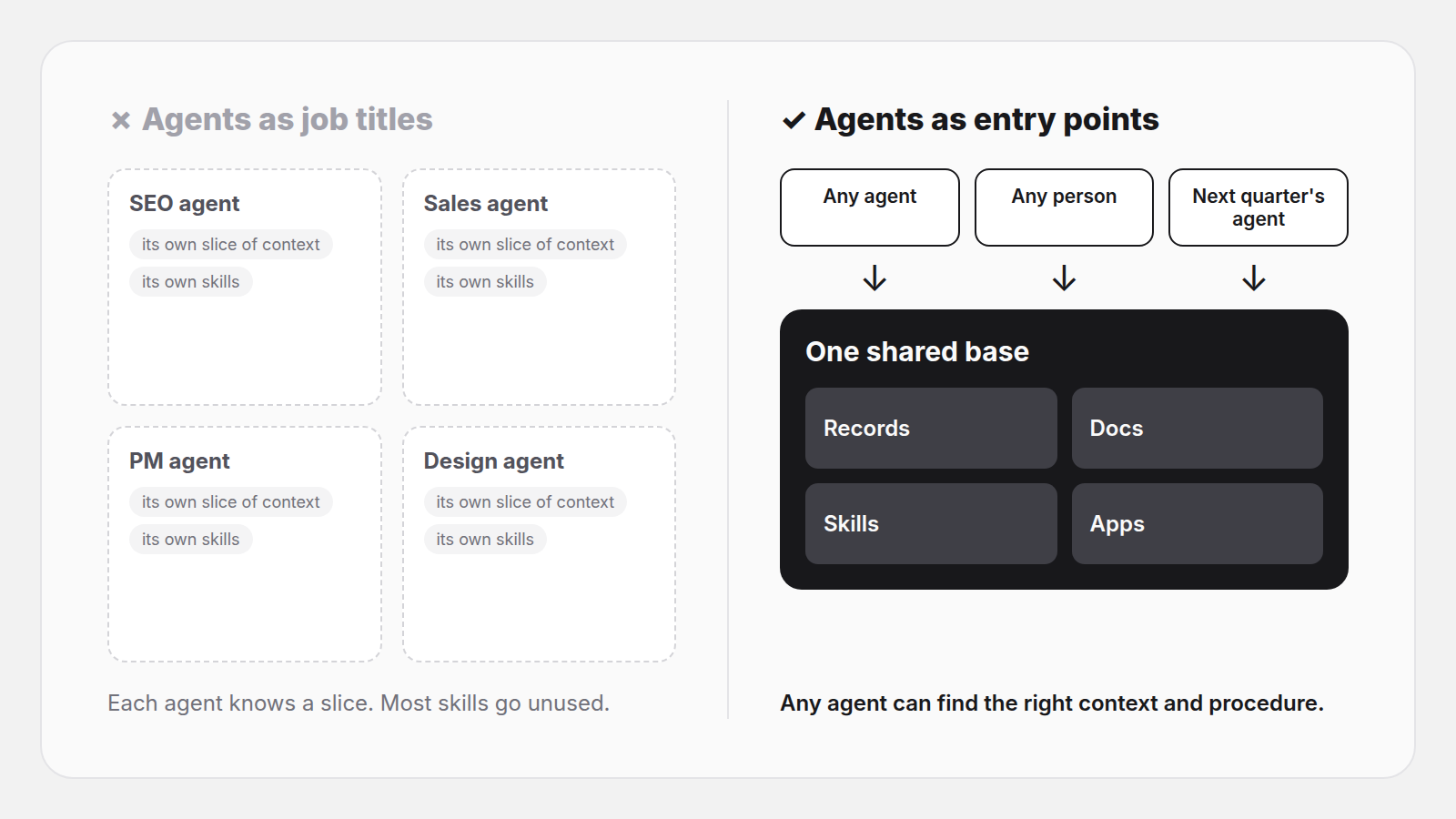
In our experience, one agent with well-matched context does more than ten agents that each hold a slice of it. The question is not "which agent should own this job?" It is "when any agent picks up this job, can it find the right context and the right procedure?"
That is the problem Busabase was built for. It is not "we need a better table" or "we need a better wiki". It is context and skills that cannot be shared across agents and people.
Agents stay stateless. The base keeps the context.
Our answer is a simple division of labour: let agents be stateless, and keep the company's knowledge and work in a shared base that people can see and manage.
Agents come and go. You will switch models, and people on your team will prefer different assistants. That should not mean starting over. The base is what stays:
- Records: customers, deals, tasks, content plans, invoices, decisions. Structured, so any agent can read and update them precisely.
- Docs: the background a person or an agent needs before starting.
- Skills: written procedures for recurring work, such as how to publish a post, how to follow up a lead, or how to file an approval.
- Apps: small working interfaces on top of the same data, for the people who want to look rather than ask.
Whichever agent a person already uses connects to the same base. At the start of a task it reads what is already there. At the end it writes the result back. The next agent, or the next person, picks up from there instead of from scratch.
Shared skills: change the procedure once
The part people underestimate is skills.
In Busabase, a skill is a node in the workspace, like a table or a document. Busabase's instructions for agents tell them to start every task the same way: search the workspace for the skills and prompts that already exist for that job, then follow them. That is how one agent can do many jobs well. It does not need to be "the SEO agent" to publish a post the way your team publishes posts; it needs to find your publishing skill.
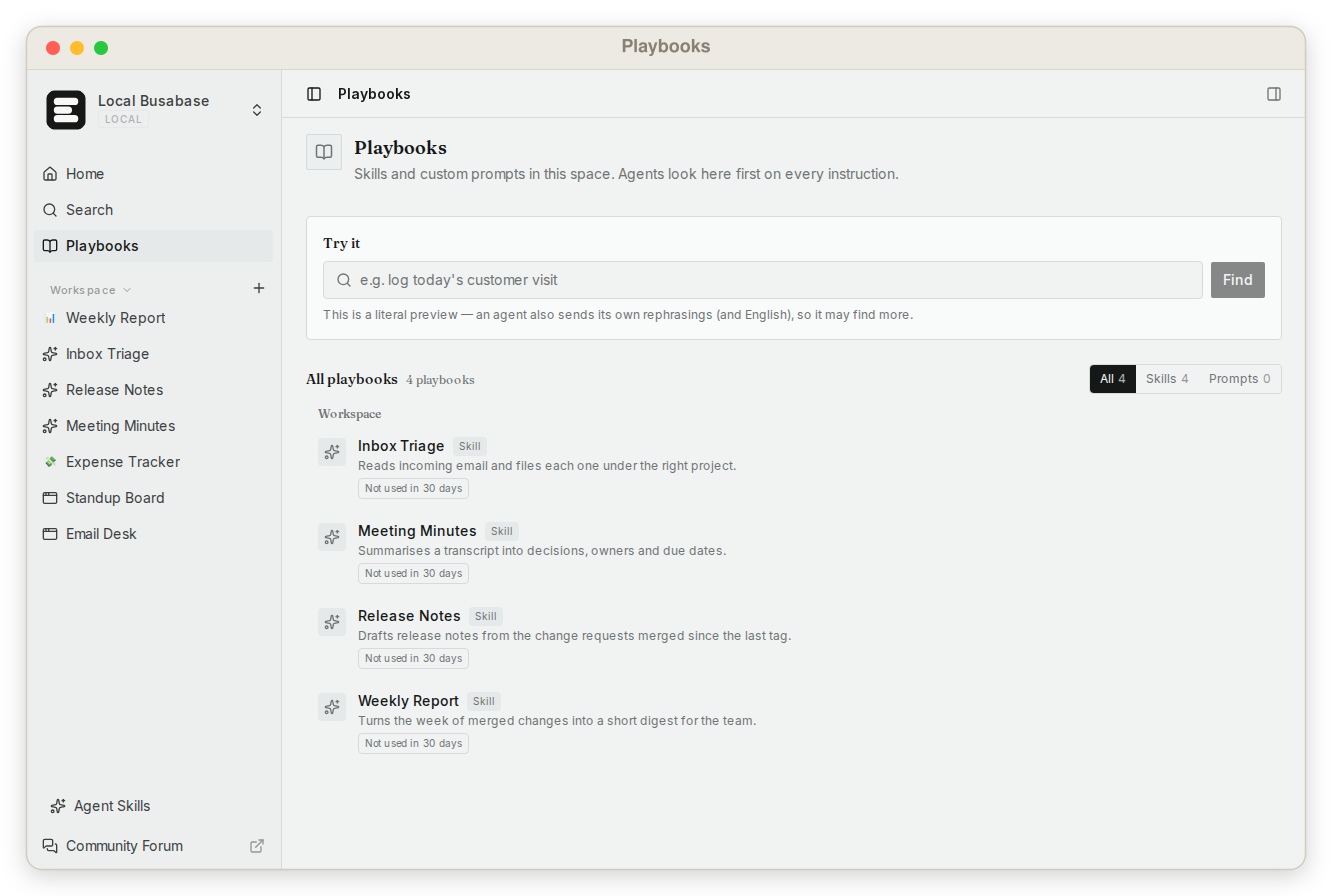
That changes two things:
- Consistency. Whoever asks, and whichever agent answers, the work follows the same procedure, because there is only one.
- Ownership. The person who owns the work can change the procedure in the workspace, in plain language. They do not need an engineer. The next run of every agent uses the new version.
One way to picture it: the skill used to live in each agent's head. Now it lives in the team's handbook, and every agent reads the handbook.
Shared context is not shared memory
It is tempting to call this "shared memory". We avoid the word on purpose, because it describes a different thing.
Memory is what an agent recalls: private to that agent, fuzzy, and hard to check. It is useful, and it belongs to the agent.
Shared context is what the team can point to: a customer record, a procedure, a status update, with an owner, a source and a history of who changed it. When you ask "what changed on this project this week?", the answer should come from the second kind.
We wrote more about the difference in Agent memory vs knowledge base vs system of record.
So why does it look like a table?
Because tables are the clearest way to share context with machines. A customer's renewal date in a typed field can be read and updated by any agent without guessing. The same fact buried in a paragraph cannot.
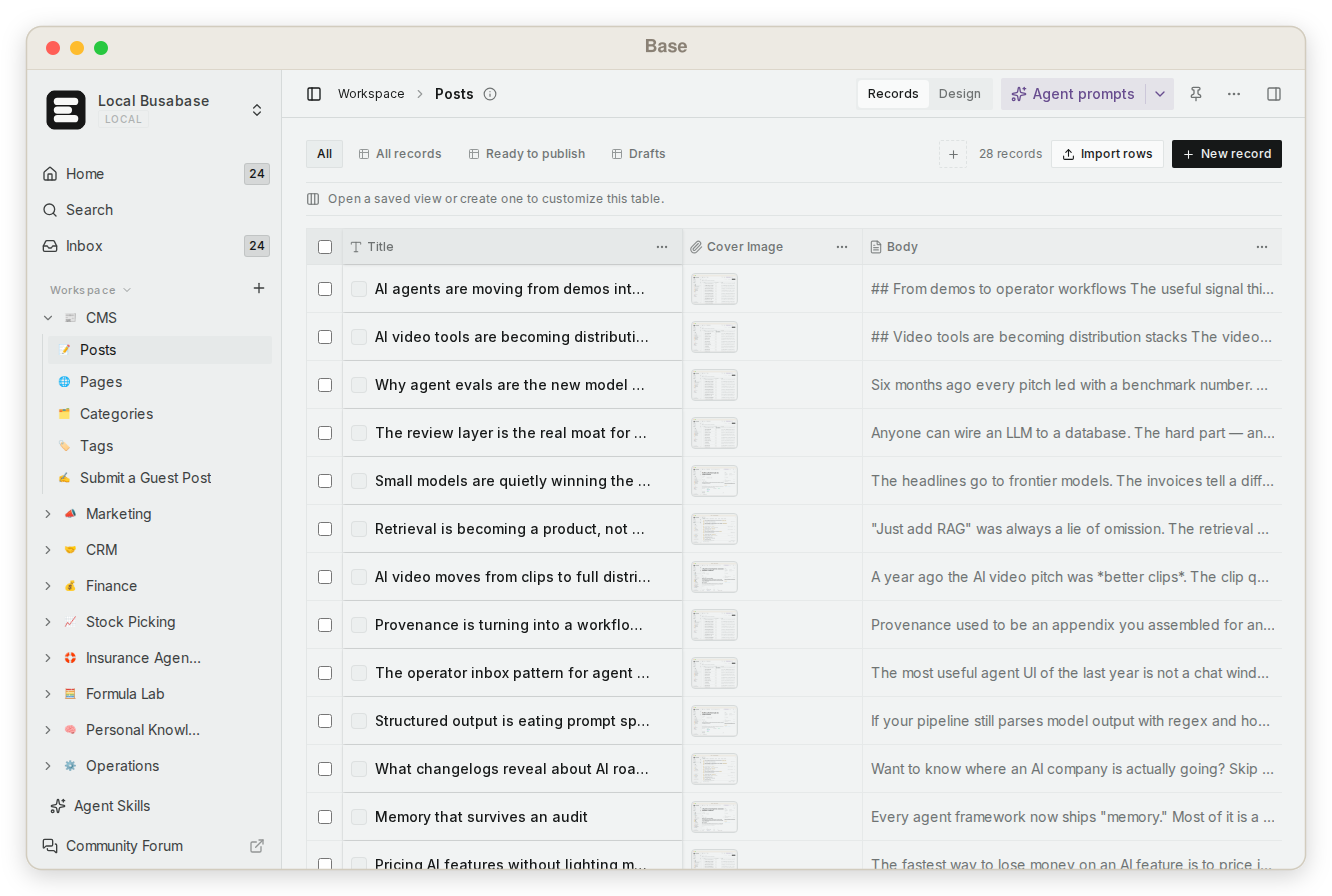
The table is the shape. Shared context is the point. Documents, skills and apps sit next to the tables for the same reason: each is the clearest shape for one kind of context.
And because agents now write into that shared context at machine speed, the base also keeps it trustworthy. You decide what each agent can read and change. For writes that matter, a change can arrive as a proposal you review before it becomes true; everything else stays fast. And you can always see what changed and who changed it. The full argument is on our page about the system of record for AI agents.
Four questions for whoever owns the work
If you run a team or a business that uses agents, ask yourself:
- Do you know how many agents and skills your team has set up, and how many are actually used?
- If the person who set up an agent left tomorrow, could anyone else change how it works?
- Has the same background or the same rules been pasted into more than one agent?
- When you want to know what changed this week, do you ask an agent, or call a meeting?
If the answers worry you, the problem is probably not your agents. It is where your context lives.
Try it with one project
Busabase is an open-source database and workspace for AI agents — agents and people share the same structured data, docs, skills, and apps, and writes that matter become reviewed, trusted records.
You do not need to reorganise your team to find out whether it helps. Start with one project:
- Put the project's latest updates and the way your team runs it into a workspace.
- Connect the agent you already use. Here is how for each agent.
- Ask it: "What changed on this project this week?"
Start free on Busabase Cloud, or download Personal Desktop to keep everything on your own machine. If you want a head start, the template center has ready-made workspaces with their skills already written.