The agent delivered a conclusion. Where are its sources and attachments?
Give the next reader one entry point to sources, cited locations, and accessible supporting files.

The conclusion is in one conversation, the source in another window, and a supporting file in the executing agent’s temporary directory. A colleague receives a polished report but cannot locate its evidence or download the material used to check it.
Shared knowledge needs a handoff that includes conclusions and evidence together. From one entry point, the recipient should find source locations, attachments, scope, and acceptance state. Another colleague or agent can then verify the work without reconstructing the original conversation.
Make each conclusion traceable to its support
A URL is an entrance, not necessarily a precise reference. A long page can describe several conditions, while a PDF can mix dates and populations. State the relevant paragraph, page, or table, along with the source date and applicable scope.
Keep original URLs for external material. Link permitted stored files or source records for internal material. A filename helps identification but does not establish provenance. Limit the conclusion to what the evidence supports.
Incomplete evidence can remain a clearly identified draft and gap for a person to resolve. A collection of unrelated links does not make a conclusion verifiable.
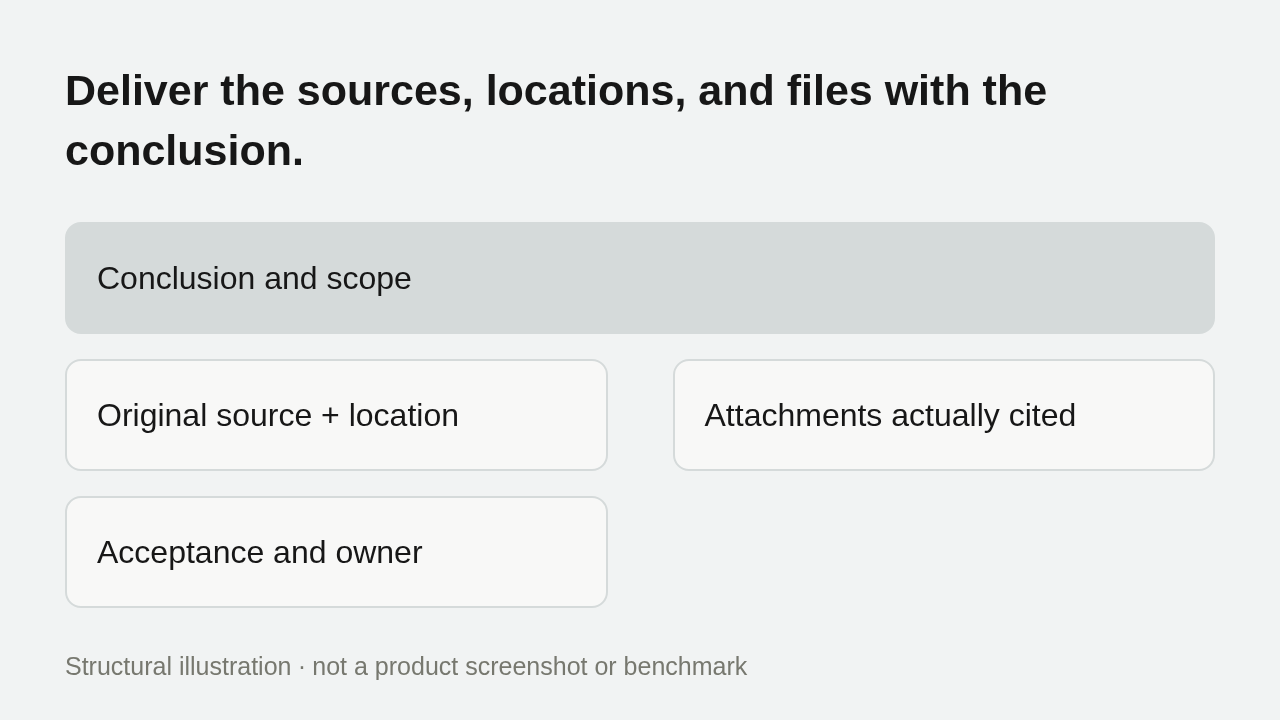
Save a minimal evidence package in Busabase
Reuse an existing research or deliverables Base. A suggested structure is:
| Object | Content | Purpose |
|---|---|---|
| Conclusion record | Claim, scope, owner, acceptance state | Identify what will be judged and reused |
| Source information | Original URL, date, passage or page | Return the reader to evidence |
| Attachment field | Permitted files actually used | Preserve accessible supporting material |
| Relations | Shared sources and associated deliverables | Maintain correspondence without repeated upkeep |
| Doc and Skill | Evidence standards and handoff method | Give future agents a repeatable process |
A simple conclusion can fit in one record. A separate source Base becomes useful when several reports reuse the same material. Split data to maintain relationships, rather than adding layers for their own sake.
Deduplication establishes storage identity
Busabase attachment fields support images, audio, video, and documents. Files are content-addressed and deduplicated, allowing identical content to be reused.
A content hash helps identify identical bytes. It does not prove authenticity or that a conclusion correctly cites the file. An inaccurate file also has a stable hash; a valid source can still be misinterpreted. Provenance, truth, and reasoning need their own checks.
When a source changes, identify the version supporting the current conclusion. Decide whether the older version and its period of applicability need preservation. Replacing an attachment silently while retaining a version-specific conclusion breaks the evidence chain.
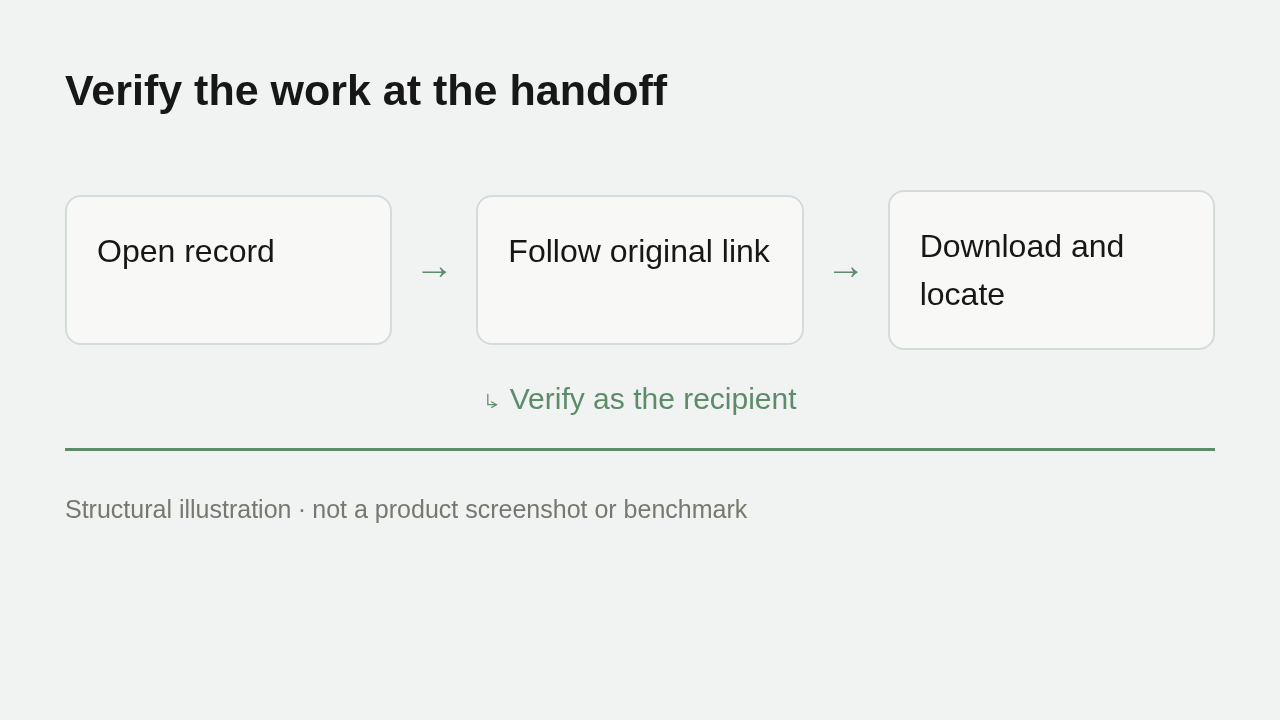
Check recipient access before calling the handoff complete
Upload permitted files and place their returned attachment references in the record. Propose the conclusion and source relationships through a ChangeRequest, following actual permissions and review requirements. Upload success alone does not confirm a correct record association or recipient access.
Use the recipient’s real account or tool to open the record, follow the original link, download the file, and locate the cited passage. Explain sign-in requirements. If a source has disappeared, retain the gap rather than substituting an unrelated search result.
Coordinate record visibility, file-sharing scope, and tool access. Sensitive material belongs in an authorized handoff, not a public report or unrestricted download link.
Let another agent continue the work
An agent connected to the same Busabase workspace can read permitted records and material through its configured connection, including the REST API. It still needs the evidence standard, a freshness check, and a distinction between accepted conclusions and drafts.
A handoff instruction could be:
Keep an original source, location, and scope for each key conclusion. Upload only permitted attachments actually cited, and link them to the conclusion record. Identify gaps in the proposal. After acceptance, read back and check that the recipient can open links and files. Do not mark untested access as verified.
This defines a process. It does not automatically validate citations or grant third-party access. The recipient needs a way to recheck changed material rather than simply trusting an old summary.
Revisit conclusions when sources change
Relations help locate conclusions associated with an updated page or file. A process can compare the new source with the cited material and propose appropriate changes. Whether the claim still holds remains a content judgment.
A usable handoff needs three things: traceable conclusions, material the recipient can access, and a recognizable acceptance state. Record missing actions and owners explicitly. Start by connecting one existing conclusion to its sources and attachments, ask another person or agent to verify it, and preserve the improved method for the next handoff.