Beyond the AI Bubble Debate: Seven Real-World Practices from the Busabase Team
Seven real AI workflows, with Busabase node layouts, agent-chat instructions, linked tasks, and checks you can use to run your own first cycle.

Models are becoming more capable, and the investment surrounding AI keeps growing. Inside a business, the question is often more immediate: after paying for the tools and connecting a model, which piece of work actually improved?
The AI bubble debate asks whether today's valuations and investment can be supported by future demand, revenue, and profits. That question is related to whether AI can complete useful tasks, but the two are distinct. A useful tool can exist in an overinvested industry. An impressive demonstration can also fail to produce a return inside a company.
Bring the discussion back to everyday work, and the questions become easier to inspect. Did the article reach publication? Did anyone follow up on the opportunity in the report? Who accepted the completed code?
The Busabase team uses AI in its own content, operations, and collaboration. These seven practices draw on actual internal records. They show completed steps alongside the work that still requires human judgment.
The common method: observe, decide, act
Each practice can follow a small loop: Observe → Decide → Act → Observe again. Data, requests, user feedback, and previous results supply the observations. An agent prepares analysis and recommendations; a person contributes judgment, taste, and priorities. The resulting tasks produce outcomes that the next run can inspect.
Your connected agent's chat can be the everyday interface. It presents a proposal; you reply, “I agree with the direction, but gather evidence first,” or specify the standard to meet. The agent links that guidance to the proposal and updates the task. Reports support decisions, and review is part of that work. Existing authorization and actual permissions determine what can execute.
The practices below describe work already undertaken. The accompanying layouts are simplified starter designs you can adapt, with example field names and conversations. The visuals are product-informed UI illustrations with synthetic data, not internal screenshots, operational evidence, or a disclosure of the team's complete internal schemas.
Prepare a workspace
Use the agent getting-started guide to connect an agent you already use. Group a scenario's resources in a Folder and reuse existing tables. A Base holds typed records, a Doc holds goals, policies, and quality standards, and a Skill holds the repeatable instructions the agent follows. A report table is also a Base: use a Markdown field for the report and separate fields for its period, sources, decision, and related tasks.
Use relation fields between tables, dates for observation windows, select fields for progress, numbers for metrics, and URLs or attachments for evidence. Keep one-off human decisions with the report or task; save reusable guidance in a Doc or Skill.
External data still needs a connected API, export, or collection tool. An agent and its tools perform the work; a scheduler starts recurring runs. Creating nodes alone does not connect analytics, send messages, or deploy code. Run one manual cycle before adding a schedule or event trigger.
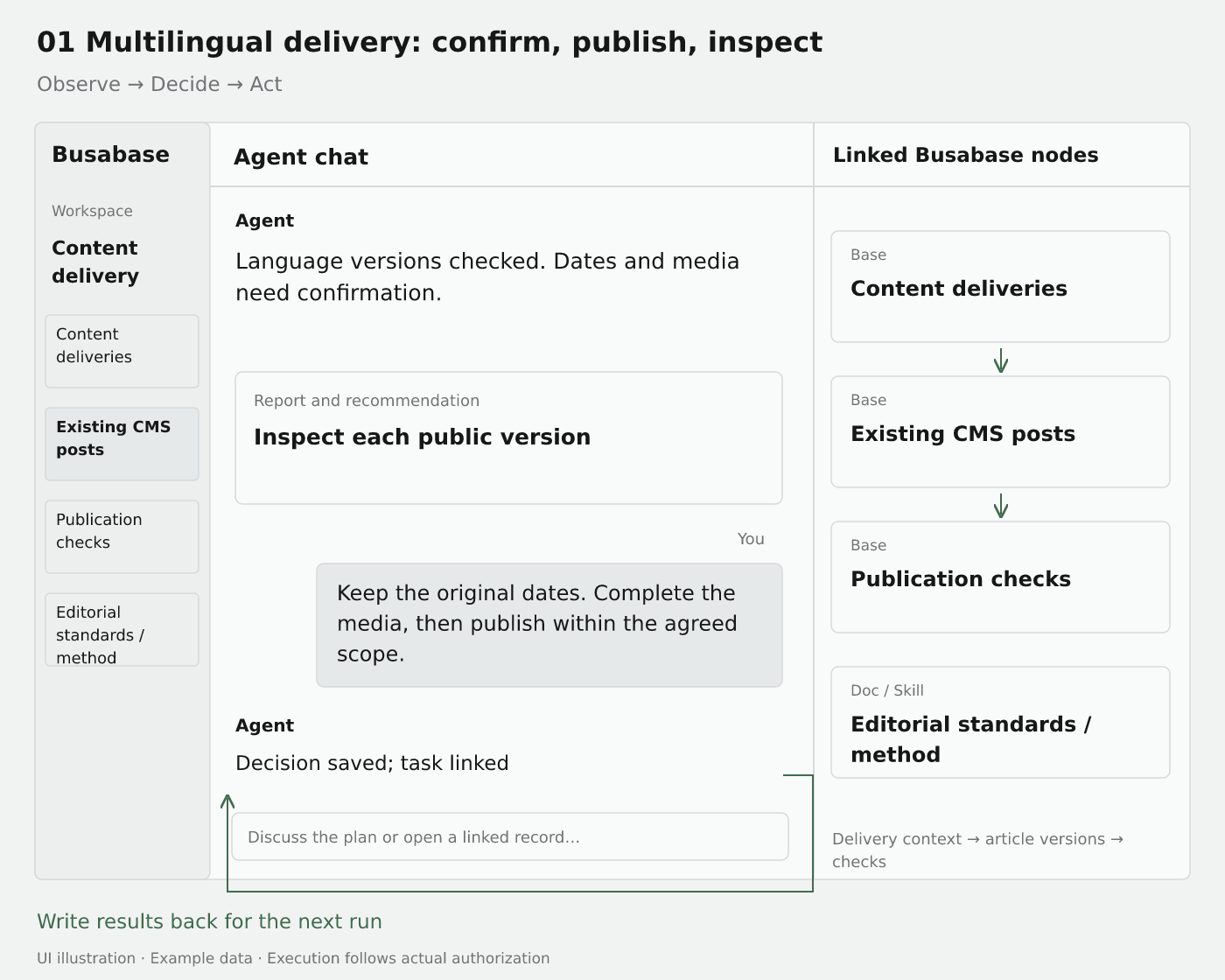
01 Taking a multilingual article batch all the way to publication
An article may have five language versions, with copy, covers, and feedback spread across different places. After editorial approval, someone still has to find the final versions, submit them, preserve the right dates, and inspect the published result. That last stretch is easy to underestimate.
In a recent delivery, the team submitted approved copy and images for 25 articles, comprising 125 language versions, to Busabase CMS. Each article's five versions went through one ChangeRequest. After merge, the agent read the canonical records back and checked the production links. All 125 direct article URLs returned successful responses.
Four articles were older assignments delivered later. The team checked their original linked daily reports and kept their original dates across two earlier days, rather than dating everything on the day of delivery. That required the assignment evidence, final copy, and publication records to agree.
The agent handled uploads, submissions, merges, and checks after authorization. The content owner approved the titles, copy, and visuals. A working URL is only one publication check; it does not establish editorial quality or a good reading experience.
The output is tangible: published articles, their language versions, media, and change histories. A later factual correction or image replacement has a specific destination.
Open the illustration at full size
Build it in Busabase
Start a “Content delivery” Folder with three tables, an “Editorial and publication standards” Doc, and a multilingual-delivery Skill:
| Node type | Suggested name | Essential fields and purpose |
|---|---|---|
| Base | Content deliveries | Article key, source report, original date, target locales, human guidance, state; one record coordinates an article's delivery. |
| Base | Existing CMS posts | Path, locale, body, cover, publication state; reuse the canonical CMS, identifying each version by path and locale. |
| Base | Publication checks | Related article version, check time, body/media checks, public URL, findings; stores actual inspection results. |
Try this in chat:
Check this article's language versions and list missing copy, covers, and date evidence. Show me the outstanding decisions here. Submit updates within the scope I confirm, inspect every published page, and link the results to this delivery. Resolve uncertain dates from the source rather than replacing them with today.
A delivery record first lists the missing items. After confirmation, each CMS version gets a linked check result. A broken image remains an explicit failed check with a correction task. The next run reads those records and resumes unfinished work. A successful URL response alone does not establish that the body and media are correct.
02 Turning a search trend into a question worth answering
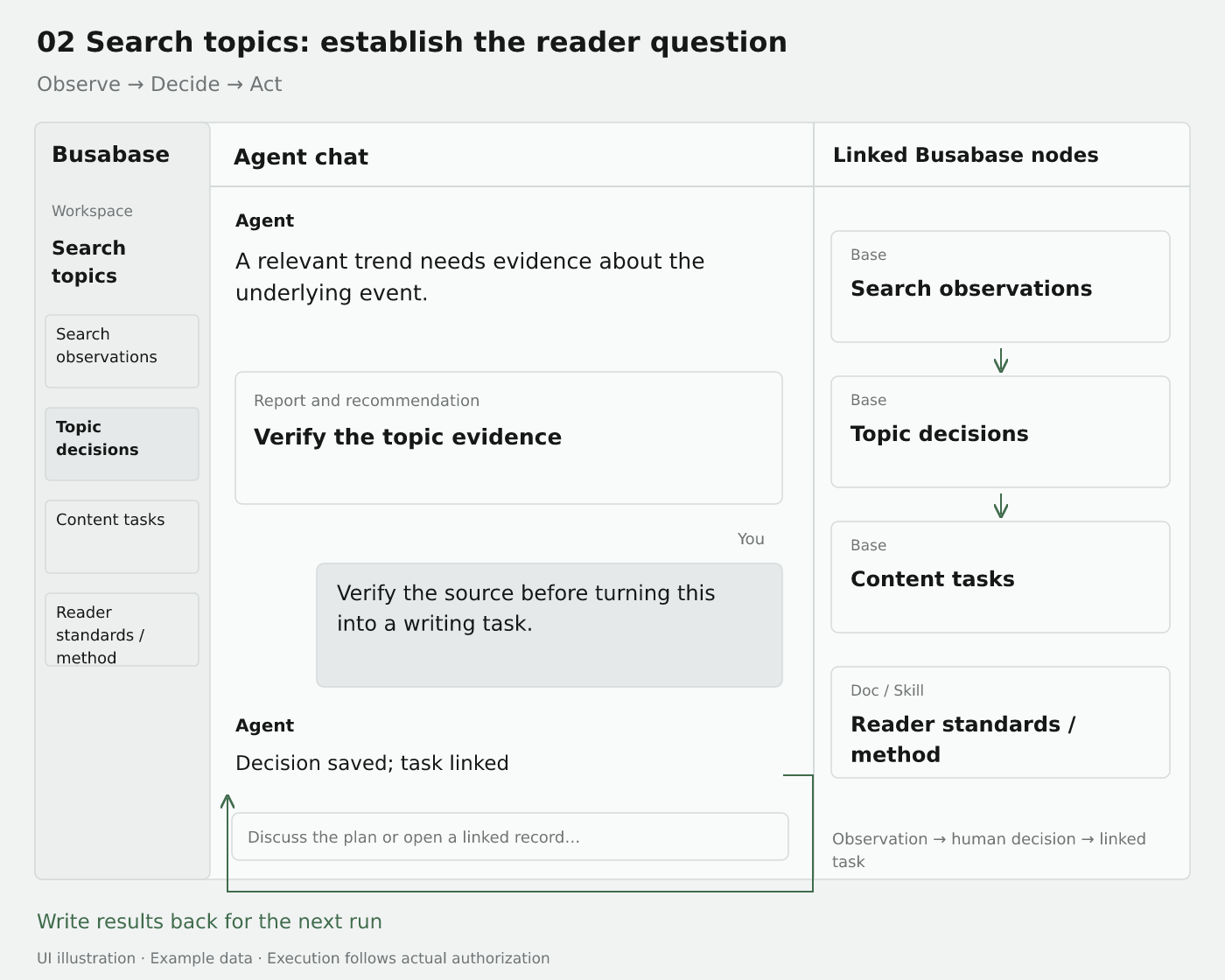
“AI bubble” provides an example. The team's search report recorded short-term interest in the United States, together with related searches about China and the meaning of a bubble bursting.
Putting the term in a headline and following it with a product introduction would miss an important step. A searcher may be trying to understand valuations, returns on investment, or a particular news story. Tool instructions would not necessarily answer that need.
The research record initially kept the term on watch: there was a demand signal, but the underlying event and a distinct reader question had not been verified. It did not automatically become a writing assignment. An editor still needs to distinguish demand for an explanation of a news story, investment-risk analysis, and practical experience of using AI at work. Each needs different evidence. Internal practices can document operational experience; industry valuations require market and financial evidence.
The team links search observations, keywords, target questions, existing pages, and execution tasks in Busabase. A selected task can be traced to its report, its content gap, and its acceptance conditions. Unselected terms retain their reasons as well.
The immediate outcome to inspect is whether a trend became a useful question and whether the assignment produced a relevant artifact. Traffic and commercial results require follow-up after publication.
Open the illustration at full size
Build it in Busabase
Create a “Search topics” Folder, a Doc defining reader questions and content boundaries, and a research/execution Skill:
| Node type | Suggested name | Essential fields and purpose |
|---|---|---|
| Base | Search observations | Query, region, observation window, source, existing page; retains the original lead. |
| Base | Topic reports and decisions | Related observations, reader question, evidence, recommendation, human guidance, decision; separates watch, investigate, and write. |
| Base | Content tasks | Source decision, brief, acceptance conditions, state, output link; delivers the chosen topic. |
| Base | Existing CMS posts | Related task and article; reuse existing coverage instead of duplicating the same intent. |
Chat instruction:
Review this week's search observations and existing articles. Identify the reader's question and keep unsupported ideas on watch. Propose one article worth writing. After I confirm the angle, create its linked task and write back the final article and later search observations.
A topic decision might read, “Underlying event needs verification; do not draft yet.” Its next task is investigation. Once writing is selected, trace observation → decision → task → article. The next report finds the same task by a stable topic key, checks delivery, and examines the article's later performance in a stated window.
03 Identifying the social post before judging its performance
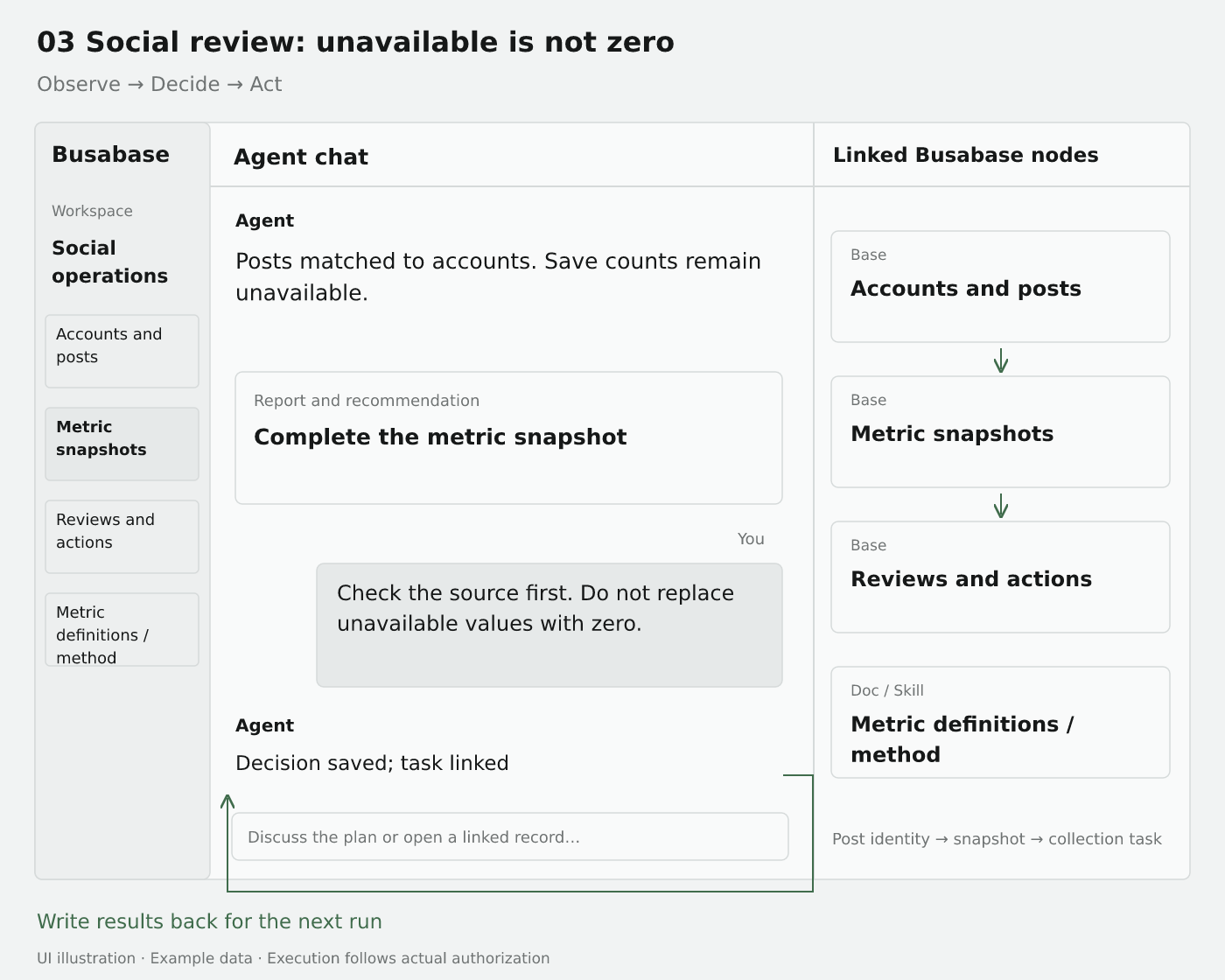
A screenshot of a promising view count is rarely enough for a review. Which account and post does it belong to? When was it published, and when were the metrics collected? Zero saves and unavailable save data call for different next steps.
The team stores accounts, posts, metrics, and source status separately in Busabase. Actual post records include platform identity, public URL, publication time, and available measures such as views, likes, comments, or saves, along with their collection source and update time.
An agent can organize observations around a specific post, and an operator can return to that record to inspect them. When one topic appears on several platforms, its performance remains separate by platform instead of becoming a misleading combined total.
Coverage is incomplete in places. A missing public URL remains a field to complete. An unreadable metric remains unavailable rather than becoming zero. Operators decide whether to collect more evidence, change the presentation, or keep watching.
The completed step is connecting identifiable posts to visible performance. Additional distribution, changes to the content, and paid promotion require judgment and the appropriate authorization.
Open the illustration at full size
Build it in Busabase
Use a “Social operations” Folder with a metric-definitions Doc and a collection/review Skill:
| Node type | Suggested name | Essential fields and purpose |
|---|---|---|
| Base | Accounts | Platform, account ID, owner, source; identifies the account being measured. |
| Base | Posts | Platform post ID, related account, public URL, topic, publication time; identifies a unique post. |
| Base | Metric snapshots | Related post, collection time, values, availability status, source; preserves each collection rather than overwriting history. |
| Base | Reviews and actions | Related snapshots, analysis, human decision, action, owner, state, result; turns findings into data-collection or content tasks. |
Chat instruction:
Review these posts after checking their accounts, public URLs, and collection times. Separate unavailable metrics from zeros and compare within each platform. Recommend a next step; after I confirm, create a collection or content task linked to its source snapshot.
For example, “Save count unavailable” creates a collection check, not a conclusion that nobody saved the post. Match posts by platform plus post ID and distinguish snapshots by collection time. Link a content revision or new publication back to the relevant post. The next review uses comparable windows and definitions.
04 Correcting a business relationship before the next handoff
The same name can appear in several business records. One person may be a prospective customer; another may be a partner. Merging records on a name match can send subsequent work in the wrong direction.
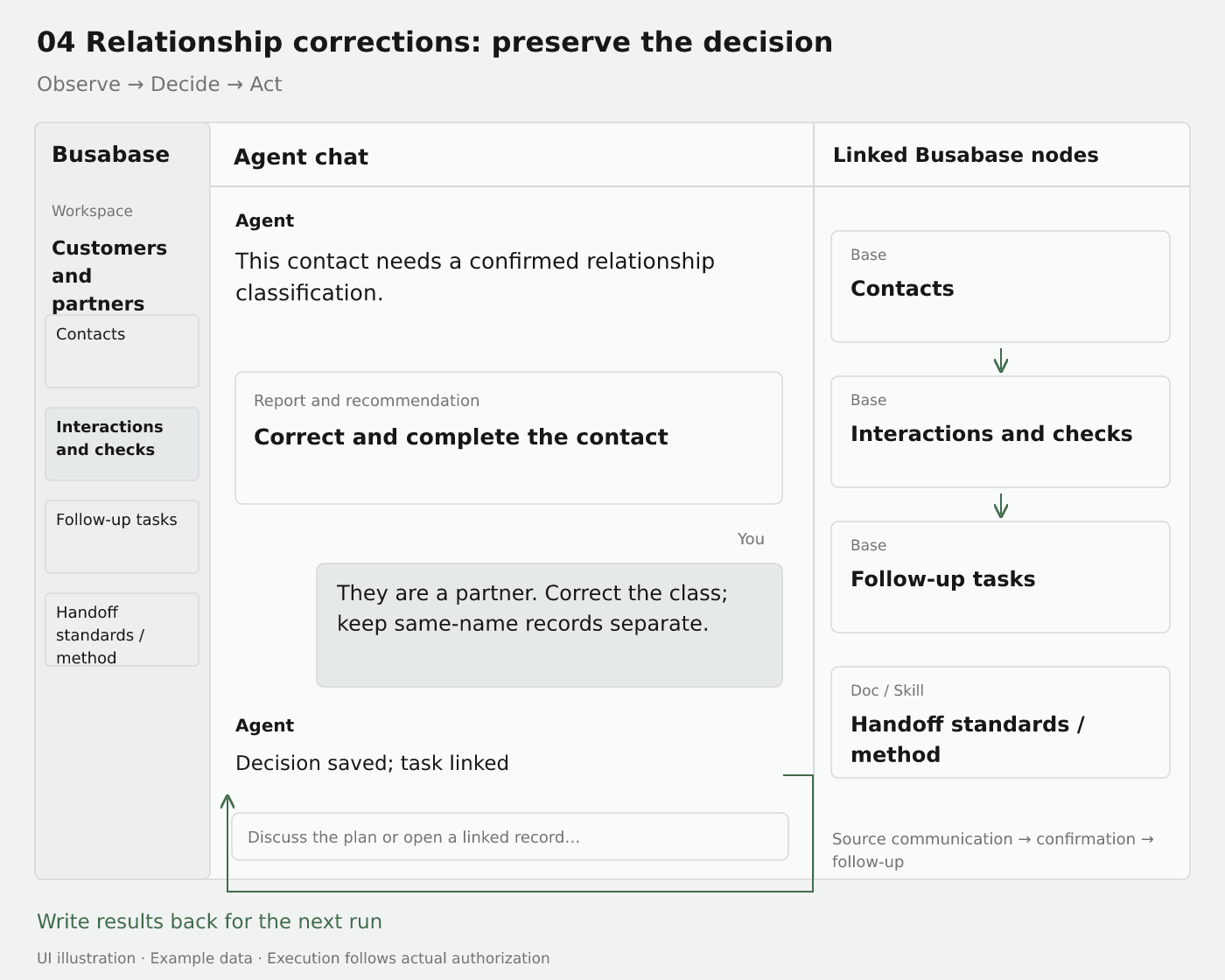
In an actual internal correction, a responsible person clarified that a contact was a partner. The team corrected the classification, preserved the basis for the decision, and listed missing details such as the organization and division of responsibilities. The correction was not presented as a new meeting, and it did not trigger a merge with a same-name customer record.
An agent can extract notes from authorized communication, identify incomplete fields, and prepare a proposed change. Someone with the necessary evidence confirms identity, commercial terms, commitments, and dates.
The result is a record another colleague can pick up: what the relationship is, what has been confirmed, and what remains unknown. It reduces the need to reconstruct context from chat.
A company does not need a fully automated sales system to start here. Separating confirmed facts from open questions already creates better conditions for a handoff.
Open the illustration at full size
Build it in Busabase
In a “Customers and partners” Folder, reuse contact data and add a relationship/handoff standards Doc and a record-maintenance Skill:
| Node type | Suggested name | Essential fields and purpose |
|---|---|---|
| Base | Contacts | Name, organization, stable contact details, relationship class, confirmation state; holds current facts without merging on name alone. |
| Base | Interactions | Related contact, occurrence time, source, confirmed facts, open questions; preserves the communication evidence. |
| Base | Relationship checks | Related contact/interaction, proposed correction, evidence, human decision; explains the change. |
| Base | Follow-up tasks | Source check, missing information, owner, due date, result; supports the next handoff. |
Chat instruction:
Check this contact against the communication. Separate confirmed facts, inferences, and unknowns, and show me the proposed changes. This person is a partner: correct only that classification and create tasks for the missing organization and responsibilities. Do not merge other same-name records.
The result is an updated contact, a check record preserving the human decision, and explicit follow-up tasks. Without reliable identity evidence, keep the classification unconfirmed. Later communication updates those tasks; a data correction does not become an invented meeting or sales opportunity.
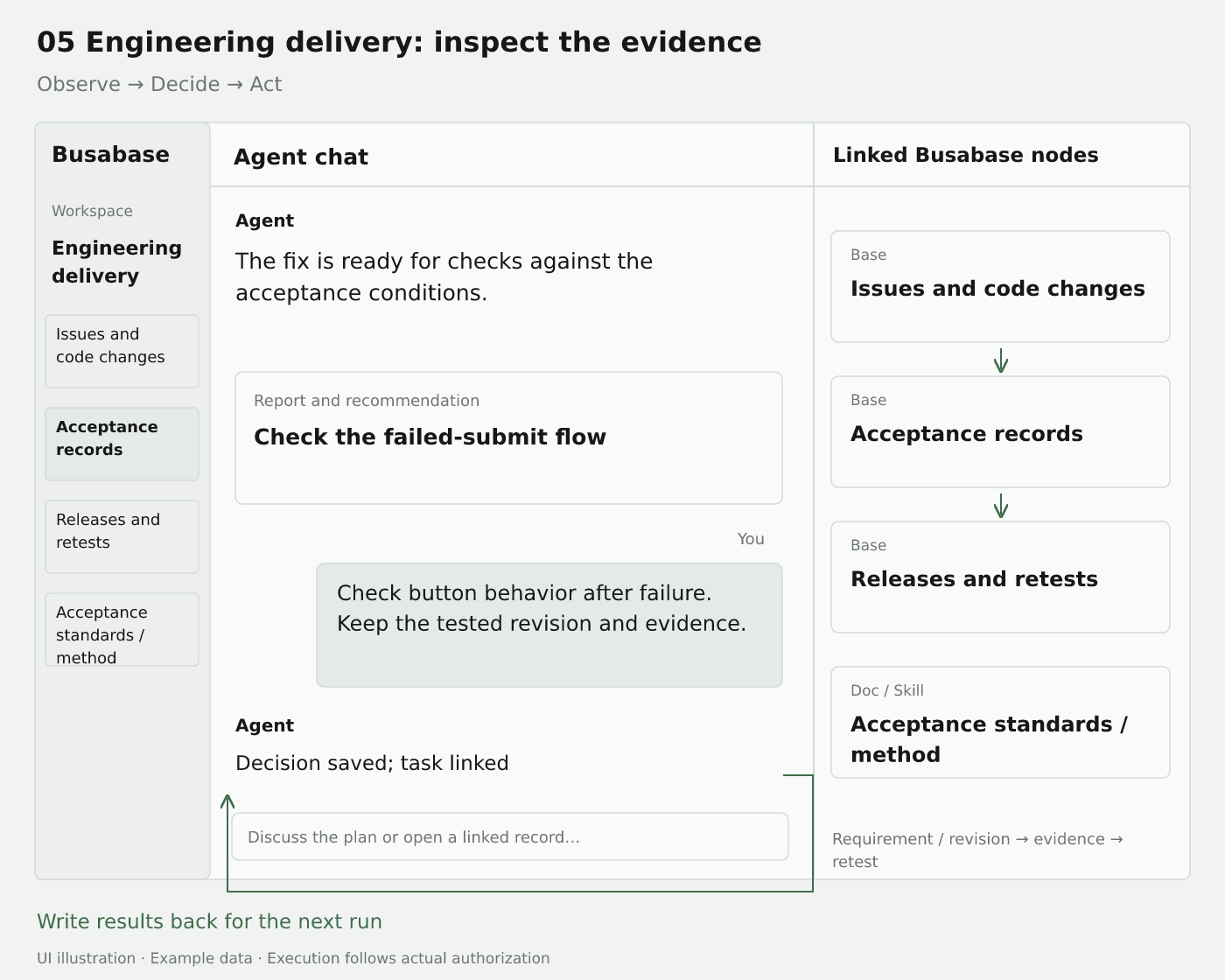
05 Keeping acceptance evidence beside the engineering decision
AI can produce code quickly. Delivery still raises questions: does the change meet the requirement, does the important interface work, and which scenarios were checked? A completion message gives a reviewer too little to judge.
The team organizes code changes, issues, and acceptance records in Busabase. Actual acceptance records include a pass decision and attached evidence images associated with the work. A reviewer can return to the relevant change and inspect what supported the decision.
Agents can prepare checklists, run authorized checks, and collect failures and results. The reviewer decides whether that evidence covers the requirement or whether more testing is needed. Passing a check establishes only that check's scope. Release and deployment retain their own authorization requirements.
This practice gives acceptance evidence a stable home. If a problem returns, the team can inspect the earlier evidence, identify an omitted check, and improve the next review.
Open the illustration at full size
Build it in Busabase
Create an “Engineering delivery” Folder. Put expected behavior and test scope in an acceptance/release standards Doc, and the reproduction/check/writeback method in a Skill:
| Node type | Suggested name | Essential fields and purpose |
|---|---|---|
| Base | Issues and delivery tasks | Requirement, reproduction, expected/actual behavior, owner, state, acceptance conditions; defines the problem. |
| Base | Code changes | Related task, repository URL, revision, merge state; points to code maintained in its repository. |
| Base | Acceptance records | Related task/revision, scenario, environment, method, result, evidence, human comments; records what was actually checked. |
| Base | Releases and retests | Related change, deployed version, deployment time, production retest, remaining issues; records delivery progress. |
Chat instruction:
Reproduce and fix this issue in the permitted environment using its acceptance conditions. Save the scenarios, results, and evidence in the linked acceptance record. Explain coverage and gaps here. Proceed within the confirmed release scope and record the deployed version and production retest.
An example task is, “After submission fails, restore the button and explain the error.” Acceptance must identify the tested revision and behavior. Failed checks return to the original task. Save the production retest separately after deployment; a future recurrence can expose an omitted environment or step. A “pass” field does not grant release permissions.
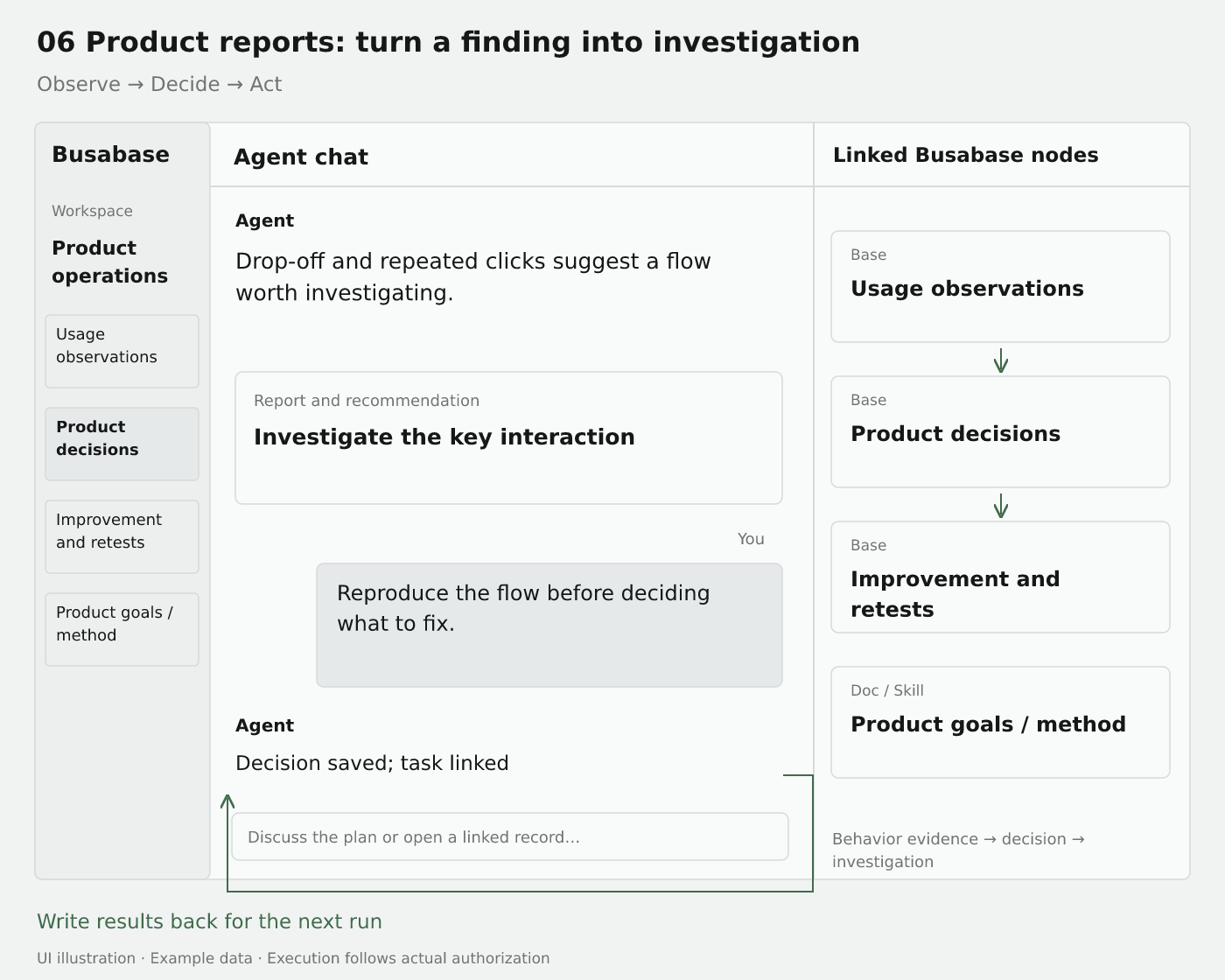
06 Following new registrations through to actual product use
A report that ends at new registrations can miss the more useful questions. Did those people complete a meaningful first action? Where did they get stuck? Should the next change address acquisition or onboarding?
The team's product reports examine registrations alongside usage behavior and preserve the measurement window, source, and follow-up interpretation. An actual report identified a gap between acquisition and subsequent use instead of treating new registrations as a complete growth result.
Comparisons need care as well. When a previous published snapshot does not match the current comparison window, the report explains which values provide directional context rather than a strict period-over-period comparison.
The agent prepares inspectable data and analysis. Business owners set goals, priorities, and resource allocations. A later report can check whether an action happened and whether the problem changed.
The output is a report that supports another round of questions. It gives the owner a more specific basis for discussing the next action.
Open the illustration at full size
Build it in Busabase
Use a “Product operations” Folder with metric definitions, product goals, and a Skill for analysis, reporting, task creation, and follow-up:
| Node type | Suggested name | Essential fields and purpose |
|---|---|---|
| Base | Usage observations | Window, source, event/funnel step, device, metric, evidence URL; captures behavior after registration. |
| Base | Product reports and decisions | Related observations, goal, analysis, human guidance, priority, action brief; saves the direction agreed in chat. |
| Base | Experience-improvement tasks | Source report, user problem, investigation/fix, acceptance conditions, state, outcome; drives the next step. |
| Base | Existing releases and retests | Related task, deployed version, retest, follow-up window; reuse the engineering table when available. |
Use GA4 funnel exploration for progression through a sequence and Clarity behavioral metrics for clues such as repeated clicks. Verify the suspected problem in the actual interaction.
Chat instruction:
Review registrations and meaningful product actions, using connected GA4 summaries, Clarity evidence, and user feedback where available. Explain definitions and data gaps; recommend one onboarding improvement. After confirmation, create an investigation or repair task. Next week, check deployment and the original problem before comparing behavior.
Drop-off and repeated clicks are investigation leads. A person can choose investigation first; a coding agent reproduces the issue before concluding a fix is needed. Do not force a user/session match between analytics platforms. Link the report to observations and tasks, and include the deployed version in follow-up windows. Separate unfinished work, deployed-but-unverified changes, and evidence of improvement.
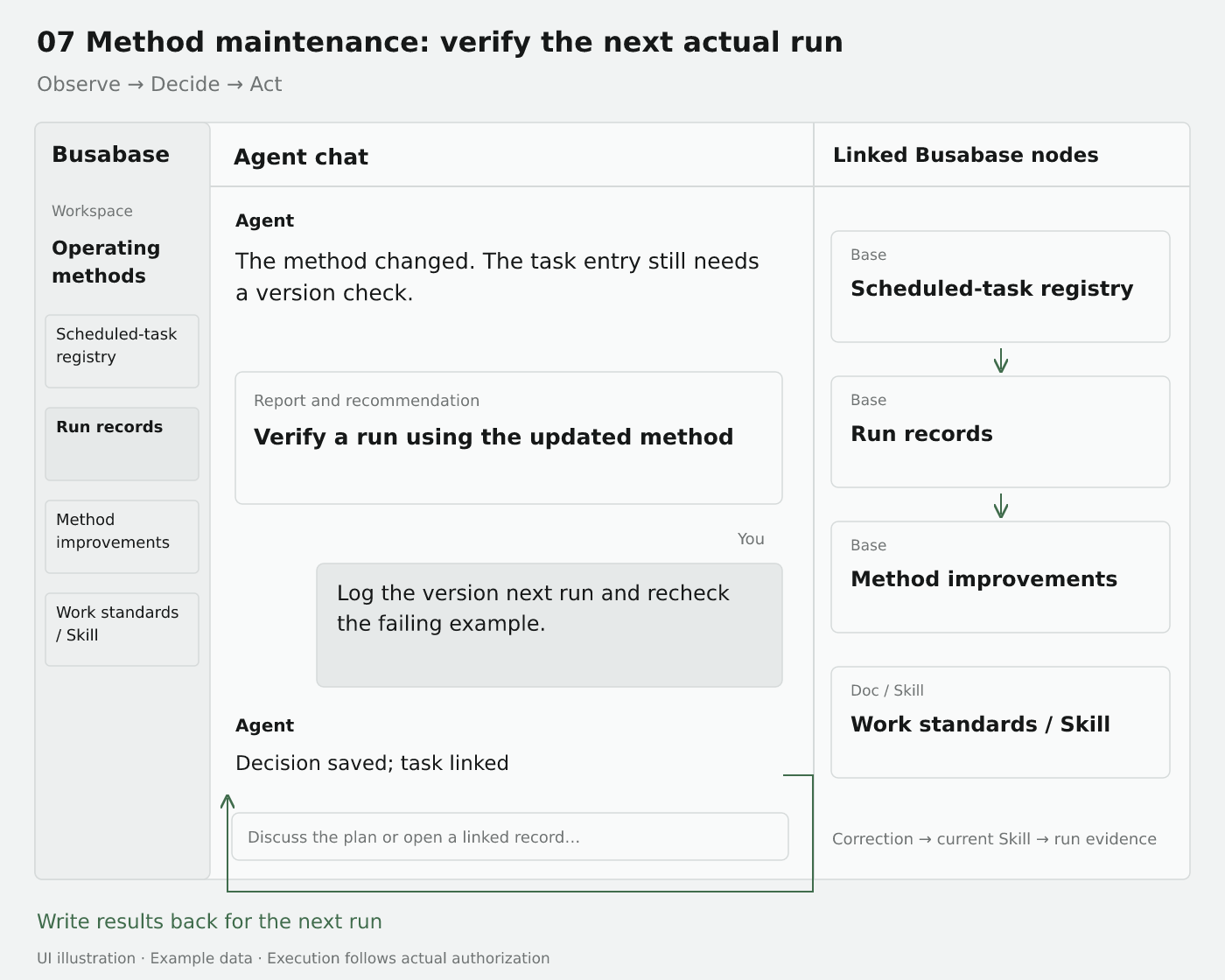
07 Updating a Skill, then checking the next actual run
A rule understood in one agent conversation does not automatically carry into the next. Repeated explanations consume effort, and an unread update allows the same mistake to return.
The team maintains some operating methods as Skills in Busabase. Automated tasks load the current method at execution time and preserve loading information in their run records. If a result is wrong, the team can check which version governed the work.
In practice, the team has encountered updated methods alongside task entries that still contained old instructions. Resolving that required more than editing a document. A subsequent run had to show that it loaded the new version and followed it.
The method, version, execution entry, and run result become inspectable parts of maintenance. Working steps can be reused, and failed steps can be corrected. Each Skill still needs a defined permission scope and review conditions; reuse does not expand an agent's authorization.
A company can begin with one recurring task: document its inputs, steps, exceptions, and acceptance conditions, let another agent take it over, and inspect the result.
Open the illustration at full size
Build it in Busabase
In an “Operating methods” Folder, keep the reusable method separate from actual executions:
| Node type | Suggested name | Essential fields and purpose |
|---|---|---|
| Skill | The operating method | Inputs, steps, exceptions, authorization scope, acceptance, writeback; holds repeatable instructions. |
| Base | Scheduled-task registry | Task name, external scheduler reference, related Skill, loading entry, enabled state; records which task should load which method. |
| Base | Run records | Related task, read time, Skill revision or content hash, input window, result, evidence; identifies the method actually used. |
| Base | Method improvements | Source failure, cause, proposed correction, human decision, Skill change, verification run; tracks whether a correction took effect. |
Chat instruction:
Turn this correction into a proposed method update and preserve the failing example. Apply the guidance I confirm to the Skill and relevant task entry. On the next run, read the current Skill, record its revision or content hash, and check the example again. Do not stop at saying you remembered it.
“Skill updated” is an intermediate result. The improvement record should lead to the change, a subsequent run that loaded it, and evidence of the resulting work. If the entry still embeds old instructions, correct it and verify again. Start with one recurring task before extending the method to others.
Test AI's value in the work itself
These practices leave open questions. Did published content attract useful visitors? Did organized data reduce review effort? Did engineering evidence shorten acceptance? Those outcomes still need measurement.
They have moved specific work forward: articles reached publication; trends received an explicit content decision; posts can be matched to metrics; business relationships can be checked; acceptance evidence can be revisited; reports examine use; and methods can be maintained across runs.
That offers a practical starting point for a business. Choose one recurring task with reasonably clear inputs and an accountable reviewer. Define the output, complete a cycle, and ask another colleague to take over. Track execution and review time, rework, adoption, and the relevant business outcome before expanding the investment.
Busabase provides a shared workspace for data tables, documents, Skills, and AirApps. Agents connect through Skills, MCP, CLI, or API. Writes retain a change history, and important changes can wait for review. Colleagues and subsequent agents continue from the resulting records.
Run one useful cycle first
Choose one scenario, save one input using its starter layout, and ask an agent for one recommendation. Add a real judgment in chat and follow a task through to its result. Check that the records lead back to the original evidence, the human decision, the actual output, and what the next run should read.
For a fuller recurring workflow, continue with How to Build a Self-Improving Agent with Busabase, which applies the same loop to SEO, email, and product operations. Verify delivery and handoff for one cycle before expanding the investment.