Claude Meetings action items need a record people can review
Keep the source, proposed change and business decision together so later agents can tell what is current.
The team discusses last week’s action again, but cannot tell whether it is unfinished work or a new requirement. The owner may have changed, and the accepted result is buried in another thread. More meeting notes have not made progress easier to track.
Claude Meetings can produce action items during a call. Ongoing collaboration also needs a stable identity, source evidence and a current state for each commitment. Maintained business records let the next discussion build on existing work instead of generating another disconnected list.
A live artifact still needs a durable decision
Claude Meetings can produce documents, whiteboards and action items during a call. Anthropic’s November 12 announcement describes the beta rolling out on Team and Enterprise with Google Meet support. These outputs shorten the distance between discussion and a first draft. They also create a handoff question: which parts should become the team’s current business records?
An item in a meeting summary may capture a suggestion, an accepted commitment or a question that nobody resolved. A later agent needs those distinctions, not just a polished summary. Preserve the meeting reference and decision state when converting the item into a record.
Structural illustration · designed workflow
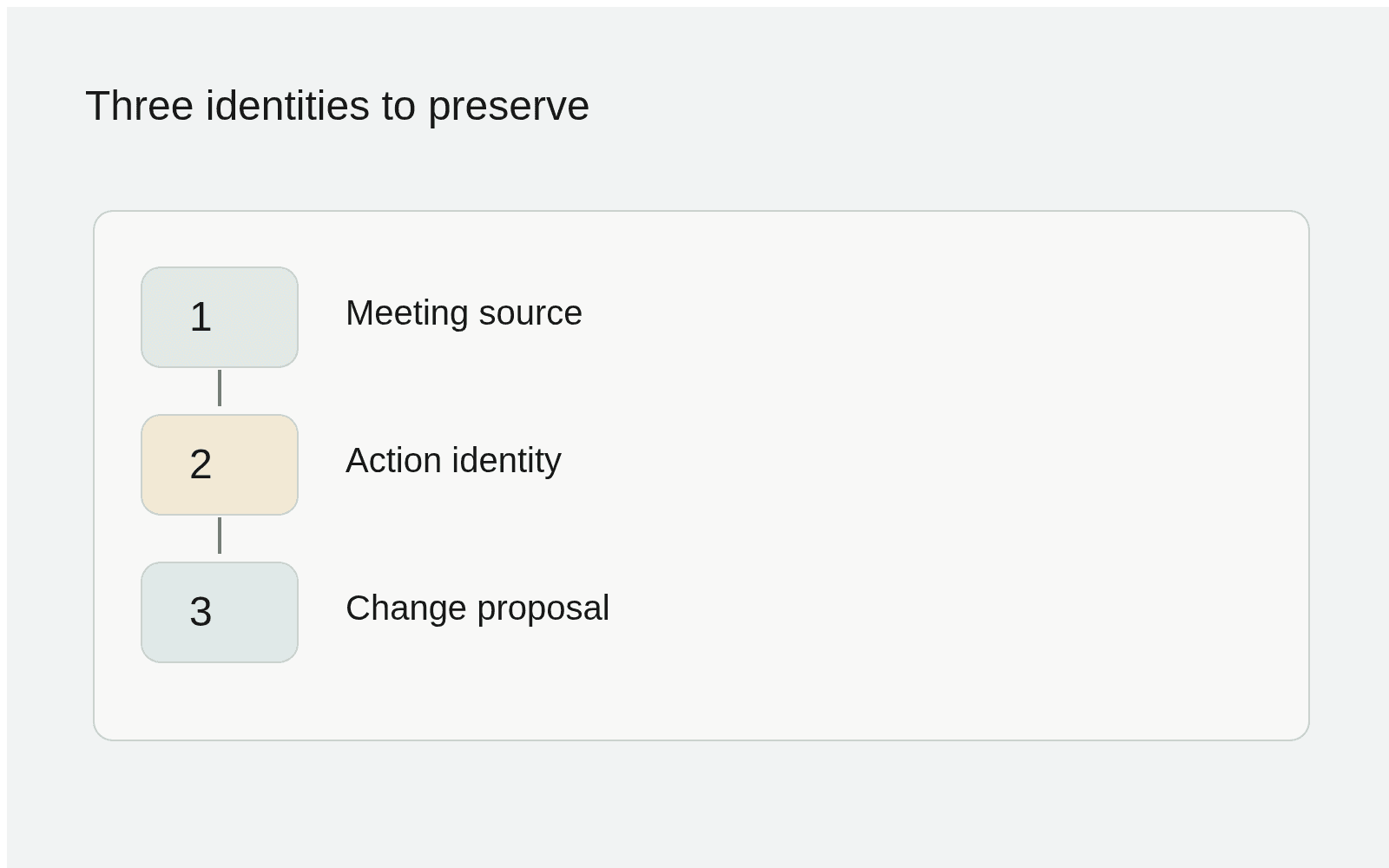
Give the meeting source and the task separate identities
A practical starter design uses a Folder containing a meeting-source Base and an action Base. A Doc holds the rules for deciding what counts as confirmed. A Skill can hold the repeatable extraction and checking procedure. These are suggested resources to build, rather than a ready-made integration.
| Resource | Essential content | Why keep it |
| --- | --- | --- |
| Meeting-source Base | Stable meeting key, source URL or permitted attachment, source time, context | Revisit the original evidence |
| Action Base | Stable action key, source relation, action description, owner, business state, acceptance condition, output URL | Track one commitment across revisions |
| Decision Doc | Who confirms ownership, which changes require review, permitted data scope | Keep reusable human guidance |
| Skill | Read source, propose changes, recover existing work, verify current values | Make the method repeatable |
Use text for stable keys, a relation for the source connection, a select for business state, and a URL for the deliverable. Keep unknown owners and dates empty. A meeting key identifies the source; an action key identifies a commitment within it. They serve different jobs.
Propose the difference, including what remains uncertain
Give your connected agent selected meeting material that you are allowed to share. Use the bring-your-own-agent guidance to configure access first. Ask it to find existing actions before proposing new ones, compare the transcript passage with the current record and show the fields it wants to change. A recurring meeting does not justify creating the same unfinished action again.
Read the supplied meeting material and the current actions for that meeting. Separate confirmed commitments, proposals and open questions. For each proposed record change, include the source passage, existing action identity, changed fields and unresolved information. Do not invent an owner or due date. Submit these changes for human review; do not execute external actions.
In the review, check whether someone accepted the task, whether scope changed and whether the evidence supports the proposed business state. Ask for clarification where the discussion is ambiguous. Store the clarification with the action so the next run does not have to reconstruct it from a separate chat.
Structural illustration · designed workflow
Choose a real review gate
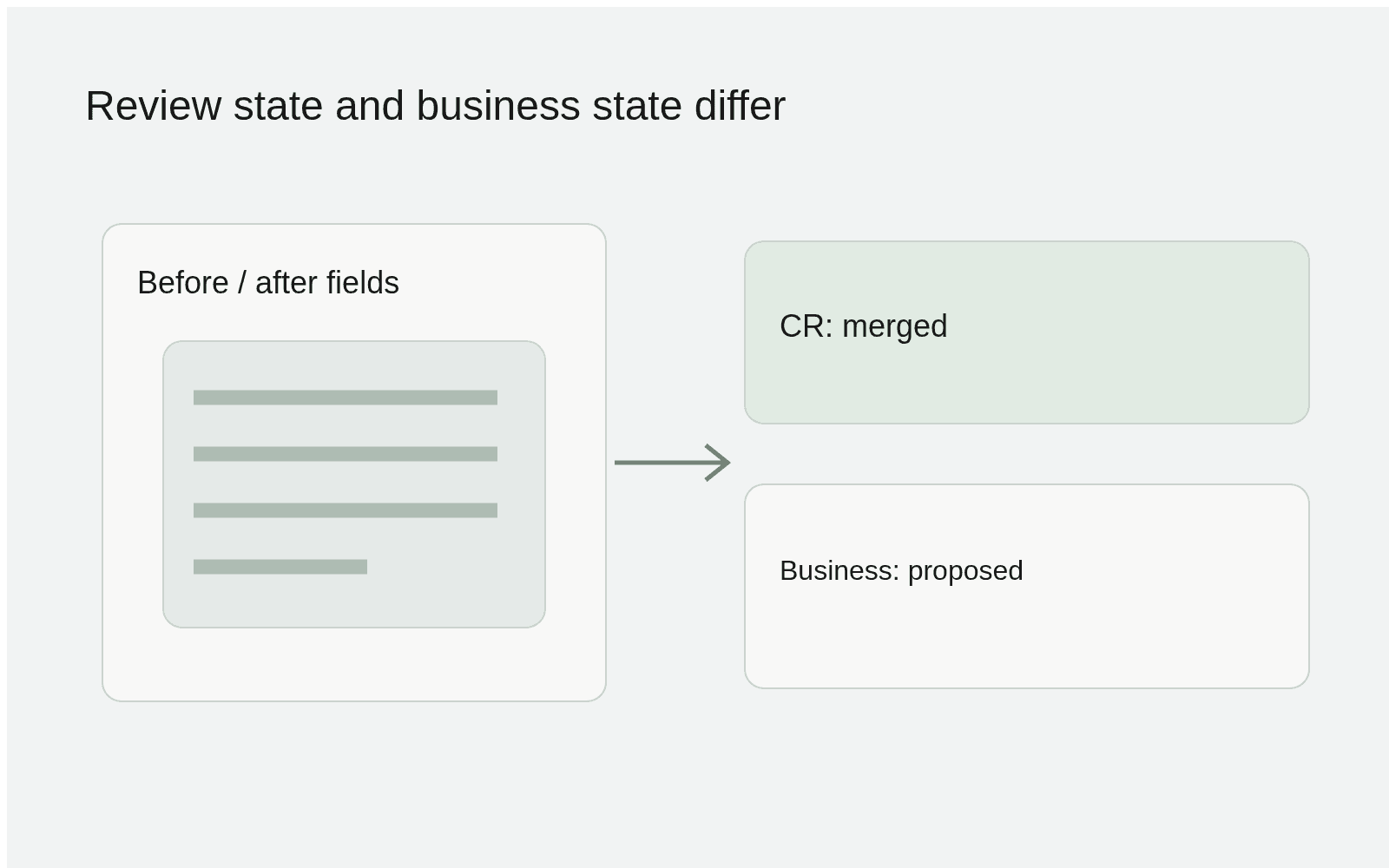
A ChangeRequest preserves proposed changes and their review history. It does not always pause for a person: a writer with write access can merge immediately. If this workflow requires human review, explicitly request it with requireReview: true where supported, or autoMerge: false on the relevant API request. Verify that the returned proposal is actually awaiting review.
The review decision concerns the record change. Merging a record whose business state is “proposed” does not mean the business commitment was accepted, and merging a task does not send a message or carry out the task. Keep CR state and business state separate. A reviewer can accept the accuracy of a record while leaving the underlying action waiting for a decision.
Read the current record before the next step
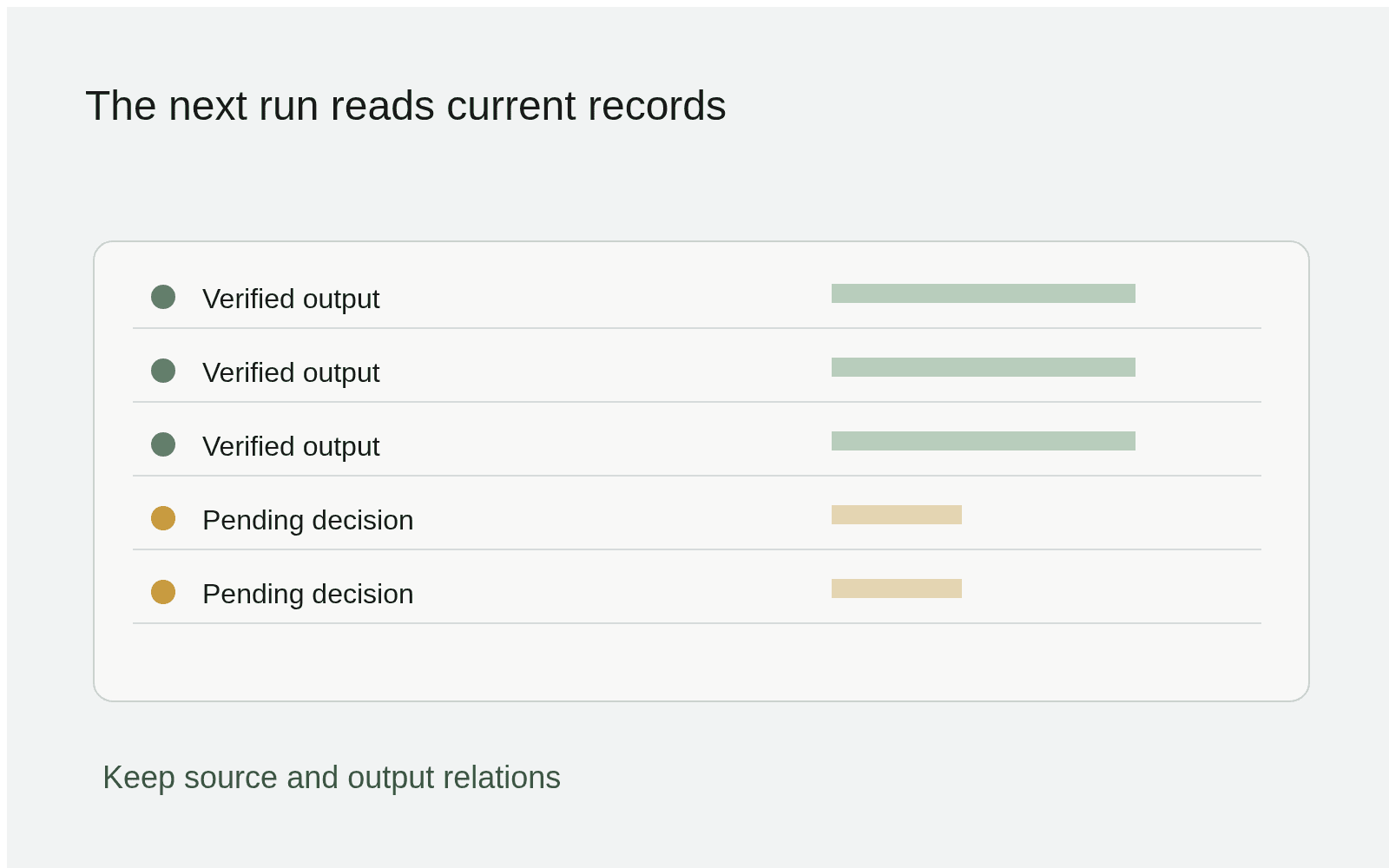
Records represent the current merged values. After the permitted merge, read the record back, confirm the changed fields and retain its connection to the meeting source. If another participant has updated the action, compare the new current state before submitting another proposal. Do not overwrite a newer owner or scope based on an older transcript.
Only then should an execution agent read the confirmed action and perform separately authorized work. Save the actual output link, acceptance result and remaining blocker back to the action through the same record workflow. A document being created is evidence of an output; acceptance requires comparing that output to the agreed condition.
Structural illustration · designed workflow
Make the next meeting read the last outcome
At the next meeting, read the existing action, source and output instead of extracting a fresh task from the same words. Update the commitment if its scope changes. If one action genuinely splits into separate work, preserve the relation so the history remains understandable.
This closes a useful operating loop: meeting evidence leads to a reviewable proposal, the accepted record guides work, and the result informs the next discussion. Busabase provides the records and change history; the meeting import and external execution still need an authorized agent or integration. Start by bringing one permitted meeting output into a reviewable Base and checking the full cycle before scheduling it.