Customer Health template: spot renewal risks and turn signals into action
Connect weakening usage, support and billing signals to an accountable retention plan.
The renewal date is still months away, but the customer has already stopped inviting colleagues. Support sees urgent tickets. Billing sees an overdue invoice. The customer success manager hears that the internal champion is leaving. Each team knows a piece of the story; nobody has a shared explanation of what to do next.
Customer Health brings those observations into linked records, a consistent score and an owned retention plan. Its value is a common basis for decisions: which account needs attention, what supports that judgment and who will act. A score is a prioritization aid, not a churn forecast.
Start with the signals, not the color
The template scores five components: active seats as a share of licensed seats, the change in active seats between two 30-day periods, open urgent support tickets, the latest account NPS response and days overdue on the oldest unpaid invoice. Each contributes up to 20 points.
The same rule applies every week. For seat utilization, at least 70% earns 20 points, at least 50% earns 12, at least 30% earns six, and lower utilization earns zero. The total is healthy at 70 or above, watch at 50–69 and at risk below 50. These are the template's operating thresholds; they have not been established as a predictive model for your customers.
Missing data receives ten points for that component. That keeps an unknown reading from counting as either success or failure, but it can make a total look more settled than its evidence. Review data freshness and missing sources alongside the score. Never copy yesterday's value forward and describe it as a fresh observation.
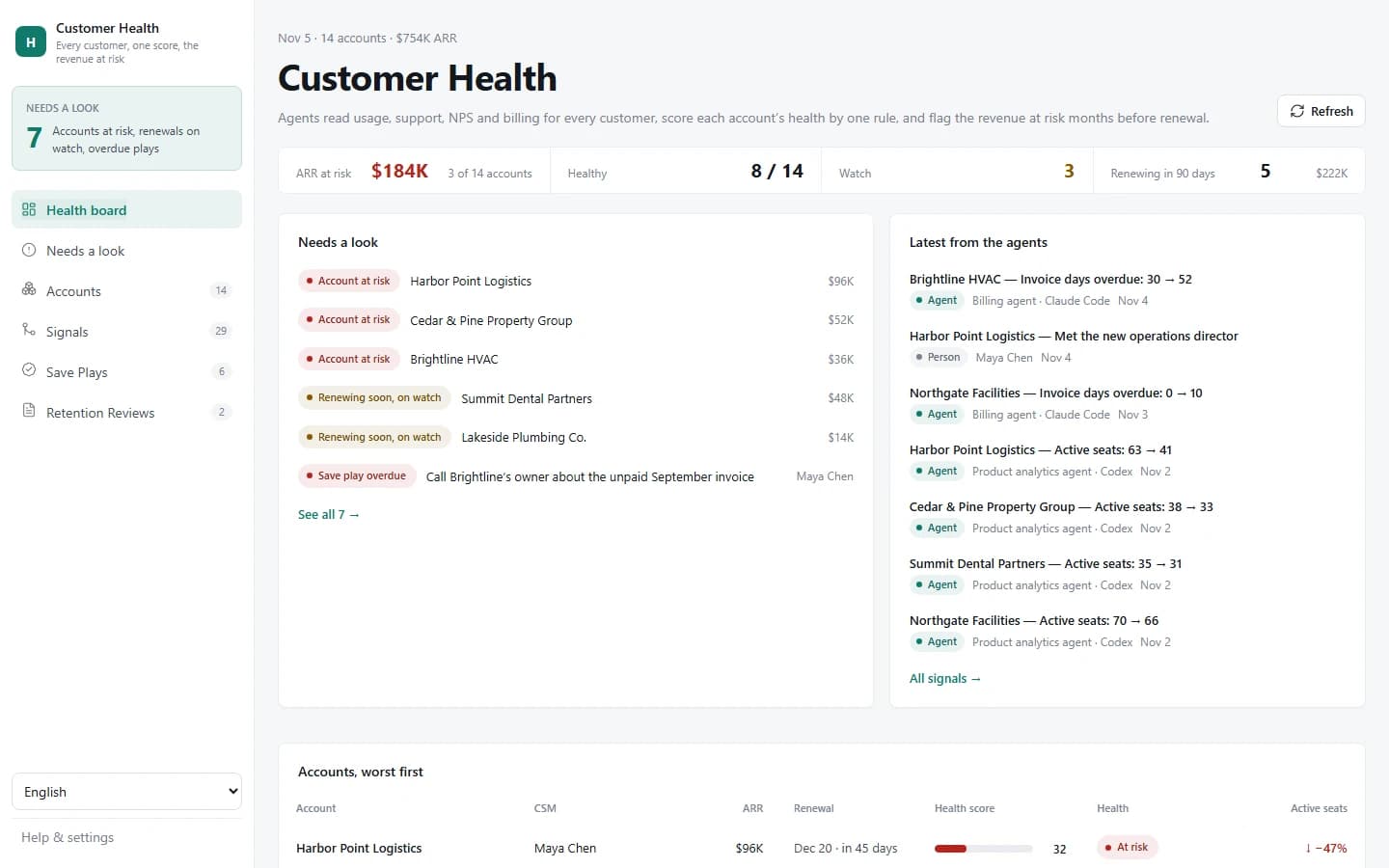
Official template screenshot · sample data · Original English interface; not live customer results. View template
Give every source a narrow writing job
Install from the template page after signing in and selecting the intended workspace. The template organizes four Bases: Accounts holds the customer and current signal fields; Signals records changes with their source; Plays holds an accountable response; Reviews keeps the weekly judgment. Installing it does not connect your analytics, help desk, survey or billing system.
Authorize those sources separately. A usage agent updates usage fields; a support agent updates urgent-ticket information. Each change should retain the previous value, new value, observation date, writer and evidence. People retain control of ARR, plan, renewal date and account ownership. This division is an operating rule; configure access accordingly rather than assuming each field is automatically protected.
An adaptable instruction is: “Read the authorized usage export for these existing accounts. Propose changes only to its usage fields, with the old and new readings and source period. Leave inaccessible sources unchanged and identify them. Recalculate using the agreed rule; do not change commercial terms or contact customers.”
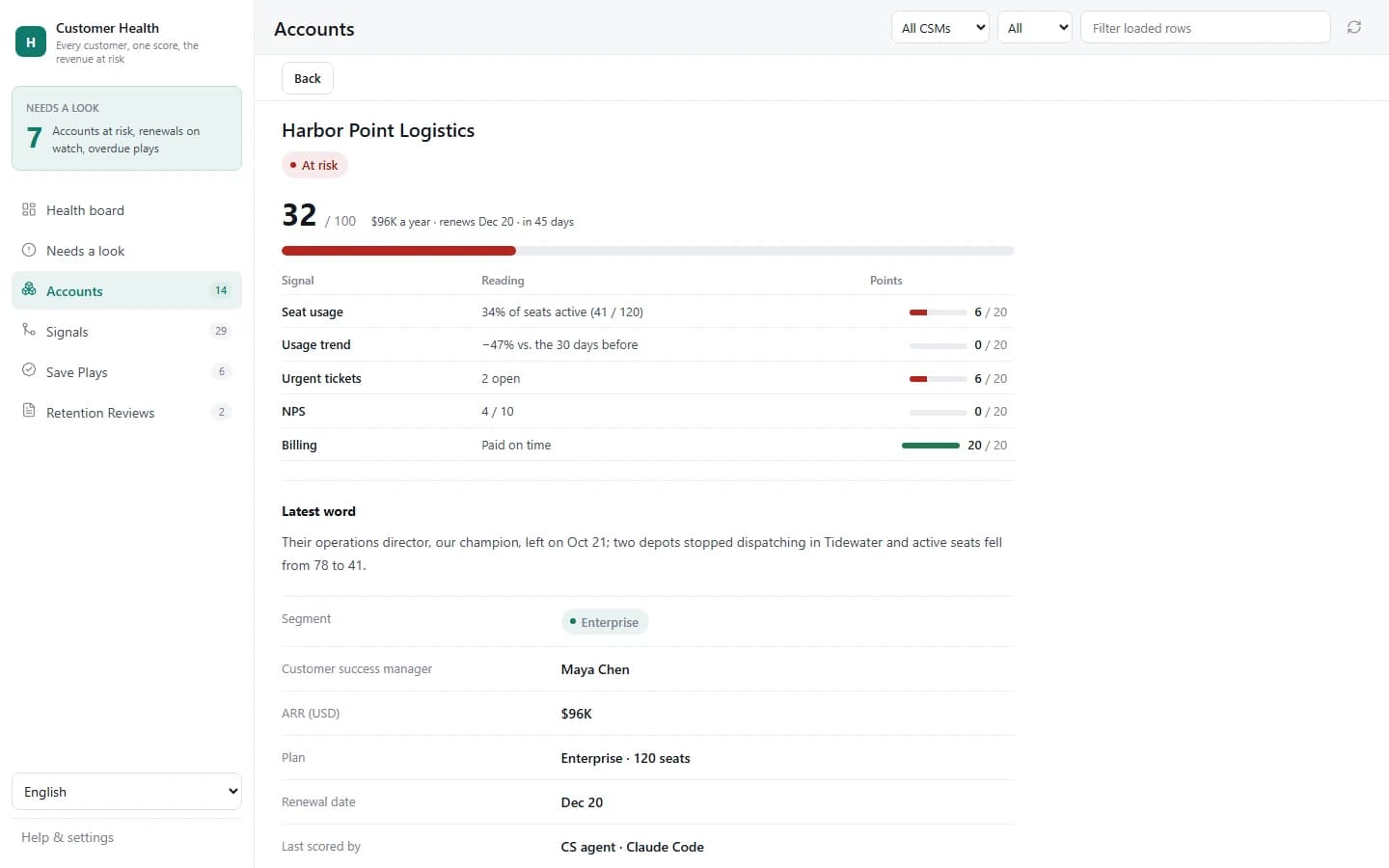
Official template screenshot · sample data · Original English interface; not live customer results. View template
Read the account beyond its arithmetic
A relationship signal, such as a departing champion, does not directly change the score. It belongs in the account review because it may explain a risk before numerical signals move. Preserve who reported it and when, then ask the customer success owner what needs confirmation.
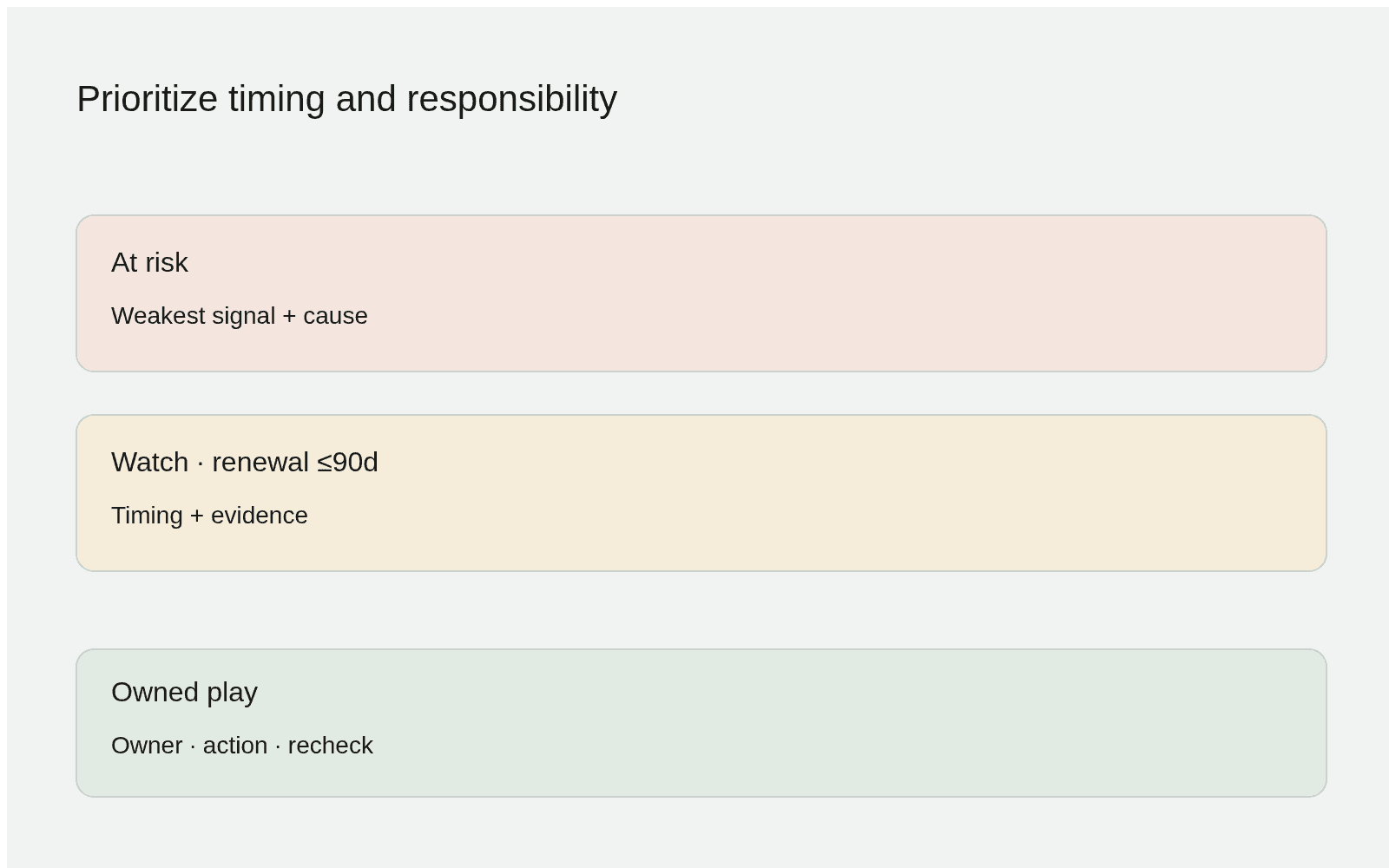
ARR at risk is the sum of ARR for accounts classified at risk. It is exposure under this classification, not expected revenue loss. Accounts on watch that renew within 90 days also deserve attention. Prioritize the combination of timing, weak components and available evidence rather than simply sorting all customers by score.
Turn a warning into a plan with an owner
For an at-risk account without an open play, propose a cause grounded in its signals, a specific next action, the customer success owner and a due date before renewal. The owner decides the appropriate customer conversation. The template does not send messages, offer discounts or negotiate terms.
Keep cause and hypothesis separate. A usage decline alongside urgent tickets justifies investigation; it does not prove the tickets caused the decline. A useful play states what the owner will check and when the team will reassess. Completion should point to what actually happened, not merely a changed status.
Make the weekly review reusable
The read-only AirApp helps inspect the account picture. Agents write through ChangeRequests; permission determines whether a proposal merges or waits. Require review explicitly or use proposal-only access where human acceptance is necessary. Reread the current records after merge.
Build the weekly review from those records: exposure and its change, the accounts requiring attention, evidence behind each judgment, open plays and watch accounts renewing soon. Save it as a draft for a person to finalize. Next week, compare against that accepted review instead of reconstructing last week's decisions from chat.
Begin with a small authorized customer cohort and one review cycle. Check that every warning can be traced to a source and every response to an owner. The template source documents the current rules. For contractual notice obligations, keep the distinct contract deadline workflow alongside the health review.