Fable 5.2 Memory: What to Keep After an Advisor Consult
Keep verifiable outcomes, evidence links, and validity boundaries for later tasks—without treating hidden advice as accepted team fact.
When a team runs long tasks in Claude Code with Claude Fable 5.2 acting as an advisor, the hardest decision happens right after the work finishes. The executor model got unstuck, shipped a change, and moved on. Next week, another task—or a teammate in another repository—runs into a closely related constraint.
If you keep nothing outside the chat, the next session may repeat the same investigation. If you dump every conversation transcript into a shared folder, future agents inherit unverified guesses alongside settled facts. And with Fable 5.2, there is a specific technical boundary: its advisor responses come back encrypted to the client.
To make Fable 5.2 memory genuinely useful across tasks, you need to separate what the native advisor feature already handles inside a session from the verifiable executor outcomes worth keeping for the team.
What the native Advisor pattern already handles for you
Before creating external records, understand how Anthropic's Advisor tool and Claude Code Advisor mode work inside an active run. An everyday executor model—such as Sonnet 4.6 on the API or your main session model in Claude Code—writes code, edits files, and runs tools. At hard decision points, the executor chooses when to consult a stronger advisor model like Claude Fable 5.2.
Three built-in behaviors matter for memory design:
- The advisor sees the full conversation so far. When the executor consults the advisor, the server forwards the active conversation history and tool results up to that moment. You do not need external memory merely to stop the advisor from starting blind.
- The advisor calls zero tools directly. Guidance returns to the executor, and the executor decides what to edit, test, or verify next.
- Turn-by-turn context survives inside the same session. Keeping the message history intact across turns lets the advisor continue from prior rounds in that conversation.
That makes the native advisor pattern very different from manually pasting prompts between two separate model chats or putting an automatic router in front of requests. Inside one active task, session history already covers back-and-forth guidance.
Availability also has clear boundaries in current official documentation: in Claude Code, the advisor feature is experimental (introduced in v2.1.321) and available on Anthropic's first-party API and Amazon Bedrock, not on Vertex AI or Microsoft Foundry, while the Messages API supports Claude Fable 5.2 as an advisor model. Access to Claude Fable 5.2 depends on your own account and provider configuration—connecting a team workspace plugin does not grant model access.
The core constraint: encrypted advice cannot become readable memory
Here is where many teams take a wrong turn. Standard advisor models return plain-text guidance to the executor, whereas Claude Fable 5.2 returns encrypted advisor results that client applications cannot inspect or read.
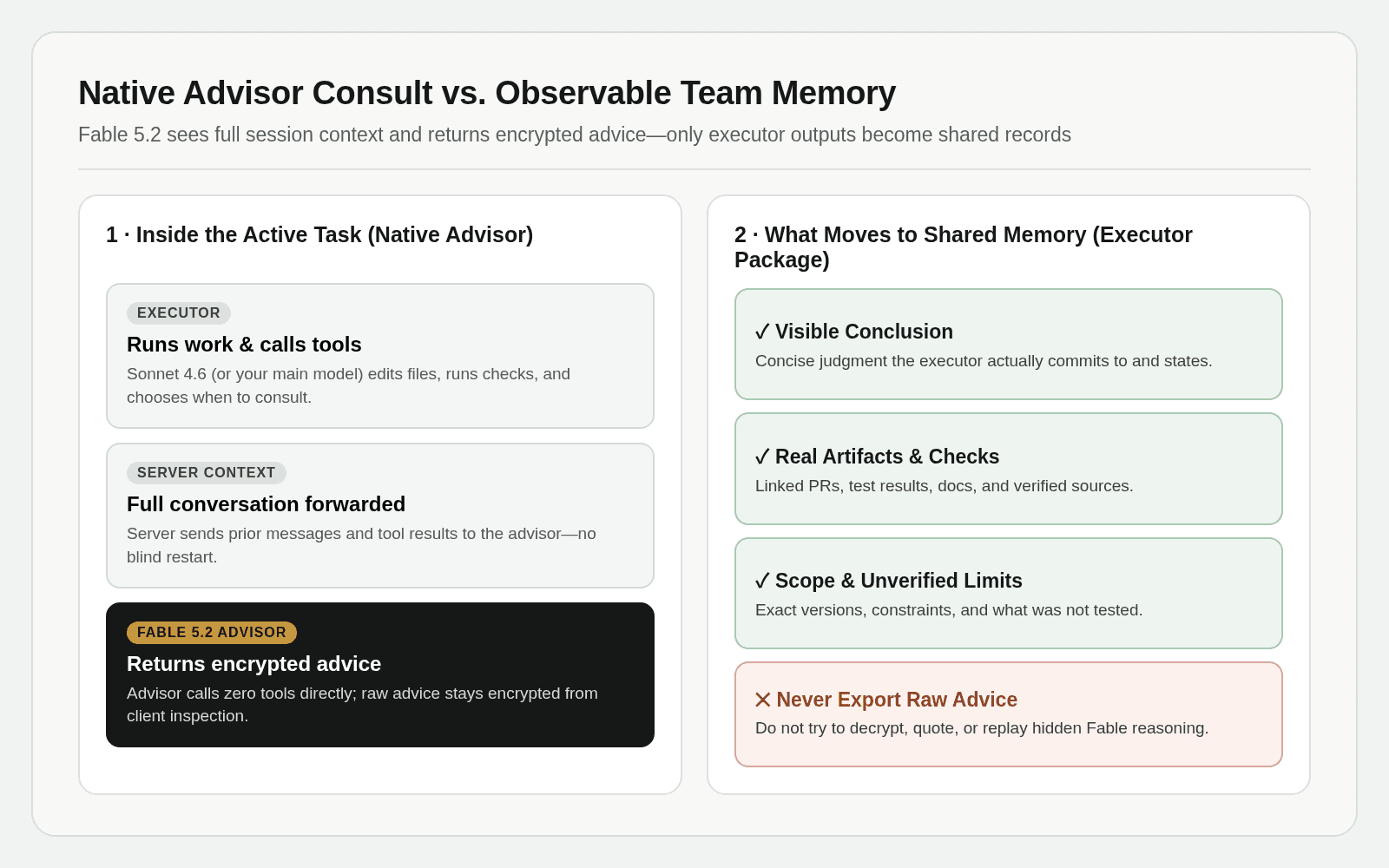
Because of that encryption boundary, never build a workflow that tries to decrypt, export, or replay raw Fable advice or hidden reasoning into a shared document—or across another model provider.
Instead, base shared memory strictly on what the executor visibly produced and verified:
- The explicit conclusion the executor committed to in its final output.
- Real artifacts and checks, such as the pull request, passing or failing test run, configuration diff, or official doc URL.
- Explicit open limits, including what was not tested, which environment it assumed, and any unresolved risk.
Treat this package as the executor's verifiable outcome—never label it as a verbatim quote from Fable 5.2 or claim automatic attribution of what the advisor reasoned internally.
Decide where each finding belongs: session, Git, or shared team memory
Not every useful observation belongs in a shared workspace. Our Claude Code knowledge base guide separates local guidance from team records; after an advisor consult, apply a three-layer filter before promoting anything.
- Keep it in the current conversation when the point only steers the active task—such as a mid-run clarification or next debugging step. Once the task closes, let it go.
- Keep it in Git, PRs, or repository ADRs when the finding governs code inside one repository, local build commands, or coding conventions owned by that repo. If every consumer works in the same codebase, a reviewed PR or ADR is already enough, as covered in our Fable 5.2 migration architecture guide.
- Promote it to shared team memory only when a later task, another agent, or another team (such as operations, support, or a neighboring service) will rely on the conclusion—and you can attach real evidence.
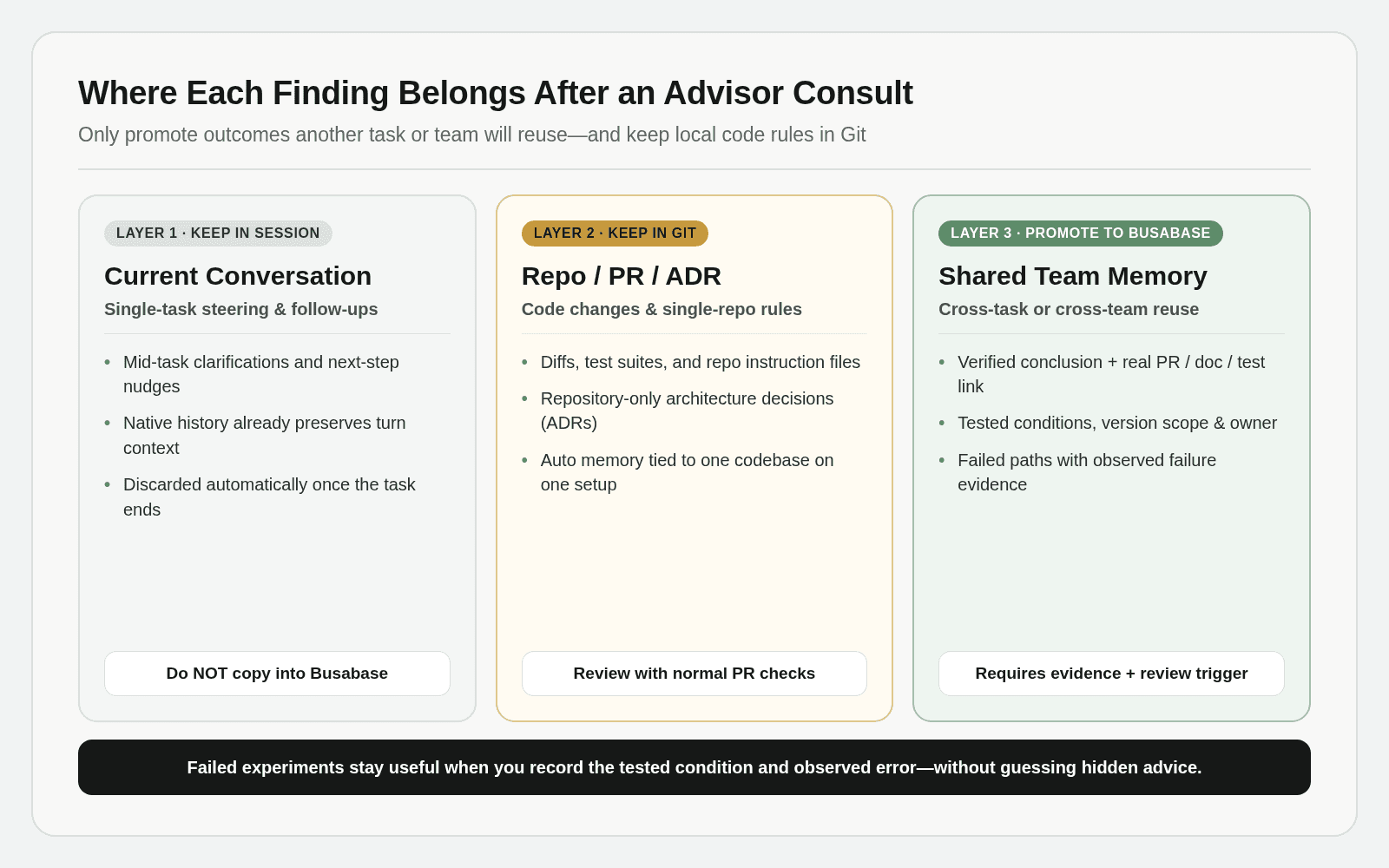
What about failed approaches? Those are often the highest-value items to keep so the next run does not repeat a dead end. Record only the tested condition and observed failure (for example, which version, provider path, or constraint triggered an error and where the log lives). Never speculate about hidden advisor reasoning to fill in why a path failed.
A minimal outcome record worth maintaining
If a conclusion clears the bar for cross-task reuse, keep the structure small so agents and reviewers can scan it in seconds. The table below is a suggested team configuration—not a pre-installed Busabase Advisor template or automatic capture tool.
| Record field | What to write | Why it protects the next task |
|---|---|---|
| Reusable outcome | One concise, plain-language conclusion | Prevents vague summaries from turning into broad assumptions |
| Origin & evidence links | Real PR, test output, doc, or deliverable URL | Lets the next agent verify rather than trust blindly |
| Verified vs. unverified scope | Exact versions tested and gaps left unchecked | Stops a narrow check from being applied everywhere |
| Lifecycle state & owner | Pending, Accepted, Conditional, or Superseded, plus owner | Separates unconfirmed notes from settled team guidance |
| Review trigger | Specific file, dependency, or policy change that invalidates it | Flags stale conclusions before they silently mislead future runs |
Notice what is missing: raw chat logs and unverified hunches. Keeping each record anchored to real artifacts and a clear review trigger prevents old consults from hardening into bad rules.
Write through the executor—and keep CR merge separate from acceptance
Because Fable 5.2 acting as an advisor has no tool access, only an authorized executor Agent (through the Busabase Claude Code Plugin or MCP) or a team member reads and updates Busabase records.
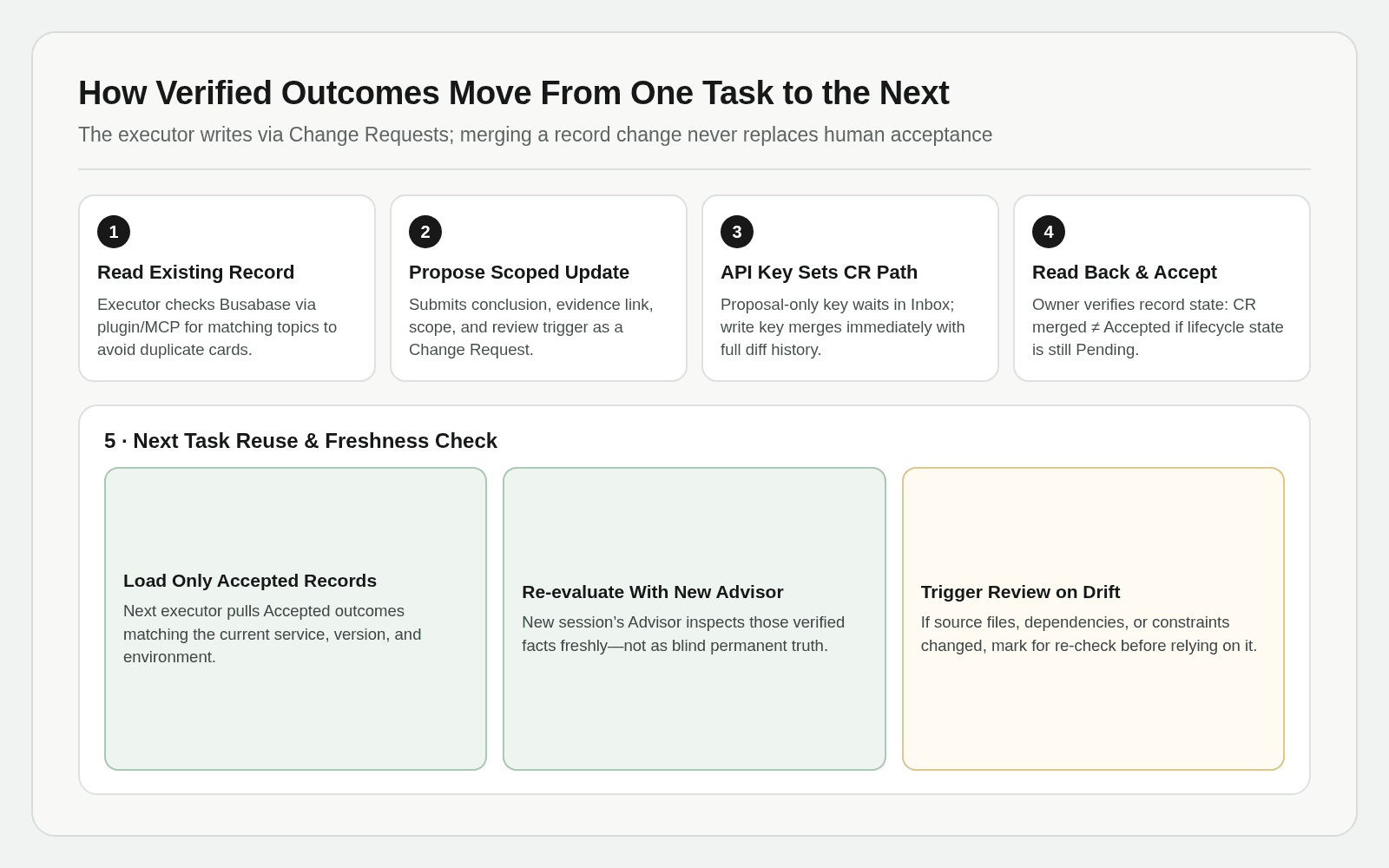
A clean writeback loop follows four rules:
- Read existing records first. Have the executor look up matching topics in Busabase before writing so it proposes a scoped update to the same record instead of creating duplicates.
- Propose with evidence and scope. Every edit enters as a Change Request carrying a plain reason, before/after field diff, and real evidence links.
- Let API key permissions enforce review. As documented in API Keys, a
changeRequest(proposal-only) key holds every agent edit in the Inbox (in_review) for human approval, while awritekey merges immediately with full reversible history unless you explicitly hold changes for review. - Read back and distinguish
mergedfromAccepted. Always read the canonical record back after a merge. A merged Change Request only confirms the table update landed in history—if the record's lifecycle state is stillPendingorConditional, human acceptance is still missing and later agents must not treat it as an approved rule.
How the next task reuses verified outcomes safely
When a related assignment starts later, the new executor reads only Accepted records whose scope matches the current service, version, and environment—along with their linked evidence. It passes those verified, public facts into the new session so the new run's advisor evaluates them alongside current code and constraints.
Do not mistake shared Busabase records for the model's built-in long-term memory. The model is not recalling hidden prior advice automatically; the executor is supplying checked team evidence into fresh context. Whenever a source file, dependency version, or constraint hits the record's review trigger, pause reuse and verify again before relying on it.
Quick decision checklist
- Native session history is enough when you are still inside one task and only need turn-by-turn continuity.
- Git / PR / ADR is enough when the outcome only affects code and conventions inside a single repository.
- Shared Busabase memory pays off when another task, agent, or team needs a verified conclusion, its evidence links, and clear boundaries across time.
Frequently asked questions
Does Fable Advisor read existing session context on its own?
Yes. When the executor consults the advisor during a task, the server forwards the conversation history and tool results collected up to that point, and turn-by-turn history inside the same session keeps that context alive. You do not need external memory to give the advisor basic task awareness.
Can we save encrypted Fable advice directly into readable team memory?
No. Claude Fable 5.2 returns encrypted advisor results that client code cannot read. Save the executor's observable outputs instead: the explicit conclusion it stated, the real PRs, tests, or documents that back it up, and what remains unverified.
Which verifiable artifacts are worth reusing across tasks?
Promote cross-task compatibility constraints, environment limits, verified dependency behaviors, and well-scoped failed experiments (recorded with their tested conditions and observed errors). Leave intermediate prompts and single-repo code style notes in the session or Git.
How do teams stop stale outcomes from misleading later runs?
Require two controls on every shared record: an explicit lifecycle state (Accepted vs. Pending/Conditional/Superseded) separate from Change Request merge status, and a concrete review trigger naming which file, version, or rule change requires re-checking before reuse.
Start with one verified outcome
Connect your executor through the Busabase Claude Code Plugin, set up one small outcome table with a changeRequest or write key matching your review needs, and test the loop on one real, evidenced finding: read for duplicates, propose a scoped record, confirm review and canonical readback, and pull that Accepted record into the next task.