Memory for GPT-6.2: Keeping Accepted Facts and Revision Rationale Across Deliverables
When reports, spreadsheets, and human edits disagree, store approved facts and revision reasons so the next run reads the right baseline.
After a team finishes a competitive review or quarterly brief with GPT-6.2, three artifacts often remain slightly out of sync: the narrative report, a summary spreadsheet, and two numbers corrected verbally during review. Two weeks later, a fresh session picks up the old draft figure—or wastes time recomputing the whole set from scratch.
OpenAI’s GPT-6.2 Astra and Sol announcement highlights stronger execution across complex documents and spreadsheet deliverables. Yet a larger context window alone cannot settle which number became the final decision. Turning one-off deliverables into durable memory requires storing accepted facts, source attachments, and revision rationale separately from chat history.
Why keeping only the final file still breaks the next run
In recurring knowledge work, rework rarely happens because the model forgot a prompt; it happens because cross-artifact conflicts leave no decision trail:
- Report prose and spreadsheet totals drift apart: One document reflects an early estimate while the sheet reflects a later finance adjustment, with no record of which one won.
- Human edits stay buried in chat comments: A reviewer overrides a figure once, and the next teammate or session has no idea why.
- Silent overwrites erase evidence: Replacing a number in place leaves future reviewers unable to tell verified source data from a temporary manual fix.
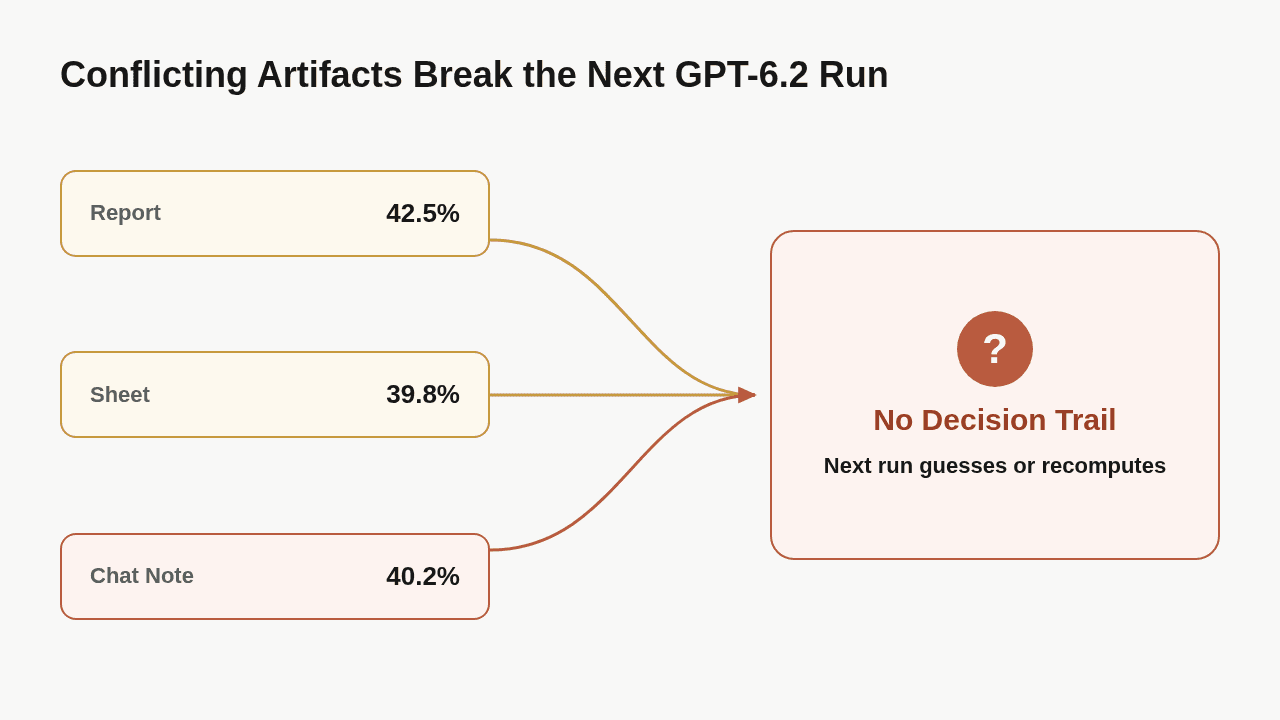
As outlined in Agent Memory vs Knowledge Base vs System of Record, transient context only recalls what was said in one thread. Only a record layer with explicit review states and commit history can answer which value is authoritative today and why it changed.
Separating sources, proposals, and accepted state
Use a Facts and Decisions Base for one recurring deliverable. Keep the actual report and spreadsheet as attachments or links; use records for the facts another task needs.
| Field | Suggested type | Why it matters |
|---|---|---|
| Fact and value | Text or number | The exact reusable item |
| Period, unit and scope | Text | Prevent a number from losing its meaning |
| Source | Attachment or URL | Let a reviewer inspect the evidence |
| Revision rationale | Long text | Explain why the value changed |
| State and owner | Select plus member/text | Distinguish a proposal from an accepted conclusion |
Ask the connected Agent:
Read the current accepted facts and the supplied final files. Report disagreements first. For supported corrections, reuse the existing record and propose the value, source and rationale. Do not invent missing evidence or mark a proposal accepted. Return the pending ChangeRequest and affected fields.
The owner checks which value is correct, its period and scope, and explicitly decides its business State. ChangeRequest status and the State field are separate: a merged change can simply store an unresolved proposal. Every write keeps a ChangeRequest and history, but it does not always wait for a person. A proposal-only (changeRequest) connection leaves edits pending; a write connection normally merges them immediately. For this review-first example, use proposal-only access or explicitly request a pending change even when the connection can write. Check the returned status. Change Requests and API permissions describe the distinction.
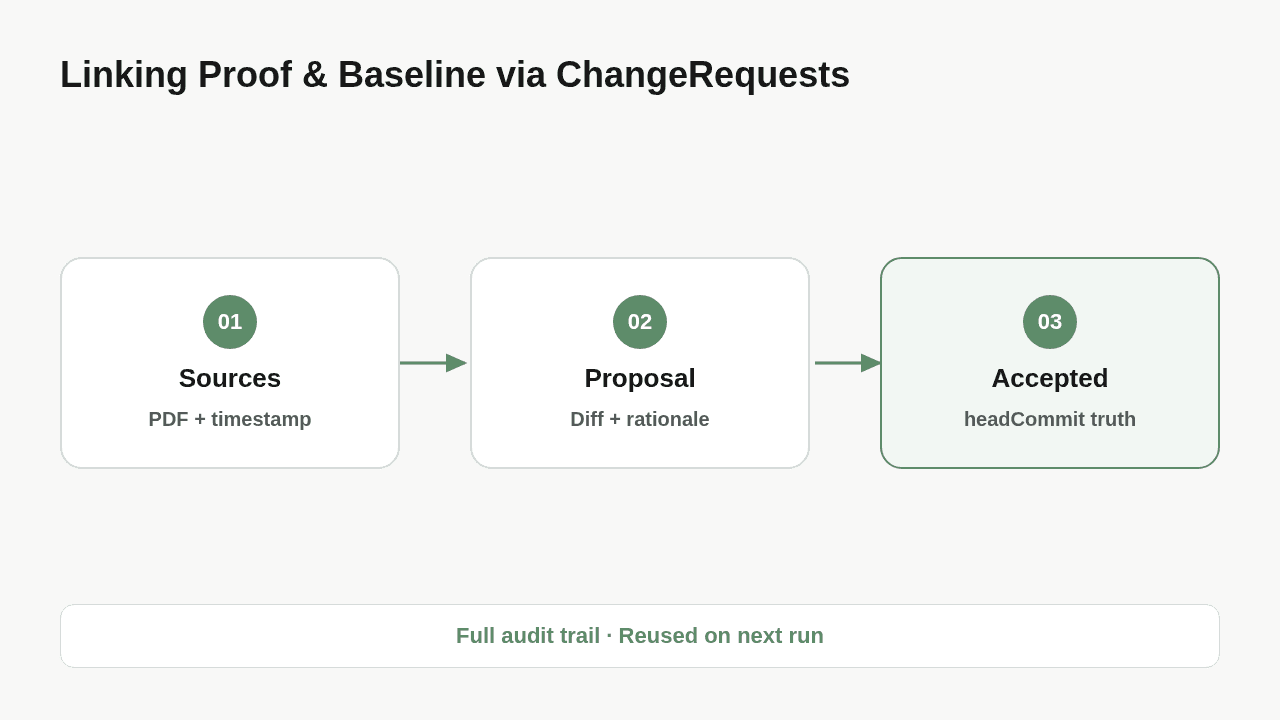
Suggested review-first workflow; it requires the connection and review settings described above. The diagram does not mean all write connections wait for human review.
Decoupling model reasoning from workspace permissions
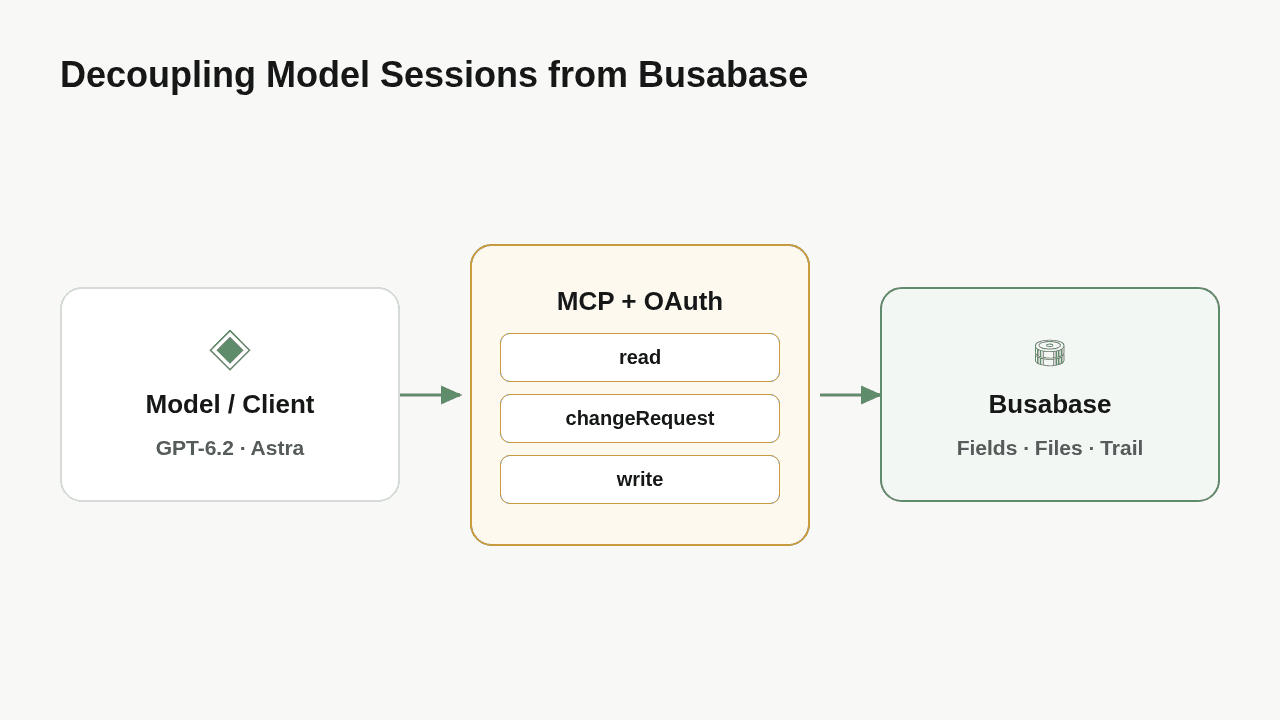
Use an agent client or integration that can call Busabase tools while running GPT-6.2. Model access and Busabase access are separate. A read connection can inspect records; proposal-only access can suggest updates; write access normally merges changes on creation unless review is explicitly retained. None of those permissions automatically validates a fact or accepts a business decision.
Start with one recurring handoff
Choose one weekly handoff. Save its real source, propose one supported correction, have the owner decide it, then start a fresh task that reads the accepted value and revision rationale. Check the returned record before calling the cycle complete. Use the quickstart to connect the client and a Playbook to save the method; saving a method does not start or schedule the Agent.