Shared Memory for Gemini 4 Carbon vs Claude Opus 5.5: Keeping One Auditable State Across Two Reasoning Tiers
Pair Carbon and Opus 5.5 without losing project state—route both models through one reviewable Base.
Your team uses Gemini 4 Carbon to pull structured fields out of dense engineering PDFs and run multi-step verification loops, then hands the synthesis to Claude Opus 5.5 for final client review and release decisions. Two days later, someone asks which version of the customer status table is current—and realizes half the decisions live inside Carbon's session history while the rest sit in an Opus chat thread.
Pairing two frontier models breaks down when memory stays trapped inside individual chat windows. Before comparing benchmarks, teams running both models need a shared memory layer that enforces one schema, preserves commit history, and puts every write through human review.
Why cross-model handoffs fail in chat memory
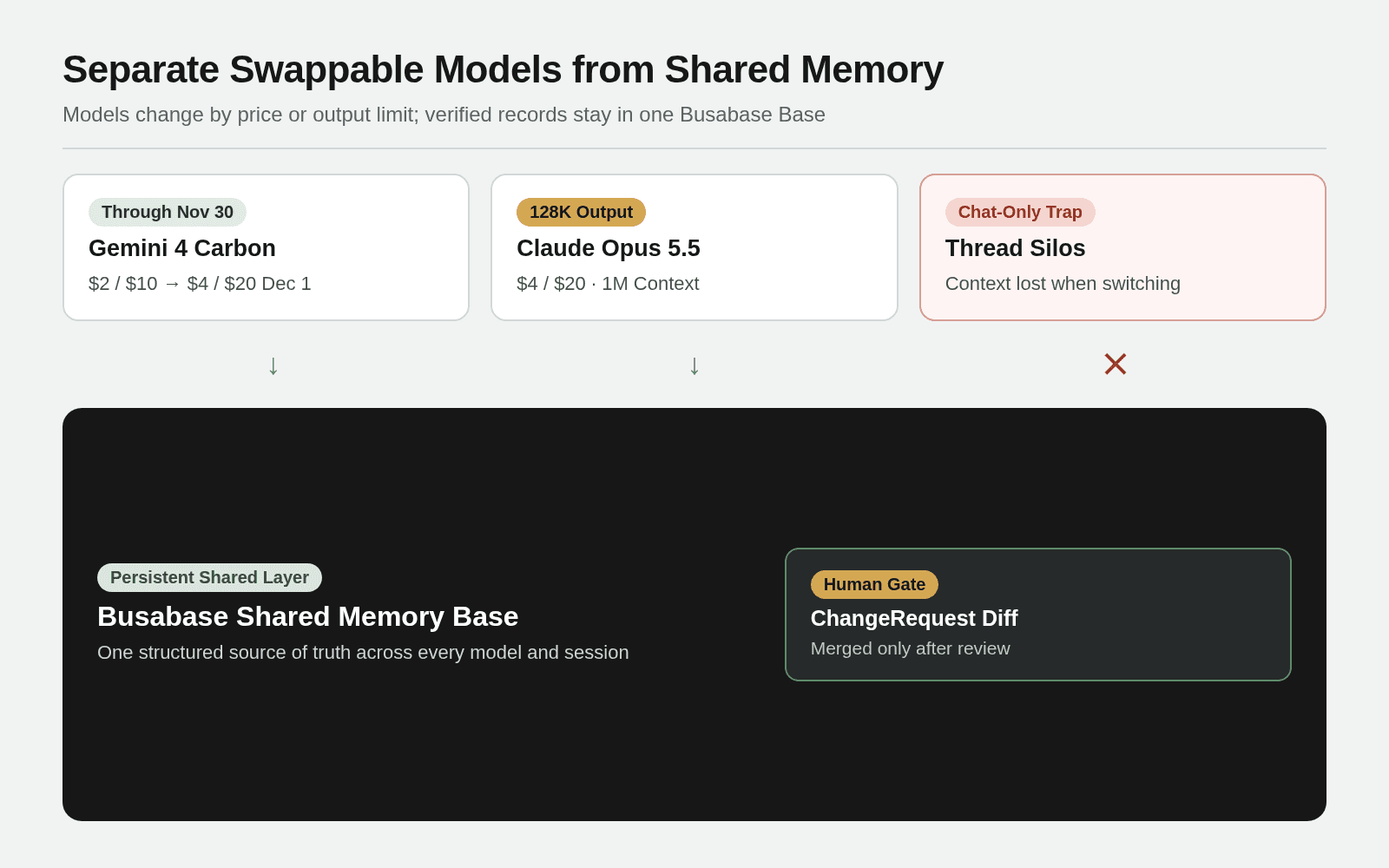
Google made Gemini 4 Carbon generally available on November 10, 2026, with an introductory $2 / $10 per-million-token rate through November 30 (moving to $4 / $20 afterward), built specifically for long-horizon coding, dense multimodal PDFs, and extended verification loops. Meanwhile, Anthropic's Claude Opus 5.5 runs at $4 / $20 per million tokens with a 1M-token context window and 128K max output, serving as the steady baseline for everyday reasoning and tool use.
Because their strengths complement each other, teams naturally split work across both tiers. The failure happens at the seam: when Carbon summarizes a 40-page packet and Opus 5.5 drafts the next action, neither model can safely trust informal text notes left in another session. Fields drift, duplicate records appear, and nobody can audit which model changed a status or why.
Model context vs. shared system of record
Session memory and vector notes help a single model recall recent context, but they do not enforce shared truth across two different models. As explained in Agent Memory vs. Knowledge Base vs. System of Record, durable operational memory needs typed fields, explicit ownership, and a review gate before updates become canonical.
| Layer | What it holds | Where it breaks across models |
|---|---|---|
| Session chat memory | Recent prompts and intermediate reasoning | Locked to one thread; invisible to the other model |
| Plain text / Markdown notes | Unstructured summaries and copied snippets | No field types, no conflict detection, easy silent overwrites |
| Busabase shared Base | Typed records, commit history, and ChangeRequests | Both Carbon and Opus 5.5 read canonical state and propose diffs |
How Carbon and Opus 5.5 share one state in Busabase
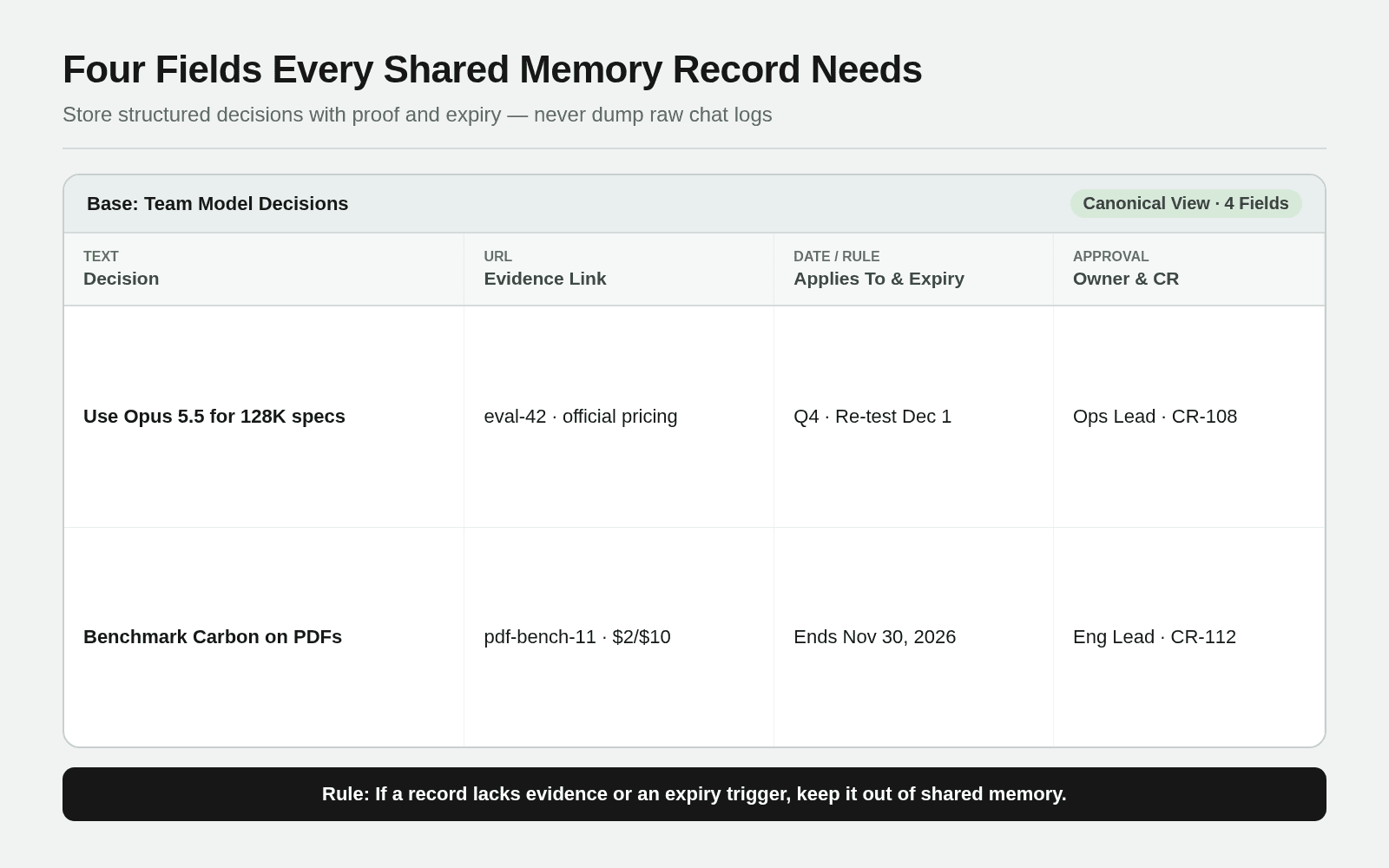
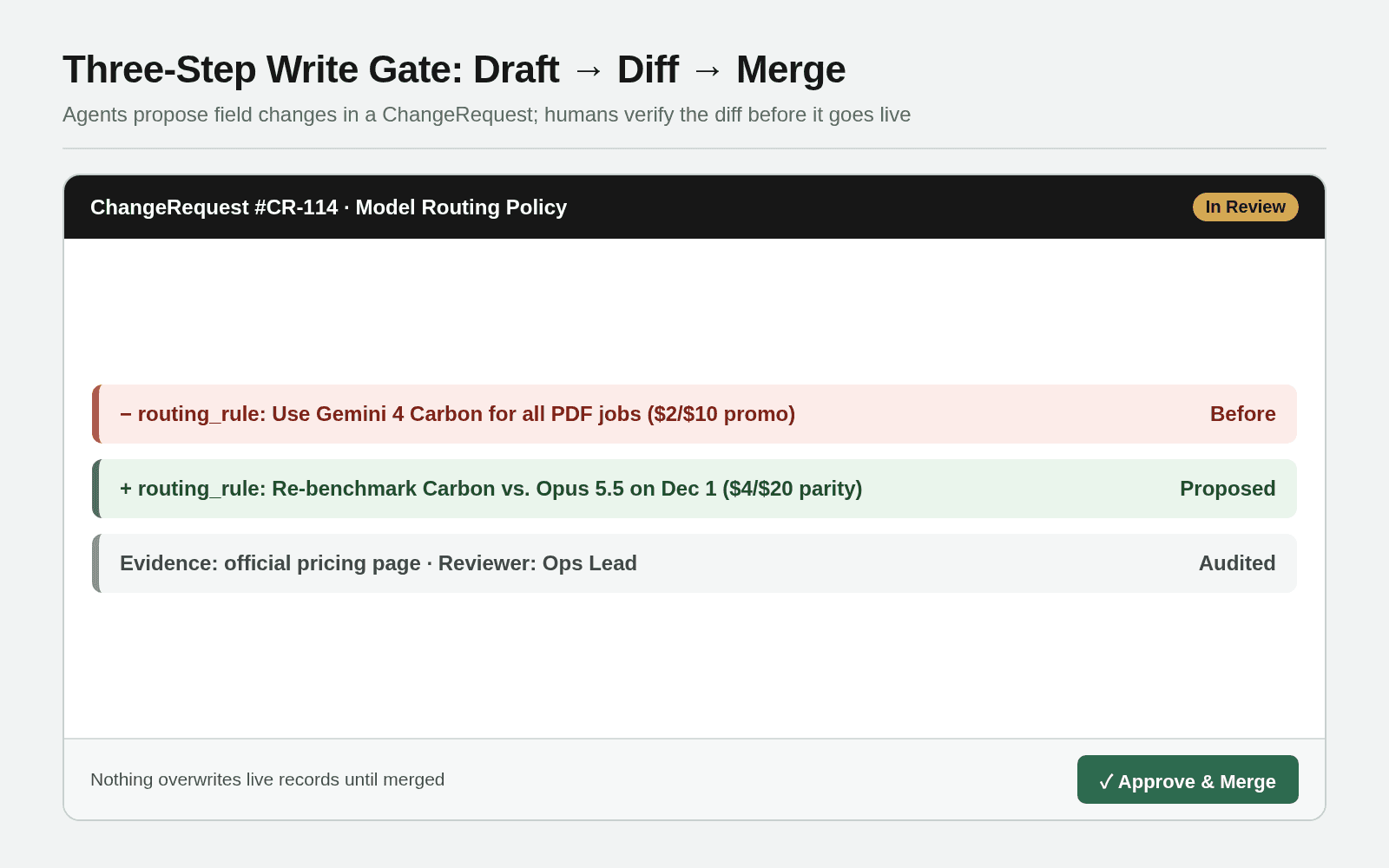
In Busabase, neither model writes directly over your live tables. Instead, both connect to the same workspace Base via MCP or CLI and follow one reviewable loop:
- Extract and propose with Gemini 4 Carbon: Carbon reads dense documents or multi-file outputs and submits structured record updates as a ChangeRequest—showing exact before/after field values against the Base schema.
- Audit and refine with Claude Opus 5.5: Opus 5.5 reads the open ChangeRequest and existing canonical records, checks edge cases or policy rules, and prepares a clear review note.
- Human approval merges into canonical state: A teammate inspects the diff in Busabase and merges only verified records. From that moment on, every future Carbon or Opus 5.5 run reads the exact same updated state.
If your team is also evaluating mid-tier routing, see our companion comparison on Shared Memory for Gemini 4 Neon vs. Claude Opus 5.5, or browse ready-made schemas in Busabase Templates.
When a shared memory layer pays off immediately
If one person runs a one-off brainstorm in a single chat window, session memory is enough. The moment two models—or two teammates—touch the same customer pipeline, content calendar, or project tracker across multiple days, a shared Base with ChangeRequest review prevents silent overwrites and keeps every model grounded in the same facts.
Frequently Asked Questions
Does Busabase host Gemini 4 Carbon or Claude Opus 5.5?
No. Busabase is the shared structured memory and approval layer that your agents connect to via MCP, CLI, or API. Your team keeps choosing which model runs each step while Busabase holds the canonical records and ChangeRequest history.
Why not just sync a shared Markdown folder between both models?
Markdown folders work for static notes, but they lack typed fields, schema validation, and per-field diffs. When two models edit the same project tracker, plain files cannot stop partial overwrites or show a clean before/after audit trail.
Can one model read what the other model wrote immediately?
Yes—once a ChangeRequest is reviewed and merged into the canonical Base, any connected agent running Carbon or Opus 5.5 queries the exact same updated head record.