Supplier Scorecard template: turn delivery and invoice signals into a procurement decision
Use the Busabase Supplier Scorecard template to turn 90-day delivery, quality, price, and invoice signals—plus missing-data uncertainty rules—into buyer-owned renewal decisions.
Two months before a packaging contract auto-renews, the numbers still look acceptable at a glance—until receiving notices late pallets, quality logs a rejected batch, and accounts payable keeps flagging mismatched invoices. Because each symptom lives in a different inbox, procurement walks into renewal talks with anecdotes instead of a single, verifiable record.
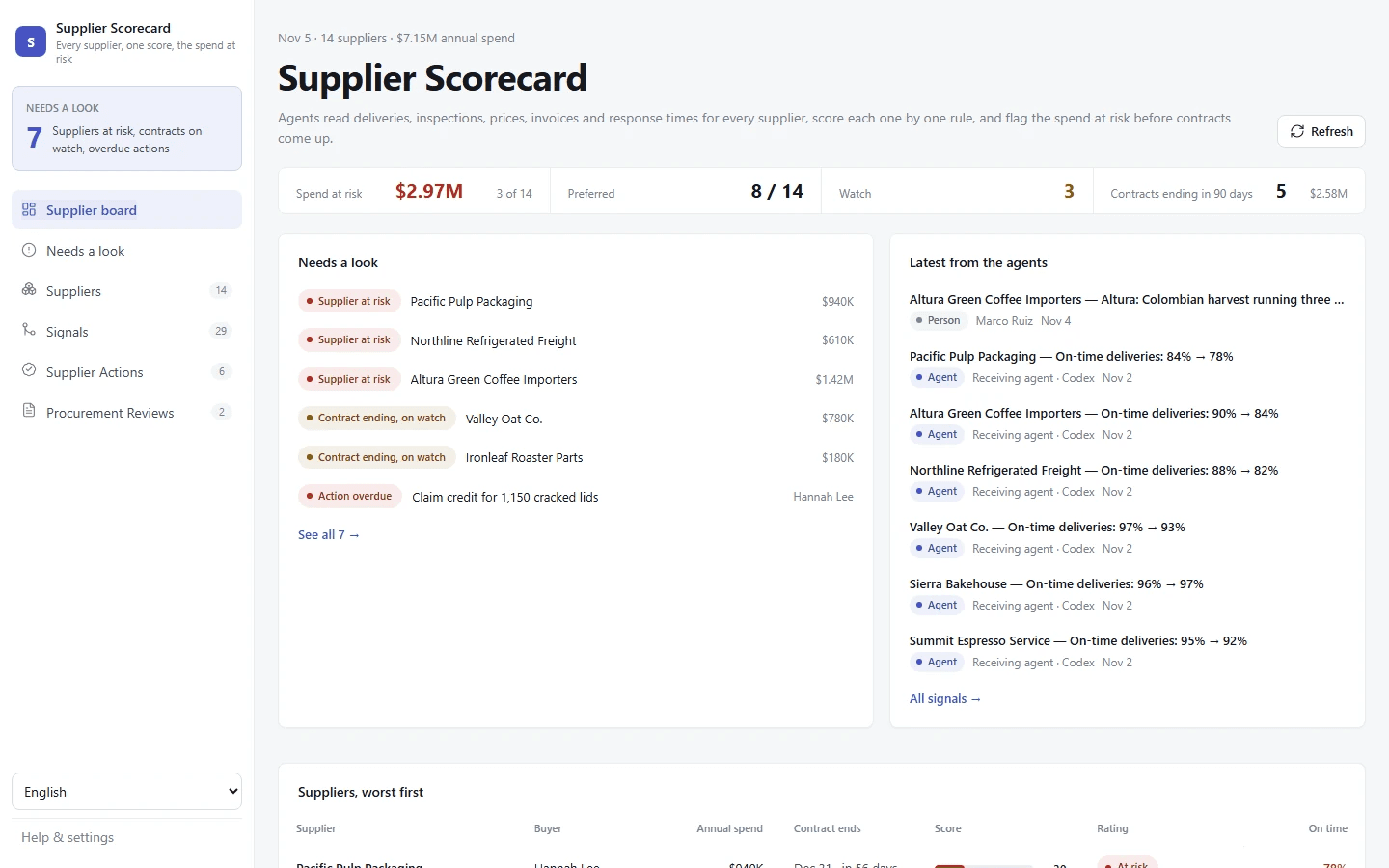
The Supplier Scorecard template (busa-suppliers) fixes that gap inside Busabase. Instead of asking one omniscient bot to invent a vendor grade, installing the template stamps a dedicated Folder containing four linked Bases—Suppliers, Signals, Supplier Actions, and Procurement Reviews—so each operational agent reports strictly from its own source and human buyers decide what to renew, renegotiate, or replace.
Resolve the desk by stamp, not by Base name
Installing busa-suppliers stamps the Folder and each child node with appId: "busa-suppliers" and explicit resourceKey metadata (suppliers, signals, actions, reviews). Agents always resolve those stamped IDs rather than guessing by Base name, preventing a procurement agent from ever writing into a similarly named folder owned by another team.
Each Base holds one clean responsibility:
Suppliers: one row per vendor, keeping buyer-owned commercial terms (annual-spend,contract-end,contract,buyer,backup) alongside five current operating measures and the calculatedscoreandrating.Signals: an append-only log of metric movements (delivery,quality,price,invoice,response) and qualitativerisknotes, each stamped withwritten-by,recorded-on,previous-value,new-value, concreteevidence(PO, lot, or invoice numbers), andsource-url.Supplier Actions: corrective plans triggered when a vendor drops toat-risk, owned by the buyer—never an abstract queue with no due date.Procurement Reviews: the weekly Monday brief summarizing exposure,at-riskvendors, andwatchcontracts ending within 90 days.
One 0–100 scoring rule—and why missing readings score 10
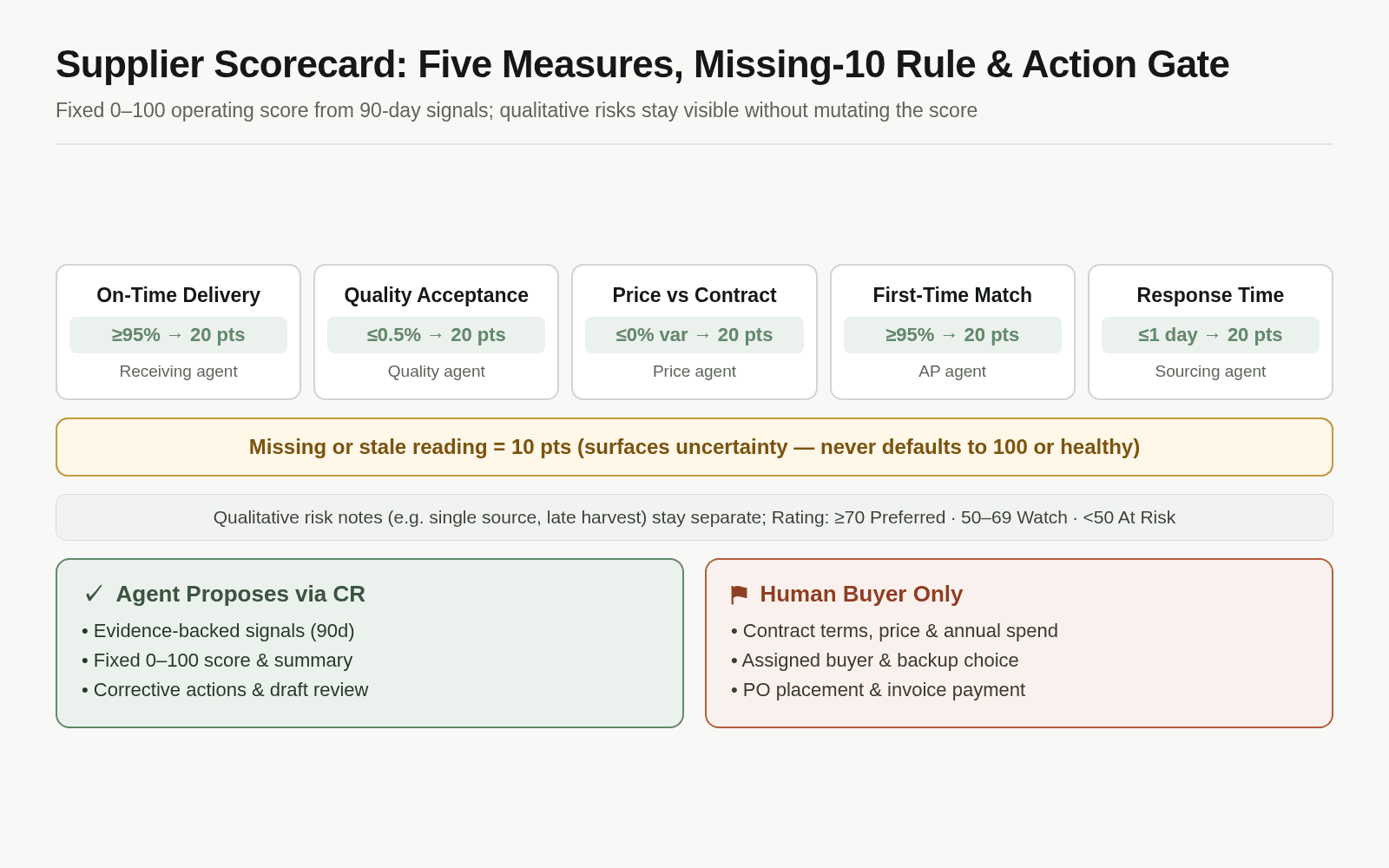
Every supplier is scored by the exact same five-part deterministic rule across a rolling 90-day window (20 points per measure, 0–100 total):
Measure (Suppliers field) | Source & maintaining agent | Full 20-point threshold |
|---|---|---|
On-time delivery (on-time-pct) | Goods receipts in last 90 days (Receiving agent) | >= 95% |
Quality acceptance (defect-pct) | Incoming inspection rejections in last 90 days (Quality agent) | <= 0.5% |
Price vs contract (price-variance-pct) | Invoiced unit price vs contract price (Price agent) | <= 0% |
First-time invoice match (invoice-match-pct) | AP three-way match rate (AP agent) | >= 95% |
Response time (response-days) | Days to first real answer on issues/quotes (Sourcing agent) | <= 1 day |
Totals map strictly to preferred (>= 70), watch (50–69), or at-risk (< 50). Crucially, any measure with no reading scores 10 points—not 20 and not excluded. If an AP feed or receiving source is temporarily unavailable, the agent skips carrying old numbers forward as fresh, records the gap, and surfaces uncertainty explicitly. Qualitative risk signals—such as a single-source dependency or a three-week harvest delay—remain visible on the supplier card without silently mutating the numeric score.
Expose at-risk spend early without predicting supply loss
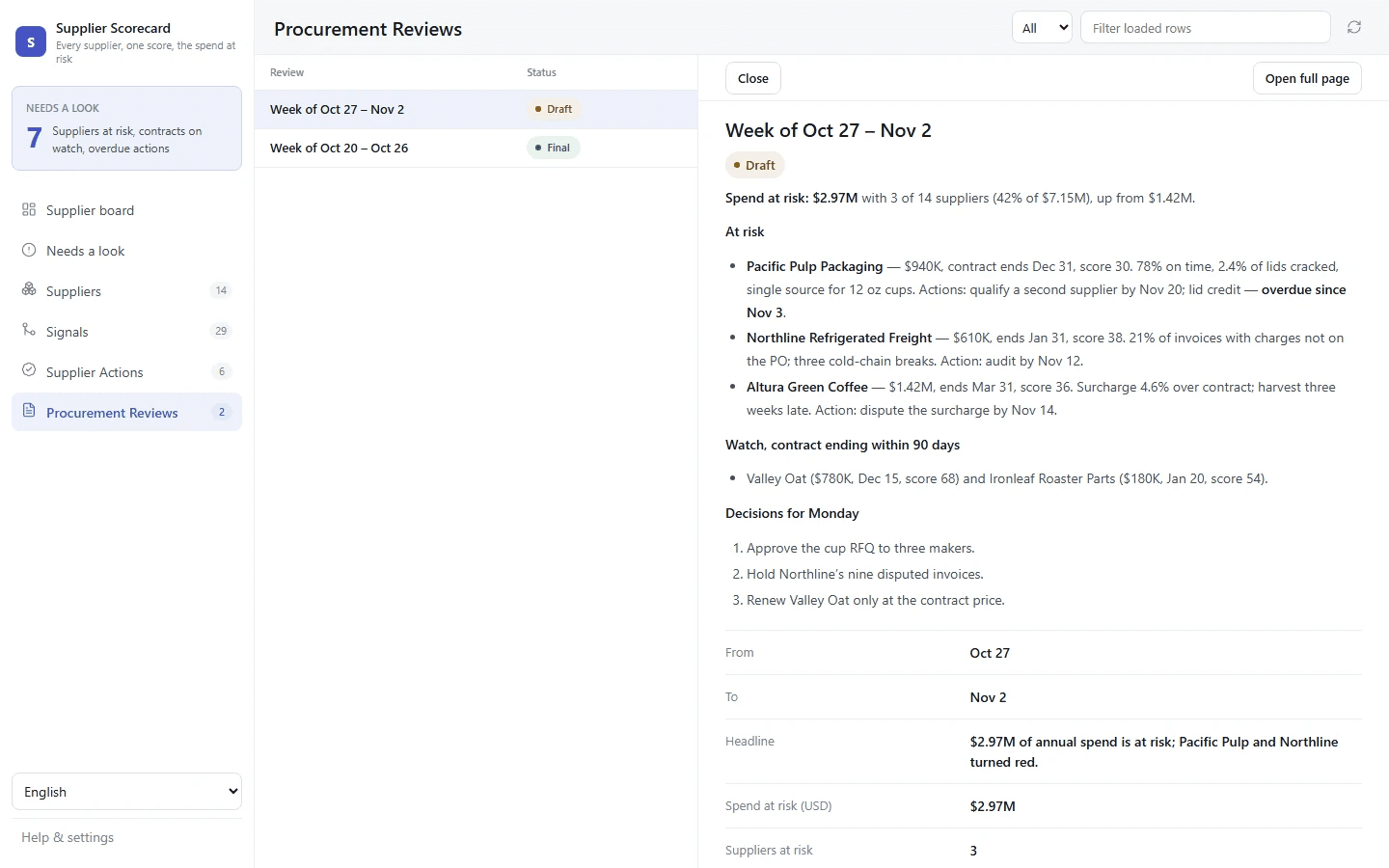
When a contract is within 90 days of contract-end—or when a supplier drops below 50—procurement needs an immediate pre-renewal lens, not a post-mortem. The Procurement Reviews view groups total annual spend tied to at-risk vendors first, followed by watch suppliers whose contracts expire within 90 days, ordered soonest-ending first.
Treat that spend-at-risk figure accurately: it is contracted annual spend currently exposed to a slipping or unverified supplier, not a prediction of lost revenue or guaranteed stockout. Showing the weakest metric, last five signals, qualified backup status (or "None qualified"), and open buyer-owned actions side by side gives the procurement lead concrete negotiation leverage weeks before renewal locks in. Unlike a financial reconciliation desk such as Busa Audit that matches individual orders and payouts, Supplier Scorecard tracks ongoing vendor reliability and contract readiness over time.
Strict buyer-only boundaries and permission-aware writes
Using Busabase as a system of record for AI agents keeps automated monitoring separate from commercial authority:
- Never touch commercial commitments: agents never alter
contract, unit prices,annual-spend,contract-end, assignedbuyer, or supplier selection, never place or cancel POs, never approve or pay invoices, and never message vendors externally. - Never rewrite signal history: if a measurement was wrong, agents append a new correcting
Signalsrow rather than editing historical entries. - Leave
autoMergeunset: every agent writes through ChangeRequests. When connected with achangeRequest-scoped API key, proposals pause inin_reviewfor human approval; with awrite-capable key, validated updates merge immediately with full commit diffs unlessautoMerge: falseis enforced. The Scorecard AirApp itself is strictly read-only.
Frequently Asked Questions
What happens if a supplier's invoice or inspection feed is unreachable this week?
The agent skips writing a new reading for that vendor rather than copying an older figure as current, and flags the source gap. Any missing measure scores 10 out of 20 points so uncertainty is visible in the total without fabricating a healthy 20/20 score.
Can a qualitative risk warning automatically mark a vendor as at-risk?
No. Qualitative risk notes (such as single-source packaging or weather delays) are logged in Signals so sourcing agents and buyers read them when planning actions or negotiations, but the 0–100 numeric score follows only the five quantitative thresholds.
Who owns corrective actions when a supplier drops below 50?
The supplier's assigned human buyer. An agent can propose the Supplier Actions row with the signal-backed cause, concrete check-in plan, and a due date prior to contract-end, while the buyer owns execution and commercial decisions.