 Busabase for OpenAI Codex
Knowledge base for Codex
Give Codex durable project knowledge it can read, update, and hand off without turning every agent output into accepted fact.
The missing layer
A coding agent can move fast. Project truth should move carefully.
Codex already understands repositories, instructions, and the files in front of it. The harder problem begins after the run: which decisions should survive, which findings are verified, and what should the next agent be allowed to treat as true?
How it works
Four steps from Codex output to trusted context
Read approved context
Codex reads the records, docs, and files relevant to the task instead of reconstructing history from chat.
Propose an update
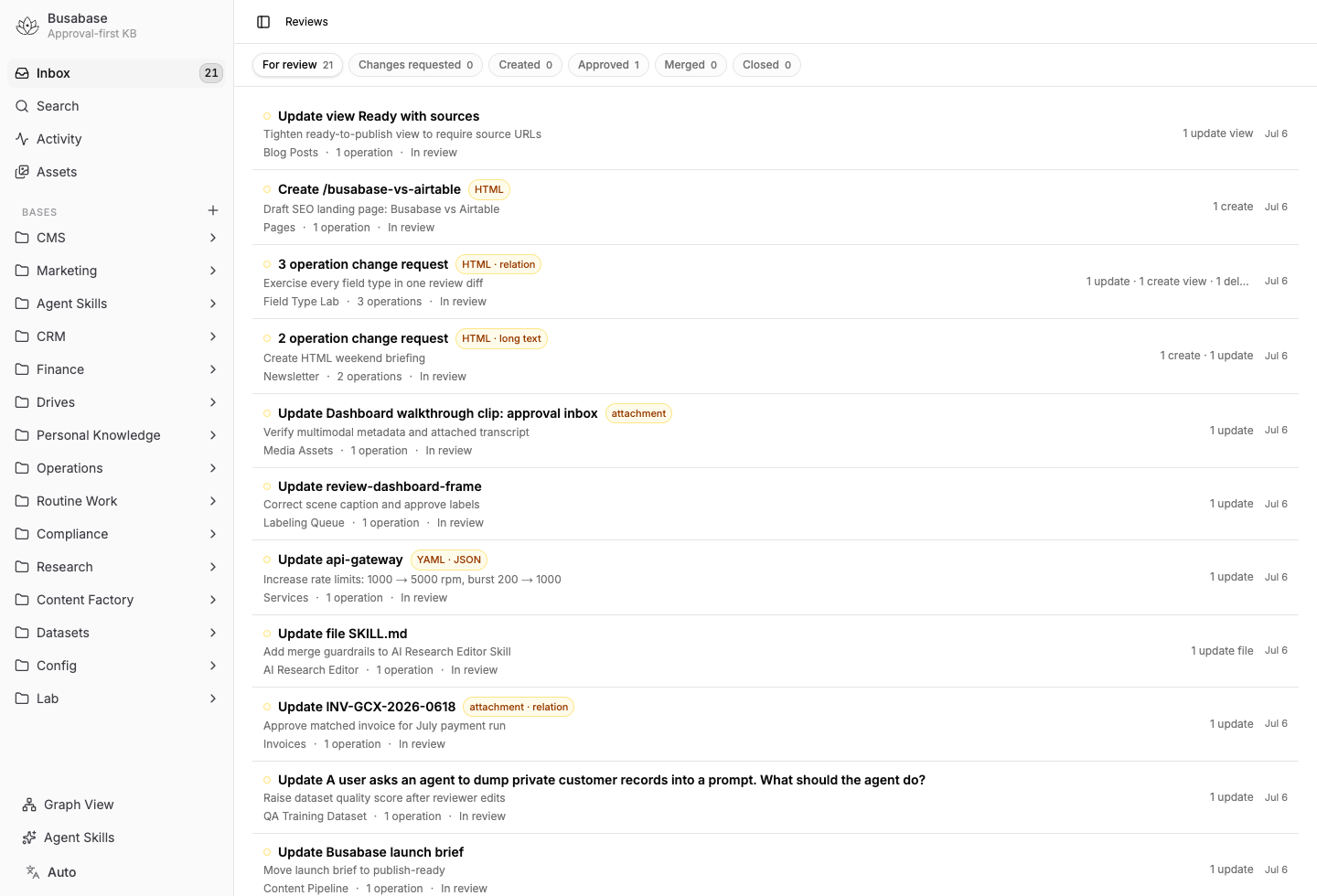
New findings arrive as a Change Request with the intended field changes and source context.
Review the difference
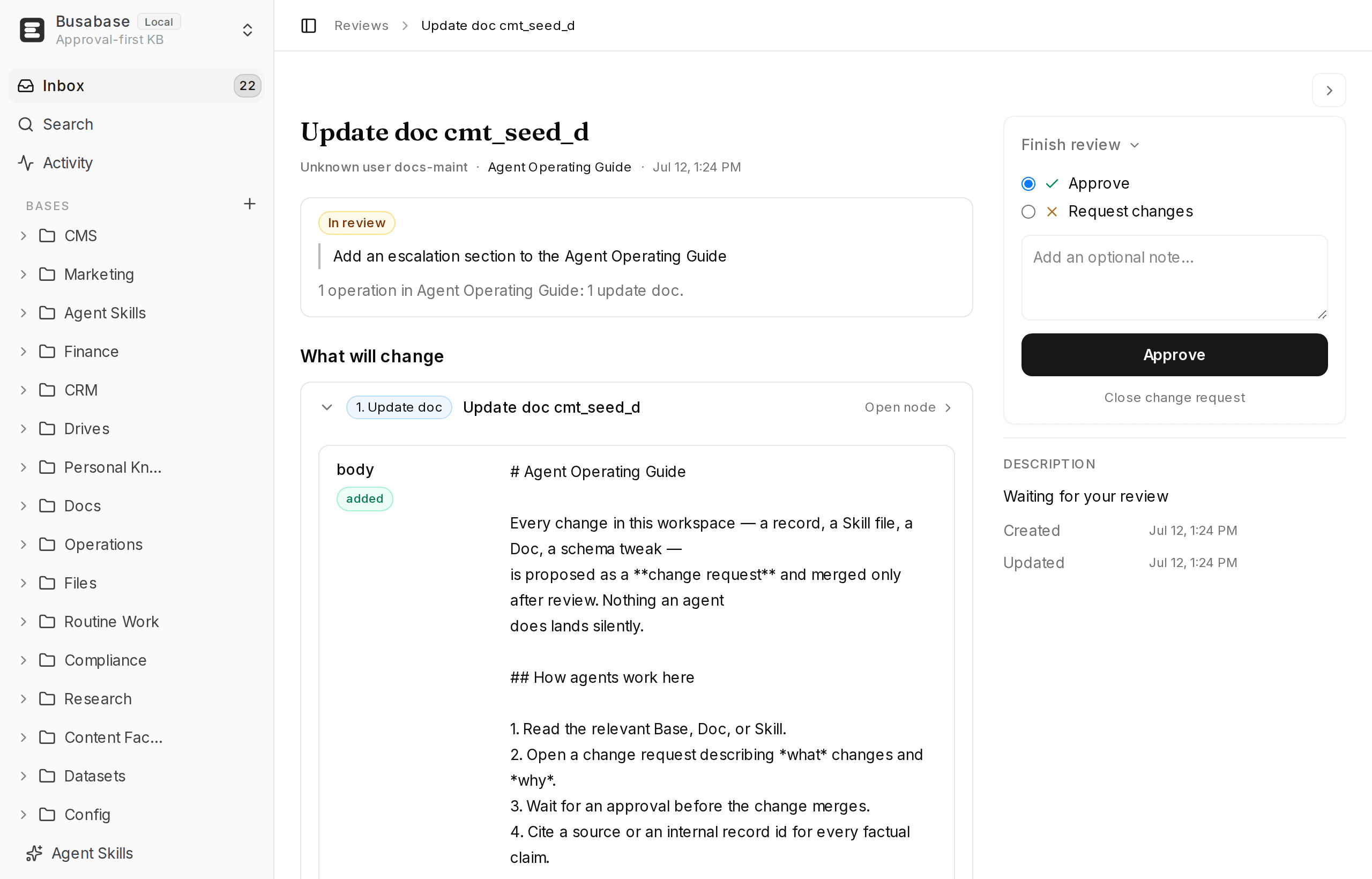
A person checks what changed, asks for revisions, approves, or rejects the proposal.
Reuse the canonical record
Future Codex runs start from reviewed knowledge while the proposal and merge history remain traceable.
What to keep
Knowledge that should outlive one coding session
Busabase is most useful for context with consequences: information another person or agent will use to make a later decision.
Architecture decisions
Decision, alternatives, evidence, owner, and the conditions that would reopen it.
Verified runbooks
Recovery steps, environment constraints, and the last successful verification.
Release and incident knowledge
What shipped, what failed, what was rolled back, and which evidence supports the conclusion.
Reusable agent workflows
Skills, review checklists, data schemas, and small apps that encode how the team works.
Choose the right layer
Busabase complements repository context. It does not replace it.
Keep code and coding rules close to the repository. Use a reviewed knowledge base for shared facts, decisions, and operational context that must remain useful across repositories, agents, and applications.
| Layer | Best for | What makes it trustworthy |
|---|---|---|
| Repository + AGENTS.md | Code, local instructions, tests, versioned configuration | Git history and code review |
| Vector search | Finding semantically related passages | Depends on the source collection and retrieval quality |
| Shared docs | Human-authored explanations and collaboration | Editorial ownership and document history |
| Busabase | Agent-written records, docs, skills, files, and apps | Change Requests, human review, sources, and merge history |
Connect Codex
Use the Skill or connect over MCP
The recommended path is the Busabase Skill, which gives Codex the review workflow as well as the connection. Codex also supports Streamable HTTP MCP and OAuth according to OpenAI's documentation.
MCP connection
codex mcp add busabase --url https://busabase.com/api/mcp
codex mcp login busabase --scopes mcp
Fit check
Use Busabase where review changes the outcome
A strong fit
- Several people or agents reuse the same decisions.
- Agent updates need an owner, source, or approval.
- Knowledge spans repositories or business systems.
- You need to reconstruct why a value became canonical.
Use something simpler
- The information is temporary scratch context.
- Git already owns the artifact and code review is enough.
- No person will review the proposed updates.
- You need high-volume event storage or vector retrieval only.
Knowledge base for Codex: common questions
Can Codex write directly to Busabase?
The available actions depend on the permission grant. For normal agent work, use Change Request permission so Codex can propose changes while review and merge remain human decisions.
Does this replace AGENTS.md?
No. AGENTS.md is the right place for repository-local operating rules. Busabase is for reviewed knowledge that should be shared across sessions, repositories, people, agents, or applications.
Can Codex use both Busabase Cloud and Desktop?
Yes. Cloud is for shared workspaces and browser-based OAuth. Personal Desktop keeps the workspace on your machine and exposes a local MCP endpoint.
Is Busabase a vector database?
No. Vector retrieval helps find related text. Busabase focuses on structured records, sources, proposed changes, human review, and canonical history. The two layers can be used together.
What should the first Base contain?
Start with one consequential workflow: architecture decisions, incident learnings, release readiness, or verified runbooks. Keep the schema small and require a source, owner, status, and last-verified date where those fields matter.
Start with one reviewed record
Give Codex context your team can trust
Connect Codex, let it propose one useful update, and inspect the difference before it becomes shared knowledge.