 Busabase × Doubao Work
Knowledge Base for Doubao Work
Doubao Work separates plugins that access external data from skills that define methods. Its enterprise knowledge feature can answer from information the user is allowed to access. Busabase adds a separate place for the structured findings your team wants to review and reuse, rather than replacing that source knowledge.
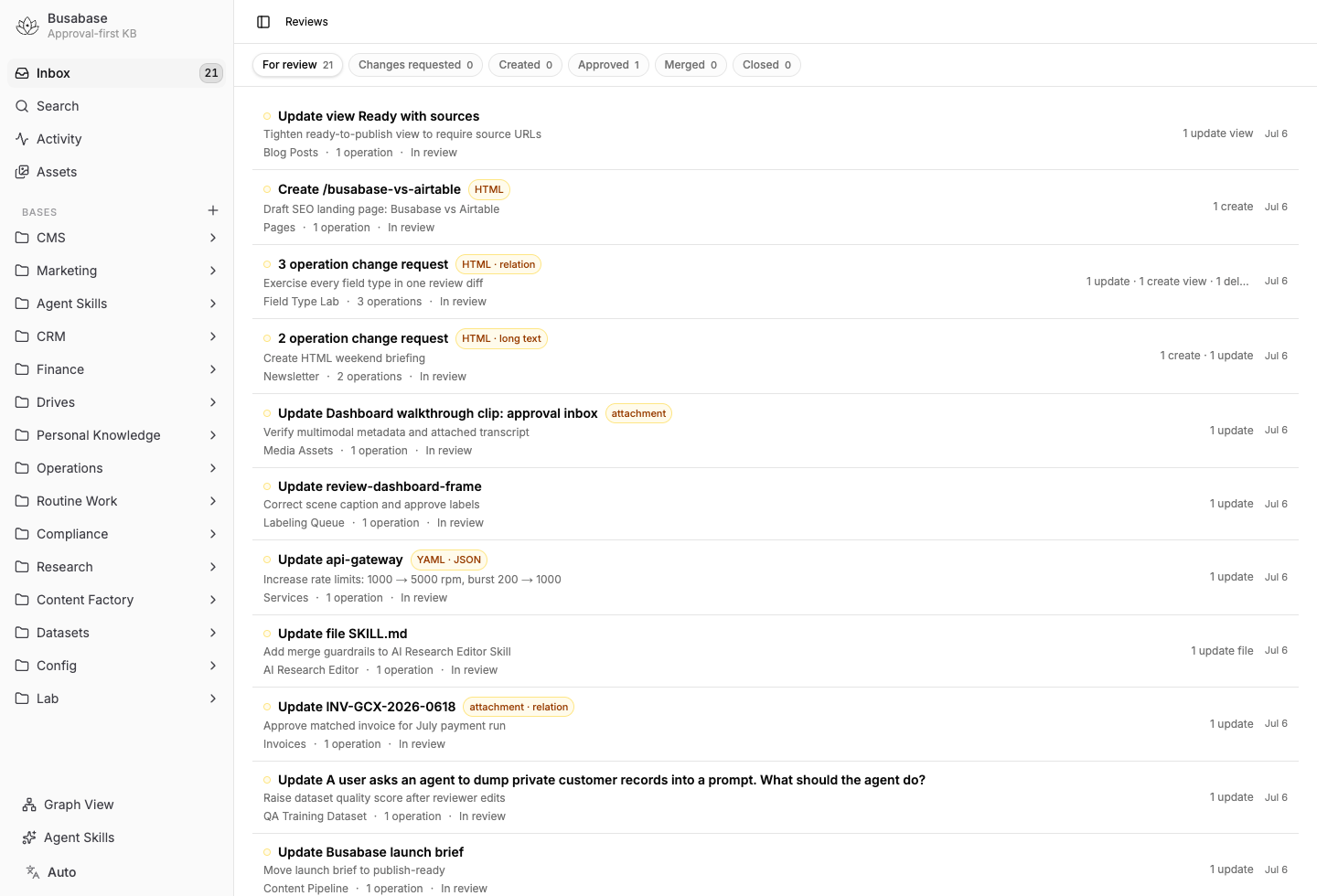
The missing layer
Access to team knowledge is different from accepting a new finding
For a recurring competitor report, internal documents explain your company, a skill defines how to research, and a plugin retrieves external evidence. A reviewed conclusion needs its own source date, scope and owner so the next report does not treat last month’s claim as today’s fact.
From proposal to accepted knowledge
Start the next task from accepted knowledge
Read applicable accepted records
Check source dates and applicability before supplying relevant accepted records to the agent.
Propose an evidenced update
Turn a finding into field-level changes with sources, execution version and open questions; submit a ChangeRequest.
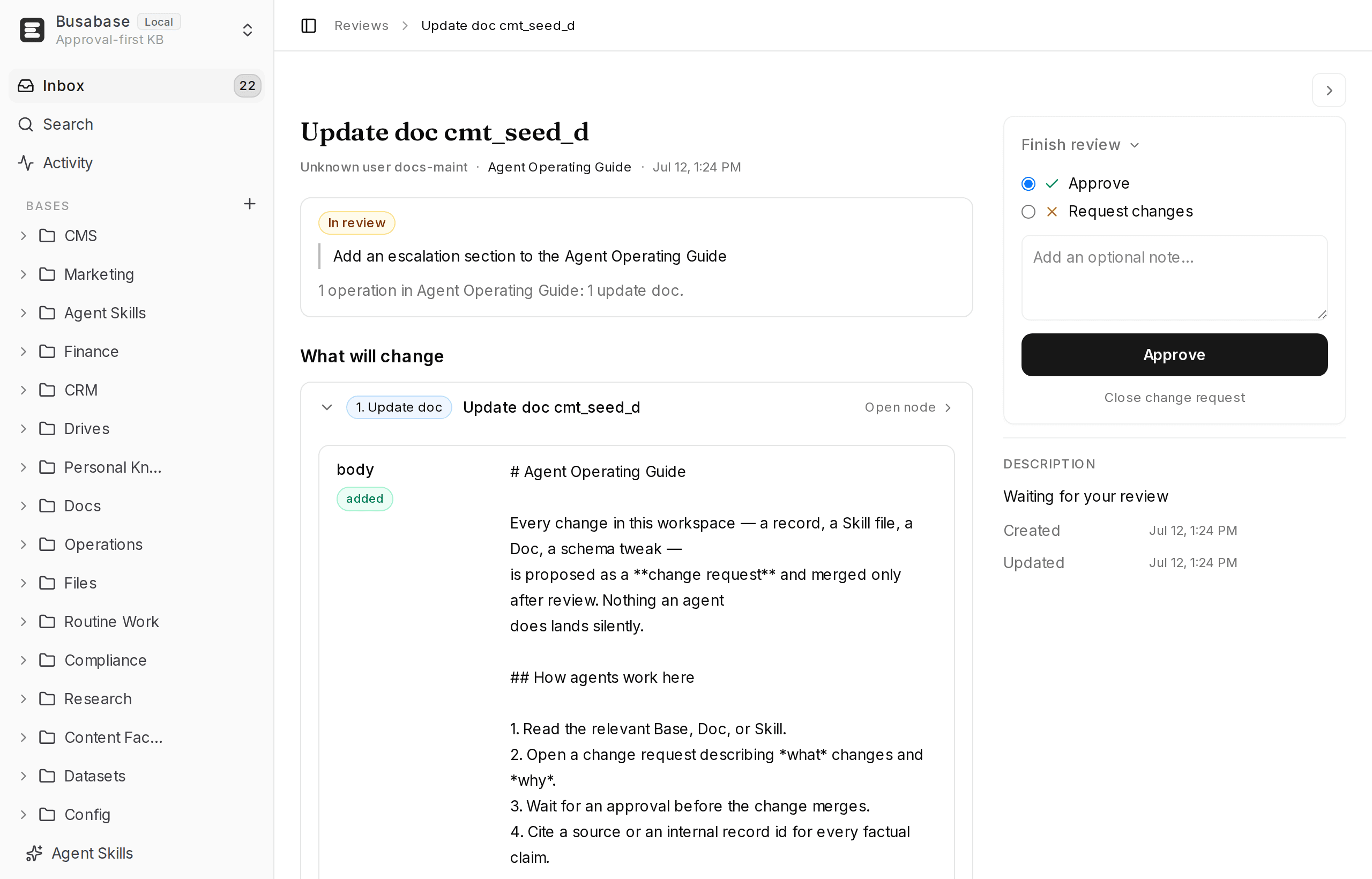
Review the exact changes
A reviewer checks changes and evidence, requests revisions, approves or rejects. An authorized role merges approved changes.
Reuse accepted findings
People and agents read the merged state. Propose a revision when a claim changes and retain its history.
What to preserve
Save a pricing observation that another report can verify
Example: a competitor changes the limits of one plan. Store the exact change and evidence rather than a vague “pricing has changed.” These fields are a suggested record design, not a built-in template.
Claim and scope
Product, plan, region and the exact limit observed. Separate a public statement from a tested account result.
Source and observation date
Official pricing URL, dated capture or document revision, and the research task identifier.
Evidence and uncertainty
Relevant source excerpt, comparison with the previous observation, and any missing regional or account information.
Owner and review
Reviewer decision, effective date, next review date and follow-up action. Propose a revision when the source changes.
Choose the right knowledge layer
Keep source knowledge, methods and accepted findings in their own layers
For a recurring competitor report, internal documents explain your company, a skill defines how to research, and a plugin retrieves external evidence. A reviewed conclusion needs its own source date, scope and owner so the next report does not treat last month’s claim as today’s fact.
| Knowledge layer | Best place for | Basis for trust |
|---|---|---|
| Enterprise knowledge and source documents | Keep internal documents and their original permissions in their source system. Do not copy the entire library into a second knowledge base. | Enterprise knowledge and source documents |
| Skills and plugin configuration | Keep research instructions, templates and connection settings in Doubao Work. Credentials are configuration secrets, not business knowledge records. | Skills and plugin configuration |
| Accepted competitor findings | Preserve the reviewed claim, source, observation date, affected product and owner as a concise Busabase record. | A reviewer checks changes and evidence, requests revisions, approves or rejects. An authorized role merges approved changes. |
| Busabase | Example: a competitor changes the limits of one plan. Store the exact change and evidence rather than a vague “pricing has changed.” These fields are a suggested record design, not a built-in template. | People and agents read the merged state. Propose a revision when a claim changes and retain its history. |
Connection and review boundaries
Verify access, then limit write authority to proposals
The official plugin guide documents custom MCP connections over HTTP or STDIO, including headers for HTTP authentication. The skill guide documents uploading a skill file or folder. These establish configuration options; a Busabase connection still needs account, tool and permission checks. Configure a supported client connection, verify the active Busabase space, and use changeRequest-scoped access for proposed changes. Confirm a small read and proposal before using it for a recurring task. This page describes a suggested workflow, not a completed Doubao Work integration test.
When to use
Add shared review where the next task needs a dependable result
Use shared review
Use this for recurring market research, cross-team reports and facts reused by multiple tasks. Keep the enterprise knowledge feature for source discovery and Busabase for deliberately reviewed records.
Use a simpler tool
Skip a second record layer for one-off answers, disposable drafts or facts already governed adequately in an existing system. Do not duplicate every source document or task transcript.
Knowledge Base for Doubao Work · Questions
Does this replace Doubao Work enterprise knowledge?
No. The native feature supplies accessible source knowledge. A separate reviewed record is useful when a specific finding needs an accountable owner and a history of accepted changes.
Does Doubao Work support custom MCP plugins?
The official guide updated September 28, 2026 documents HTTP and STDIO custom plugins. HTTP configurations can include custom authentication headers.
Has this Busabase connection been tested end to end?
No. Official configuration support has been verified, but this draft does not claim a successful client login or tool execution. Validate access and proposal authority before production use.
Can a skill be uploaded rather than created in chat?
Yes. The official guide allows a local skill file or folder. It specifies a skill.md file with a YAML name and description; validate the actual package and requested permissions before installing.
How should a recurring report handle changed evidence?
Read the current source, compare its date and scope with the accepted record, and propose a revision with evidence. Do not silently turn an older observation into a current claim.
Start with one reviewed record
Give the next task knowledge with sources and an owner
Choose one result the team will reuse, define a minimal record and reviewer, then validate access and proposal permissions using the connection guide.