 Busabase × Google Gemini CLI
Knowledge base for Gemini CLI
A terminal run can be restored. A useful result must be explained, sourced, and reviewed before another Agent treats it as evidence.
Three local artifacts
Instructions, restore points, and evidence solve different problems.
Gemini CLI loads hierarchical GEMINI.md context, can save local checkpoints before file edits when checkpointing is enabled, and keeps session history. These features help the current run. They do not by themselves prove that an experiment succeeded or that a result is ready for reuse.
Experiment register
Make every result reproducible without storing the whole terminal transcript.
A result is useful when the next person can reconstruct the question, input, command, environment, outcome, and limits. The record should point to raw artifacts rather than paste all of them into one long note.
| Field | Record |
|---|---|
| hypothesis | What did this run attempt to establish? |
| input_ref | Which dataset, issue, file, or source was used? |
| command | What exact task or entry point was executed? |
| environment | Which repository, branch, model, or runtime applied? |
| result | What happened in plain language? |
| evidence | Where are logs, output files, screenshots, or tests? |
| review_state | Proposed, in review, accepted, or rejected? |
| next_run | What should change in the next attempt? |
A run has a lifecycle
Separate execution progress from the claim that survives it.
Interactive and automated runs both generate intermediate output. Treat those outputs as working material until the evidence is attached and a reviewer accepts the conclusion.
Define the question and acceptance criteria.
Execute in a known environment and preserve artifacts.
Summarize the result with evidence and limits.
Check reproducibility and reject unsupported claims.
Expose the approved record to future runs.
Evidence stays inspectable
Store the result next to the file or output that supports it.
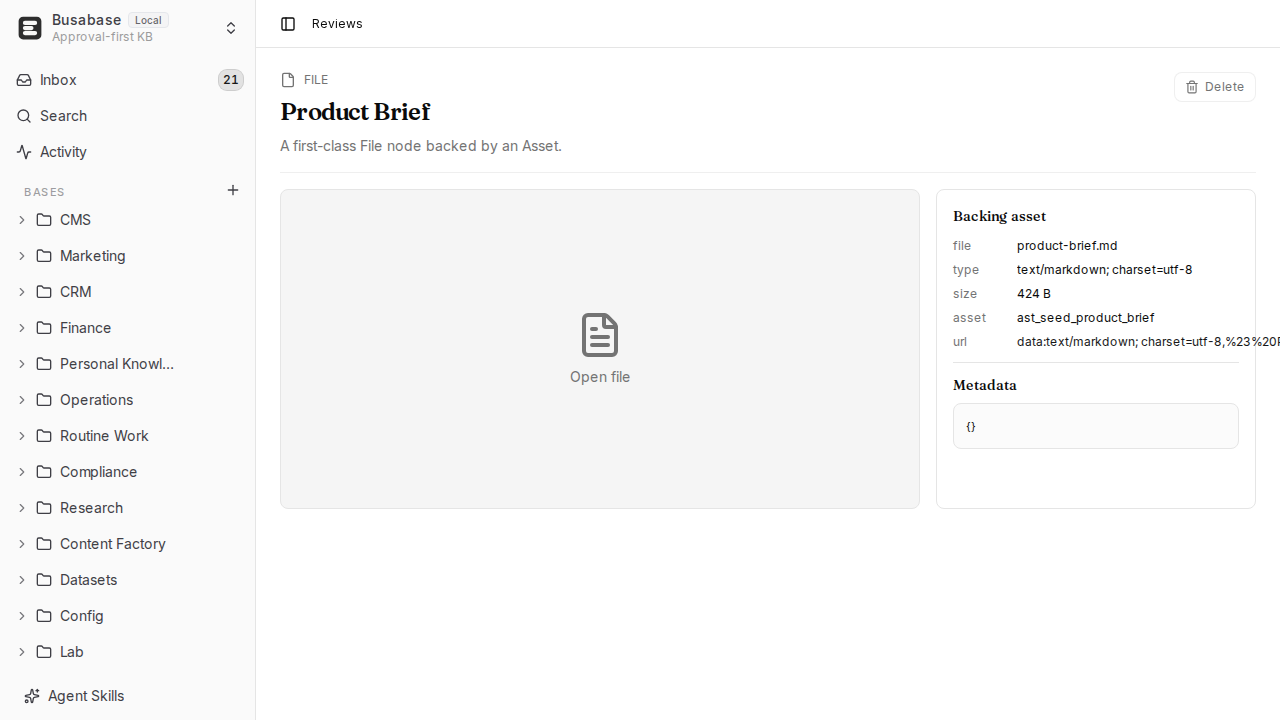
Busabase can keep structured records beside files, docs, and Skills. Gemini CLI reads the accepted summary, then opens the source artifact only when the current task needs the detail.
- Claim
- The migration completed without data loss.
- Evidence
- Dry-run report, row counts, and verification output.
- Limit
- Verified only against the staging dataset.
- Reviewer
- Data owner accepted the result for the next phase.
MCP is the transport, not the trust model
Keep Gemini's tool confirmation and Busabase review as two separate controls.
Gemini CLI supports Streamable HTTP MCP and OAuth discovery. Its MCP configuration can filter tools and request confirmation unless a server is explicitly trusted. Busabase adds the data decision: a tool call may succeed while the proposed value still waits for human review.
May I run this tool?
Tool confirmation, include/exclude lists, server trust
Should this value become canonical?
Change Request, field diff, reviewer, merge history
Questions about durable run knowledge
Gemini CLI knowledge base FAQ
Does Busabase replace GEMINI.md?
No. GEMINI.md is instructional context that Gemini loads with prompts. Busabase holds reviewed results and facts with fields, evidence, ownership, and change history.
Is a checkpoint an approved result?
No. A checkpoint is a local recovery mechanism. It can restore files and conversation state, but it does not establish that the run was correct or accepted by the team.
Should terminal logs be copied into a Base?
Usually not. Store a concise result and link the relevant log or output file as evidence. Keep the record readable enough to compare several runs.
Can automated runs propose records?
Yes, if the connection and permission allow it. Use a stable run key for deduplication and keep merge authority with a reviewer when the output affects shared knowledge.
What is a good first workflow?
Use a repeatable research or verification task: dependency evaluation, migration rehearsal, benchmark review, incident diagnosis, or release-readiness checks.
Start with one result worth reproducing
Give the next Gemini CLI run evidence, not a transcript dump.
Create a small experiment register, attach the source output, and review one conclusion before it becomes input to the next run.