 Busabase × Goose
Knowledge Base for Goose
A Goose recipe packages instructions, extensions and parameters into a reusable workflow. Sharing the recipe does not share the creator’s conversation or private memory. Busabase can hold the source material and accepted findings that a team wants to reuse across runs.
The missing layer
A reusable recipe is not an approved result
One recipe can run many times with different files, parameters and findings. Separating method from accepted knowledge lets the team improve the workflow without overwriting earlier review decisions.
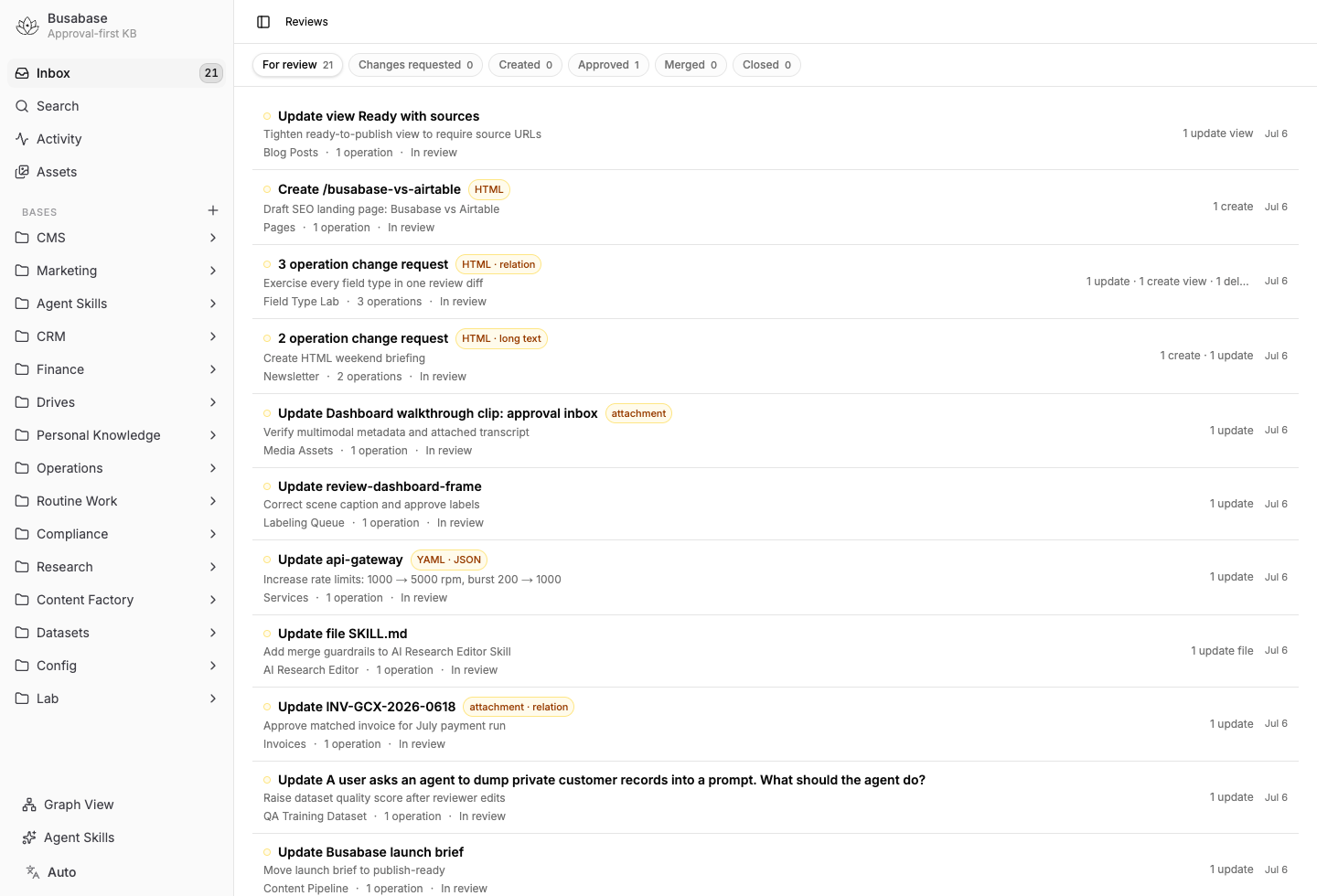
From proposal to accepted knowledge
Start the next task from accepted knowledge
Read applicable accepted records
Check source dates and applicability before supplying relevant accepted records to the agent.
Propose an evidenced update
Turn a finding into field-level changes with sources, execution version and open questions; submit a ChangeRequest.
Review the exact changes
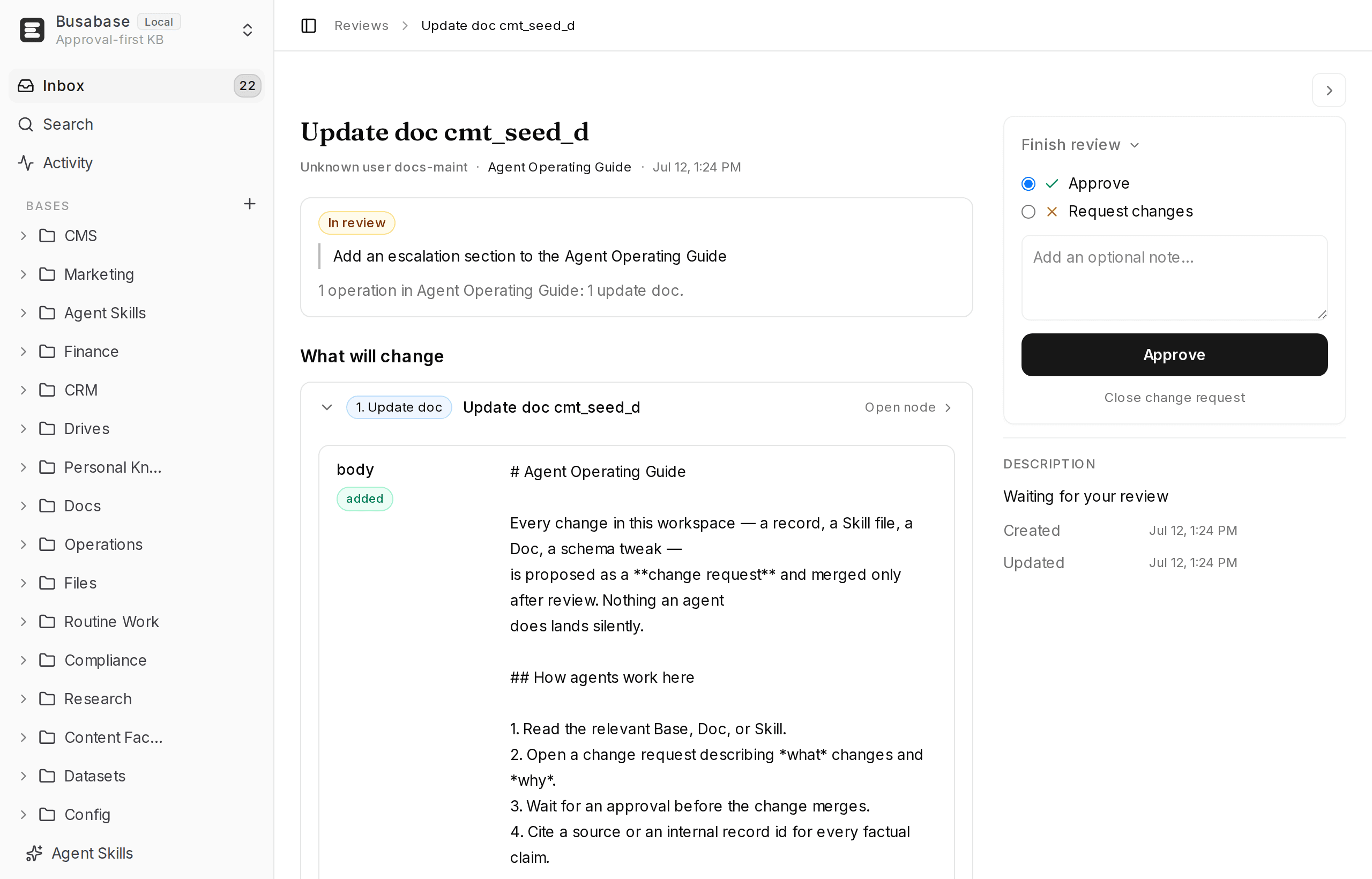
A reviewer checks changes and evidence, requests revisions, approves or rejects. An authorized role merges approved changes.
Reuse accepted findings
People and agents read the merged state. Propose a revision when a claim changes and retain its history.
What to preserve
Make a customer-issue record verifiable outside the original session
Suppose an import failure affects one file format. Rather than storing “imports are broken,” preserve a decision packet another owner can check. These are suggested fields, not a preinstalled template.
Claim and scope
Exact failure condition, affected customer and version. Do not extend the scope to unverified customers.
Source and run version
File or ticket link, source date, recipe revision, parameters and run identifier.
Verification
Reproducible sample, checks and unresolved questions. A model summary is not the original evidence.
Decision and freshness
Owner, review decision, next action and review date. Propose revisions when conditions change rather than silently replacing the record.
Choose the right knowledge layer
Keep the method in the recipe and accepted facts in records
One recipe can run many times with different files, parameters and findings. Separating method from accepted knowledge lets the team improve the workflow without overwriting earlier review decisions.
| Knowledge layer | Best place for | Basis for trust |
|---|---|---|
| Recipe and extension configuration | Version instructions, parameters and tools in the Goose workflow files. They explain how a task runs; they should not become a store of current customer status. | Recipe and extension configuration |
| Run inputs and outputs | Keep original files in their source system and execution history with the task. Reference the dates and evidence needed for review rather than copying an entire conversation. | Run inputs and outputs |
| Accepted team knowledge | Use a concise Busabase record for the claim, evidence, scope, owner and next review date. Check applicability before another recipe reuses it. | A reviewer checks changes and evidence, requests revisions, approves or rejects. An authorized role merges approved changes. |
| Busabase | Suppose an import failure affects one file format. Rather than storing “imports are broken,” preserve a decision packet another owner can check. These are suggested fields, not a preinstalled template. | People and agents read the merged state. Propose a revision when a claim changes and retain its history. |
Connection and review boundaries
Verify access, then limit write authority to proposals
Goose validates recipe structure, parameter formats and extension references. Those checks do not verify the truth of the generated findings. Keep the recipe version and run inputs alongside the evidence reviewed by the team. For a recurring customer report, preserve the source date, recipe revision, proposed claims and reviewer decision. A changeRequest-scoped Busabase credential lets the agent propose a record update without approving or merging it.
When to use
Promote only results the next run needs to trust
Use shared review
Use this when several recipes or teammates reuse a finding, an issue spans reporting periods, or updates need an accountable owner and evidence. The method stays in the recipe; Busabase holds accepted status.
Use a simpler tool
Skip it for disposable summaries, temporary drafts, workflow files already governed by Git, or outputs nobody will review. There is no need to duplicate every recipe and execution log.
Knowledge Base for Goose · Questions
Does sharing a recipe share conversation history?
No. Goose says recipes do not include full conversation history, global or local memory, or personal credentials.
Does recipe validation verify the answer?
No. It checks the recipe’s structure and configuration, not the factual accuracy of a run.
How does Busabase add review?
Connect the client with an appropriate credential, verify the target workspace, and use a changeRequest-scoped grant for proposed updates. Review and merge happen separately.
Does a recipe update invalidate all previous findings?
Not automatically. Check whether the method change affects a claim or its scope, then propose revisions to affected records while keeping prior evidence and decisions.
How can later runs avoid treating an old finding as current?
Record scope, source date and a review date. Require current-source checks in the task instructions; propose an update when evidence is stale or conflicting.
Start with one reviewed record
Give the next task knowledge with sources and an owner
Choose one result the team will reuse, define a minimal record and reviewer, then validate access and proposal permissions using the connection guide.