Memory for Gemini 4 Argon vs Claude Opus 5.5: preserve evidence when reasoning results disagree
When Gemini 4 Argon and Claude Opus 5.5 disagree on the same operational case, separate ephemeral caches from five Busabase record roles so rejected claims stay auditable.
Two agents inspect the same enterprise renewal exception five minutes apart. A fast triage agent running gemini-4-argon flags the account as policy-compliant because a signed addendum is visible in its prompt window; a second-pass reviewer running Claude Opus 5.5 flags the discount cap as unapproved because it also read an updated finance policy row. If the second run silently overwrites the shared table—or a router resolves the conflict by majority vote—the team loses both the evidence trail and the reason the two conclusions diverged.
Running two reasoning models against changing operational records is now routine, especially when teams pair high-throughput screening with deliberate review. The failure mode is rarely raw model capability. It is treating model-side context and caches as shared business memory instead of keeping accepted facts, source versions, and unresolved claims separate in a Busabase Base.
Why model-side state cannot resolve cross-model conflicts
Official documentation for both models shows why execution context cannot act as shared team memory:
- Gemini 4 Argon (
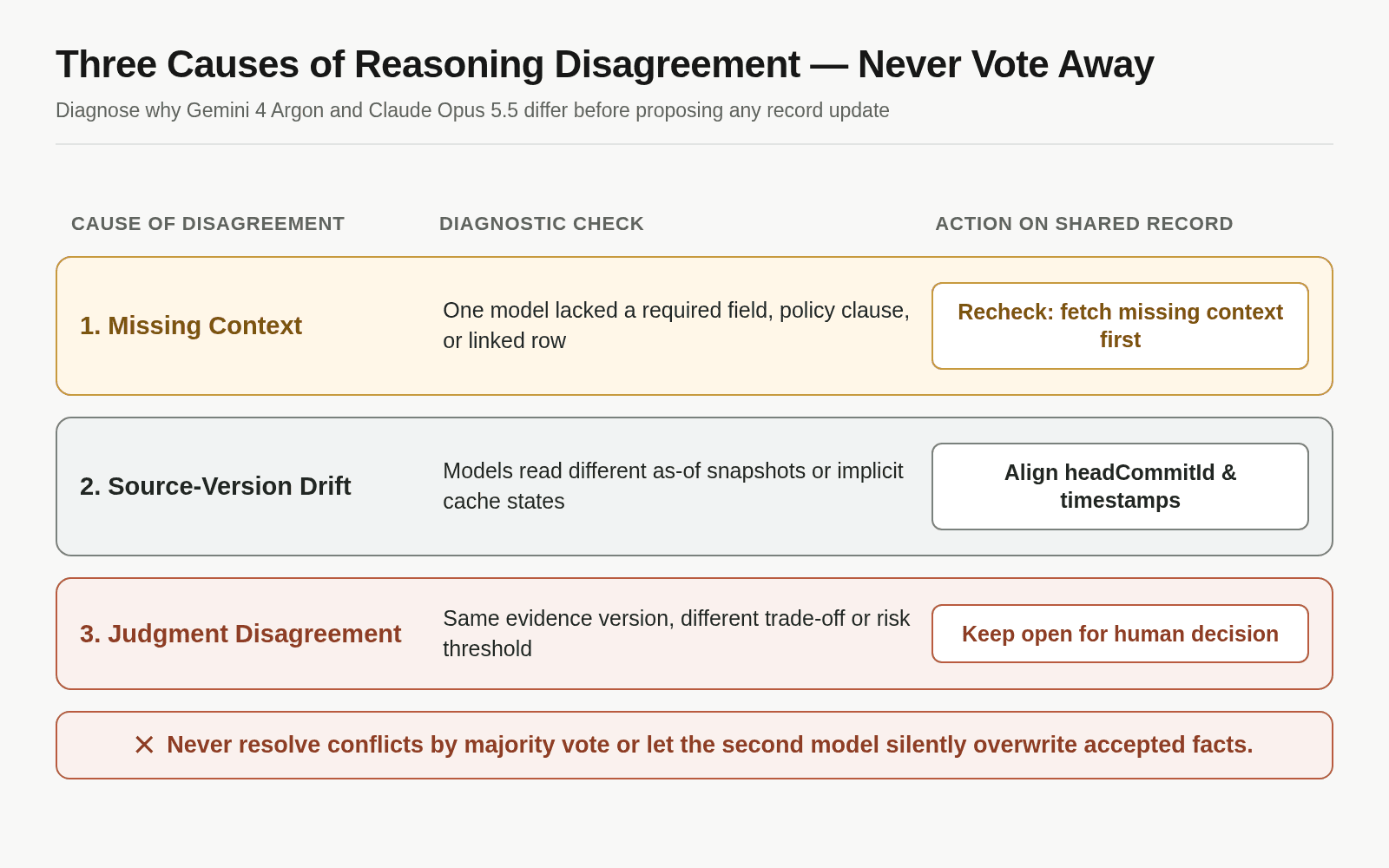
gemini-4-argon) provides a unified 1-million-token context window (1,048,576input tokens;65,536default synchronous output or up to1,048,576long decode viabackground: true) and tunablethinking_level(low,mediumdefault,high). It supports implicit context caching only (automatic discount on repeated prefixes of 4,096+ tokens; explicitcachedContents/caches.createis not supported) and maintains multi-turn state on Google's side throughprevious_interaction_id. Standard Paid Tier pricing is$2.00input /$10.00output (including thinking tokens) /$0.10cached input per million tokens through November 30, 2026, moving to$4.00/$20.00/$0.20from December 1, 2026. - Claude Opus 5.5, announced September 22, 2026, reduces typical run cost by 40% relative to Opus 5 (
$4input /$20output /$0.20cache reads /$5cache writes per million tokens; Fast mode$8/$40), uses adaptive thinking, and emphasizes clearer long-session communication and stronger safeguards against unapproved or hard-to-reverse actions.
Those capabilities optimize how each model reasons inside its own run. Neither provider transfers hidden reasoning across model vendors, and neither turns a prompt cache into an auditable ledger of what changed between runs. If you only need to decide how to split bulk extraction versus review across Gemini 4 Neon and Opus 5.5, see our earlier Gemini 4 Neon vs Claude Opus 5.5 routing guide. Here, the harder problem begins after both models have already run—and returned conflicting answers.
Separate three causes of disagreement before editing any fact
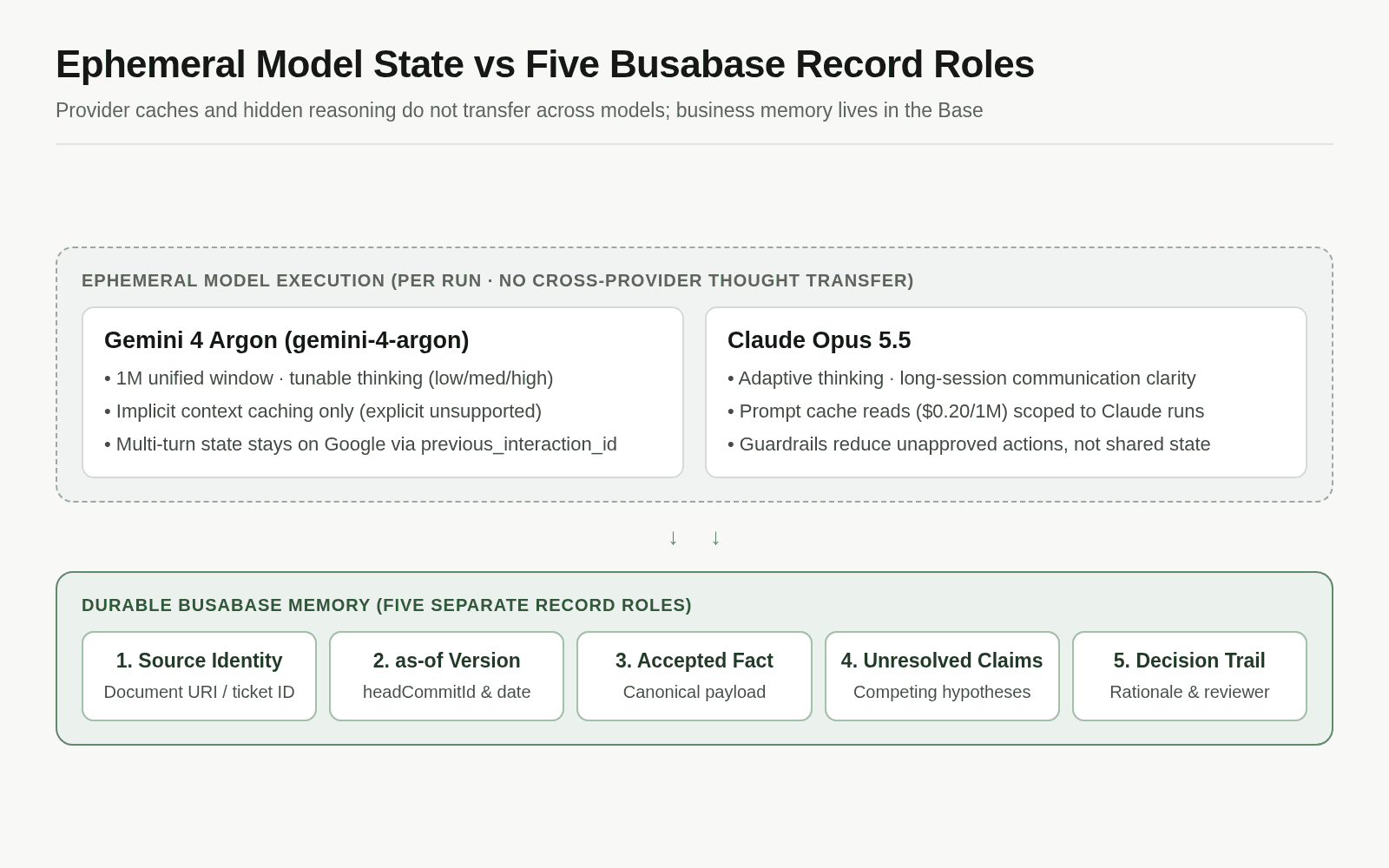
When Gemini 4 Argon and Claude Opus 5.5 reach different conclusions, do not collapse the disagreement with majority voting or let the later timestamp win automatically. First diagnose which of three distinct failures occurred:
| Cause of disagreement | What happened between runs | Required action on shared memory |
|---|---|---|
| Missing context | One model lacked a required field, policy clause, or linked row | Recheck: retrieve the missing source or linked row and re-evaluate |
| Source-version drift | One run read an earlier as-of snapshot or stale prefix while the other read a newer commit | Align version: compare headCommitId and source timestamps before choosing a value |
| Genuine judgment disagreement | Both models saw the exact same evidence version, yet applied different trade-offs or risk thresholds | Keep open: store both claims outside canonical facts and escalate to a human reviewer |
Notice why majority voting fails on all three rows. If two cheap passes missed a policy row that one deeper pass retrieved, 2-to-1 voting codifies incomplete context. If two runs read yesterday's snapshot and one read today's amendment, voting locks in stale data. And if two runs genuinely disagree on an ambiguous clause, hiding the dissent destroys the exact signal a human decision-maker needs.
Five record roles that keep evidence intact
To make disagreements inspectable weeks later, separate every operational workflow into five explicit roles inside your Busabase records:
- Source identity: canonical URI, ticket ID, or document reference proving where an input came from.
as-ofversion: theheadCommitIdand timestamp each model actually inspected.- Accepted canonical fact: the single current value in
headCommit.payloadthat downstream workflows trust. - Unresolved competing claims: hypothesis fields, child claim rows, or review comments holding Argon's and Opus's competing conclusions without mutating accepted facts.
- Decision rationale: who accepted one claim, rejected the other, and why.
Keeping competing claims outside headCommit.payload is what protects downstream dashboards and automations. Downstream reads only see verified canonical state, while reviewers still see both models' reasoning side by side.
Read-first bounded updates and permission-aware ChangeRequests
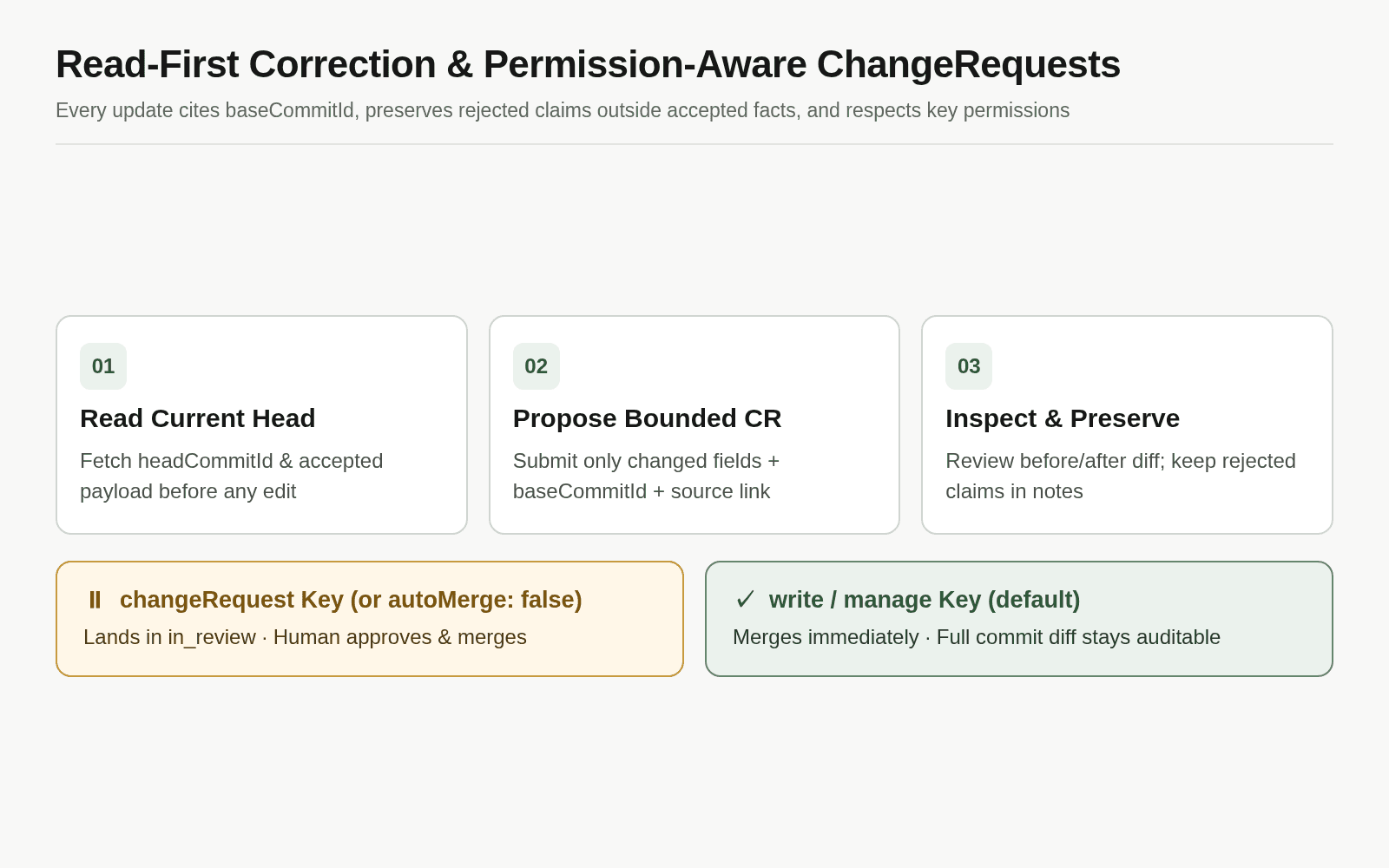
Before either model proposes a fix—or when a reconciliation agent drafts a correction after comparing Argon and Opus—always enforce a read-first workflow via Busabase MCP or CLI:
- Read current canonical state first: fetch the live record's
headCommitIdand currentpayload. Never draft a patch from cached memory. - Submit a bounded ChangeRequest: include only the specific fields under dispute, cite the exact
baseCommitId, and attach source links plus the competing claim summary in the proposal message. - Inspect the before/after diff: verify that non-disputed fields remain untouched and that the unaccepted hypothesis is preserved in review notes or a claim row rather than erased.
How that proposal lands depends explicitly on your API key scopes and ChangeRequests configuration—not a blanket promise that every write pauses:
- A
changeRequest-scoped key can only submit proposals; every write lands inin_reviewand waits for a human reviewer to approve and merge. - A
writeormanagekey merges immediately by default—keeping full commit history and diffs auditable—unless the caller explicitly passesautoMerge: falsewhen human sign-off is required for disputed records.
Frequently Asked Questions
Can Gemini 4 Argon and Claude Opus 5.5 share prompt caches directly?
No. Argon supports implicit context caching inside Google's API and previous_interaction_id for Google-hosted multi-turn state, while Opus 5.5 manages prompt cache reads inside Anthropic runs. Neither shares hidden reasoning tokens or caches across providers. Durable cross-model memory has to live in structured records outside both model providers.
How does Busabase prevent a stale model run from overwriting a newer edit?
By tying updates to baseCommitId inside ChangeRequests. If Argon reasoned over commit A and another agent or person already merged commit B, a read-first check detects the mismatch before commit A's conclusion can overwrite commit B blindly.
Should every multi-model disagreement wait for human approval?
Only when judgment or policy trade-offs genuinely conflict, or when your governance rule requires sign-off. Missing context and version drift can be resolved by re-fetching the missing source or aligning headCommitId; for disputed writes, use a changeRequest key or pass autoMerge: false so the ChangeRequest stays in in_review until a human decides.