Comparison
Busabase vs Cognee for AI Agents
Cognee is an open-source memory engine: it takes documents, code, and conversations, has a model pull out entities and relationships, and builds a knowledge graph your agents query. Busabase is where agents and people keep the team's records, Docs, Skills, and apps — and every change, from an agent or a person, is a Change Request you can read, review, and roll back.
Both talk about a “company brain”, but they mean different things. Cognee's brain is inferred: a graph a model assembles from your sources so agents can recall it. Busabase's is maintained: the records and rules your team writes down, owns, and corrects in one place. Plenty of teams will run both.
Last verified 13 November 2026 against Cognee's homepage, pricing page, documentation and changelog, and GitHub repositories, and Busabase's current product.
The short verdict
Choose Busabase when
Choose Cognee when
Use both when
The core difference: every change is a Change Request
In Busabase, an edit to a record, a Doc, a Skill file, or a Base's schema is never a silent overwrite. It is a Change Request — a branch made of immutable commits, much like a pull request in code. Merging moves the record forward and keeps everything that came before.
Cognee is built for a different loop. Its documentation lists four operations: remember turns text, files, or URLs into a graph; recall queries it; improve “bridges session memory into the graph and applies feedback-based weighting”; forget deletes an item, a dataset, or everything a user owns. Since version 1.6.6, “improve() reviews conflicting facts by default,” and an API “resolves a fact conflict by choosing one of its facts.” That is the engine keeping its own graph tidy. Its delete documentation describes no undo or version history for memory, and the docs describe no step where a person sees a proposed change before it lands.
That suits recall, where the graph should keep reshaping itself as sources change. It does not suit the price you quoted, the term in a contract, or the rule a support agent must follow — there you want to see the change, know who made it, and be able to take it back.
- Every write explains itself. A message plus a field-level before-and-after diff, so a reviewer reads one change instead of re-checking the whole record.
- Every change has an author. The person or agent, and the key or tool it came through, are recorded on the commit.
- Nothing is lost. Records, Docs, and Skills keep their full history, and any change can be rolled back.
- Review is your call. Writes with write access merge immediately. A proposal-only key makes an agent's changes wait in the Inbox for a person to approve or send back.
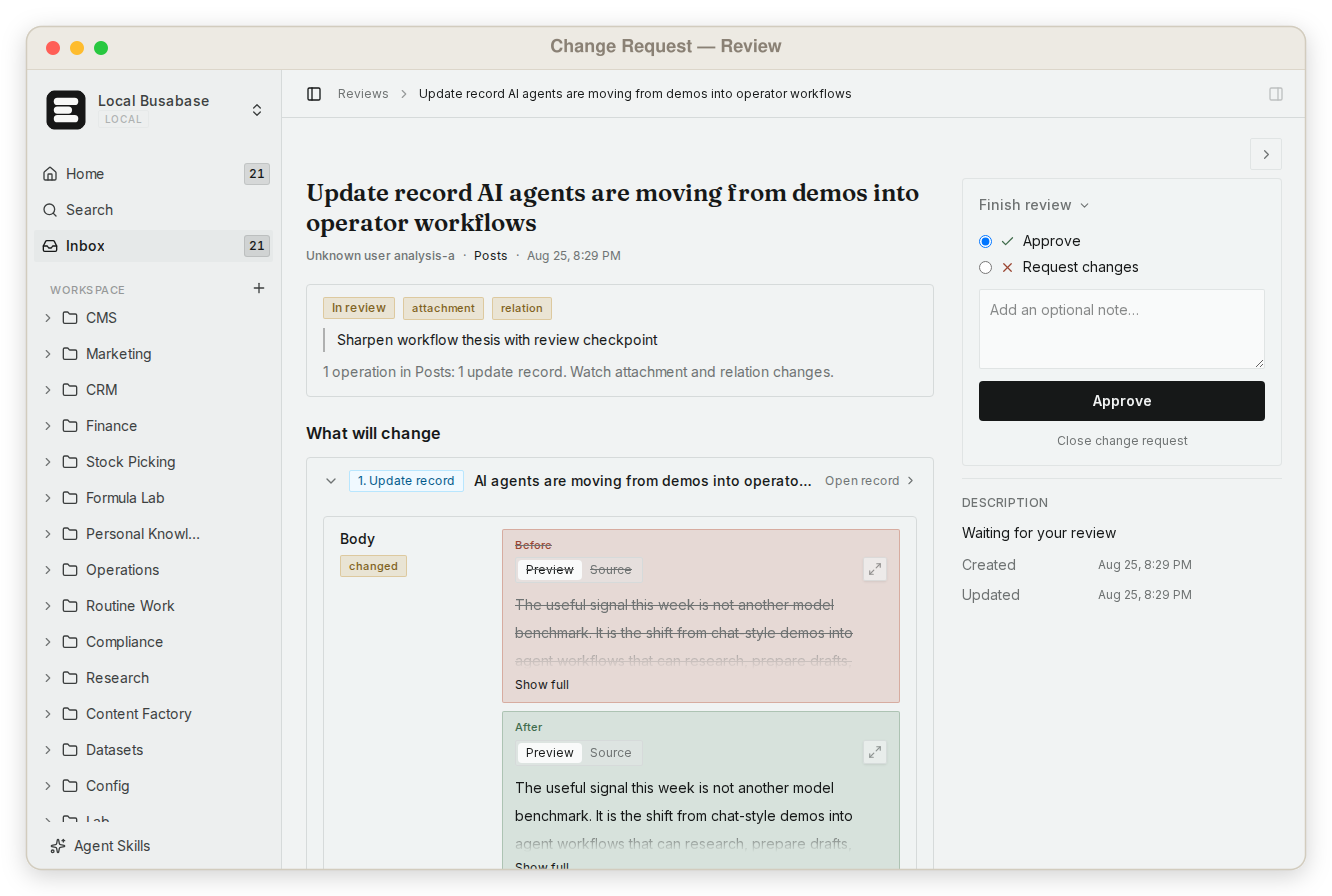
That is how a team lets agents write to the data it actually runs on: not by locking them out, but by making each change readable, attributable, and reversible.
What else Busabase gives your agents and your team
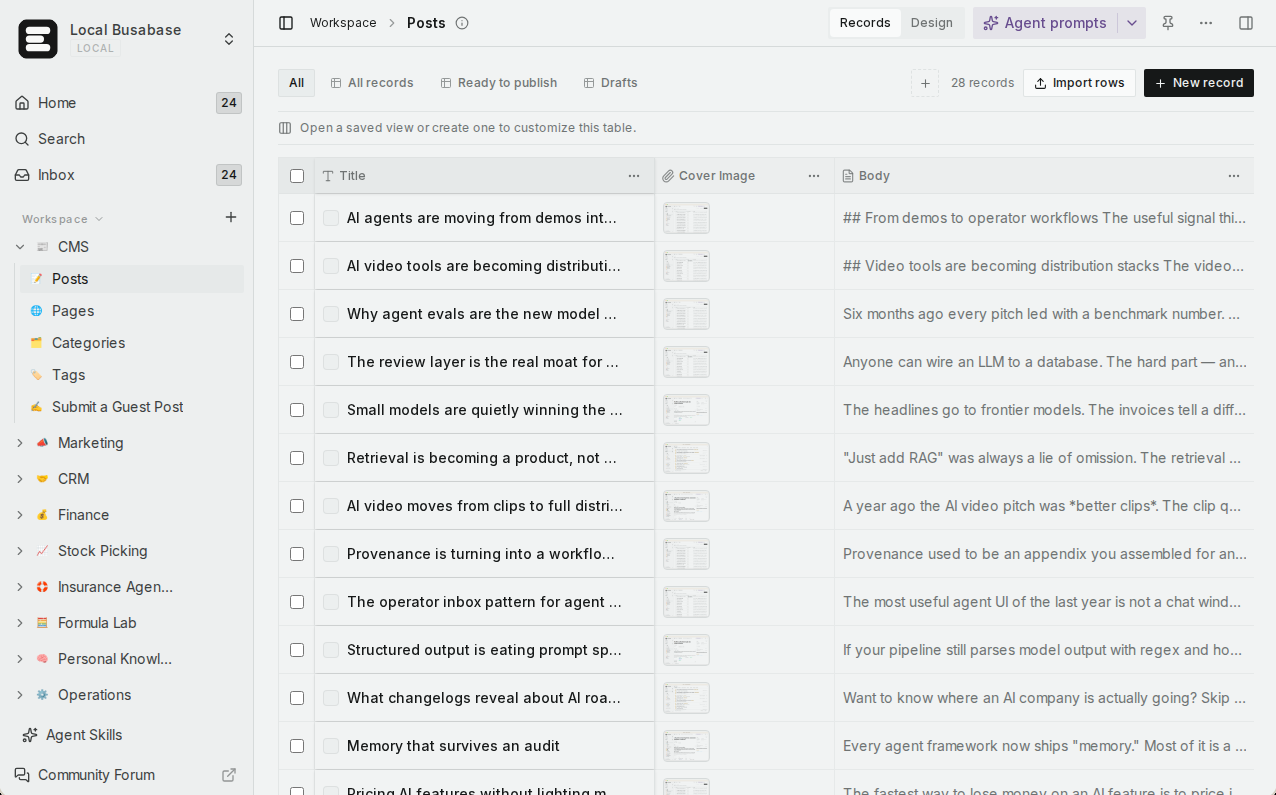
A graph memory makes agents better at recall. A Busabase workspace gives agents and people a shared place to do the work itself.
Visual data tables
A team knowledge base
Grep across everything
Skills you upload
Apps with four engines
Websites on your domain
Built for teams
Agents connect in minutes
Runs where your data has to
Comparison by the job you are trying to do
Each row is a job teams actually bring to these products. Where Cognee is the better tool, the row says so.
| What you are trying to do | Busabase | Cognee |
|---|---|---|
| See every change before and after, who made it, and why | Built in — each Change Request carries a message, a field-level diff, the author, and the key it came through; full history and rollback | Not documented — remember, improve, and forget change the graph directly; the docs describe no change history or undo for memory |
| Let an agent propose a change that waits for a person | Yes — give it a proposal-only key; its changes wait in the Inbox | Not documented — improve() reviews conflicting facts automatically, and an API resolves a conflict by choosing one fact |
| Correct a wrong fact once, for every agent | Yes — edit the record; the fix is a Change Request and the old value stays in history | Resolve the conflict, or forget the item and re-ingest; there is no shared record a teammate edits |
| Keep structured records — customers, deals, decisions | Yes — Bases with typed fields, linked records, and forms | Entities and relationships a model extracts from your sources, shaped by custom data models and ontologies |
| Let teammates read and edit what agents wrote | Yes — table, gallery, kanban, calendar, and Gantt views, no code | A local UI and graph visualisation for developers; memory is built for agents to query |
| Keep the policies and docs agents must follow | Yes — Docs, files, and Bases in one tree with one permission model | Documents are ingested as a source; Cognee is not a place to write and maintain them |
| Find exact text across everything | Yes — one regex grep across files, Doc bodies, records, and agent prompts | Natural-language recall over graph, vector, and code context, with automatic or chosen search strategies |
| Give every agent the same team Skills | Yes — upload your Skills once; every connected agent reads the same version | Its plugins bundle Skills for memory tasks such as forgetting and session recaps; not a home for your own |
| Turn the data into an app or a website | Yes — AirApps in the browser, on your machine, in a cloud sandbox, or as a website on your domain | Not its job — memory is something your agent or app calls |
| Connect Claude Code, Codex, Cursor, and other agents | Yes — MCP, CLI, OpenAPI, webhooks, and agent plugins | Yes — Claude Code and Codex plugins that capture prompts and tool traces, an MCP server for Cursor, Cline, and others, and framework integrations |
| Predictable pricing as the team grows | Flat per seat — no metered overage | Cloud Free includes 1M tokens; Standard is billed per million tokens processed, plus $5 per extra workspace |
| Self-host | Yes — MIT, from a laptop to an air-gapped network | Yes — Apache-2.0; running the graph on Postgres is a demo feature, with the production version sold as a licensed product |
| Build a knowledge graph from documents, code, and conversations for agents to recall | Not its job — use Cognee | Yes — automatic entity and relationship extraction, graph plus vector retrieval, and session distillation. This is Cognee's home ground |
Coming next
Three features are being built now. They are not available yet; we list them so you can plan, and this page will be updated when they ship.
App users In development
Ontology In development
Fine-grained permissions In development
Two kinds of company brain
Cognee’s homepage says “Your company builds a shared company brain for agents.” It is a good phrase, and our essay Agent memory vs knowledge base vs system of record explains why the same words can describe two very different stores. The test is simple: when something in it is wrong, who notices, and who is accountable for fixing it?
An inferred brain is built by a model. Point it at ten thousand research papers, a GitHub organisation, or a year of Slack, and it links people, systems, and concepts that no one would ever map by hand. That is where a knowledge graph earns its keep. The trade-off is that nobody wrote any single edge, so nobody owns it; when a link is wrong, the fix is to resolve a conflict, re-weight, or delete and rebuild.
A maintained brain is written down on purpose. The price list, the customer's contract terms, the escalation policy, the Skill that tells every agent how to draft a quote — each has an owner, a history, and one place to correct it. When an agent proposes a change, a person can see the diff and the reason before it becomes what every other agent reads. That is the job Busabase is built for.
Most companies need both: a graph to search what the sources say, and records for what the team decided.
Using them together
A common split for a team whose agents research and then act:
- Cognee remembers the large, messy sources — papers, tickets, repositories, chat history — and the agent recalls connected context from that graph while it works.
- The agent reads the team's policies and Skills from Busabase, so every agent follows the version the team agreed on.
- When the work produces something the business will act on — a decision, a customer commitment, a price — the agent writes it to a Base in Busabase as a Change Request, with its reason.
- A Busabase space also exports to plain Markdown and JSON, so the records your team maintains can be one of the sources Cognee remembers.
A rule of thumb: if it only helps an agent find context, let the graph hold it. If someone will act on it, make it a record.
Pricing at a glance
Busabase
Plus: from $10 per seat per month (billed yearly). Pro: from $20.
Flat per seat, no metered overage. Self-hosting is free under MIT with no seat limit.
Cognee
Cloud Free: $0 a month — 1 workspace and 1M tokens included, no card required, unlimited users.
Standard: $1.00 per 1M tokens processed, plus $5 per additional workspace a month; adds data source integrations (Slack, Notion, Linear, Google Drive) and code indexing.
Enterprise: contact sales — a BYOC engagement in your own cloud, with dedicated support and SLAs.
Prices as published on 13 November 2026. See Busabase pricing and Cognee pricing for current details.
Where Cognee is the better choice
- You want a knowledge graph built for you. Cognee turns documents, code, and conversations into entities, relationships, and searchable chunks, and retrieves graph, vector, or code context at query time — with ontologies when you need your own domain model.
- You want memory inside your coding agent today. Its Claude Code and Codex plugins capture prompts, tool traces, and responses into session memory and sync them into the graph when the session ends.
- You value a large open-source engine. Apache-2.0, more than 33,000 GitHub stars, pluggable graph and vector stores, and imports from Mem0, Letta, Zep, and Graphiti. Cognee announced a $7.5M seed round in February 2026 and says it is “running live in more than 70 companies” (Cognee blog).
Busabase's limits, plainly: it does not build a knowledge graph from your documents, has no vector index or semantic recall, and no realtime subscriptions. Sign-in for the end users of apps you publish is in development (App users) but not available today. If you need graph recall over a large corpus, run Cognee alongside it.
Frequently asked questions
Is Busabase a knowledge graph like Cognee?
Cognee reviews conflicting facts. Isn't that the same as a Change Request?
Can I use Cognee and Busabase together?
What happens when an agent learns something wrong?
Does every agent write in Busabase need a human review?
Can I self-host both?
Next step
Connect the agent you already use and ask it to move one thing your team relies on into a Base — your price list, open decisions, or the policy it should follow. Change one value, then open the Change Request it leaves behind.
Related reading: Agent memory vs knowledge base vs system of record · Busabase vs Mem0 · Busabase vs Zep · Busabase vs Supabase · All comparisons · How Change Requests work
Sources: Cognee homepage, Cognee pricing, Cognee docs: introduction, Cognee docs: forget, Cognee changelog, topoteretes/cognee on GitHub, Cognee Claude Code plugin, Cognee seed announcement, Busabase pricing